Page 2 of 2
Re: Soy Sauce
Posted: 01 March 2024, 18:01
by bamb1n0
Remkar wrote: ↑01 February 2024, 20:54
From the rules:
"SOY SAUCE
Soy sauce makes every dish taste better. It’s the perfect addition
to a varied meal.
At the end of a round in which soy sauce is played, all players
compare how many different colored backgrounds they have among
the cards they have played. If a player has the most (or tied for the
most) different colors and has also played a soy sauce card, it is
worth 4 points. You may score multiple soy sauce cards in a round.
A soy sauce card itself is considered when determining the most
different colors. Only dessert cards played in the current round are
counted."
Those are from the rules for Sushi Go Party!;
from the rules for the Sushi Go! Soy Sauce Promo:
"A soy sauce card is worth 4 points if you collected the most variety of card colors during a round. (All players count and compare cards.) "Color" refers to the main background color of each card. If multiple players play soy sauce cards and then tie for most variety, they split the 4 points equally, ignoring any remainder. Soy sauce and chopsticks cards count as colors but puddings only count if they were played during the round. Also, if you play multiple soy sauce cards, only 1 scores."
Re: Soy Sauce
Posted: 10 February 2025, 20:32
by ermocito
Can anyone tell me how many background colors we perceive exist in Sushi go?
I have some color blindness, but I perceive differences in background color for sashimi vs nigiris/wasabi, as well as differences between tempura & dumplings, and differences between chopsticks & pudding.
I could guess 5 (ignoring all differences listed above), but I am really asking how they are programmed for the purposes of BGA games.
Re: Soy Sauce
Posted: 10 February 2025, 21:43
by Jellby
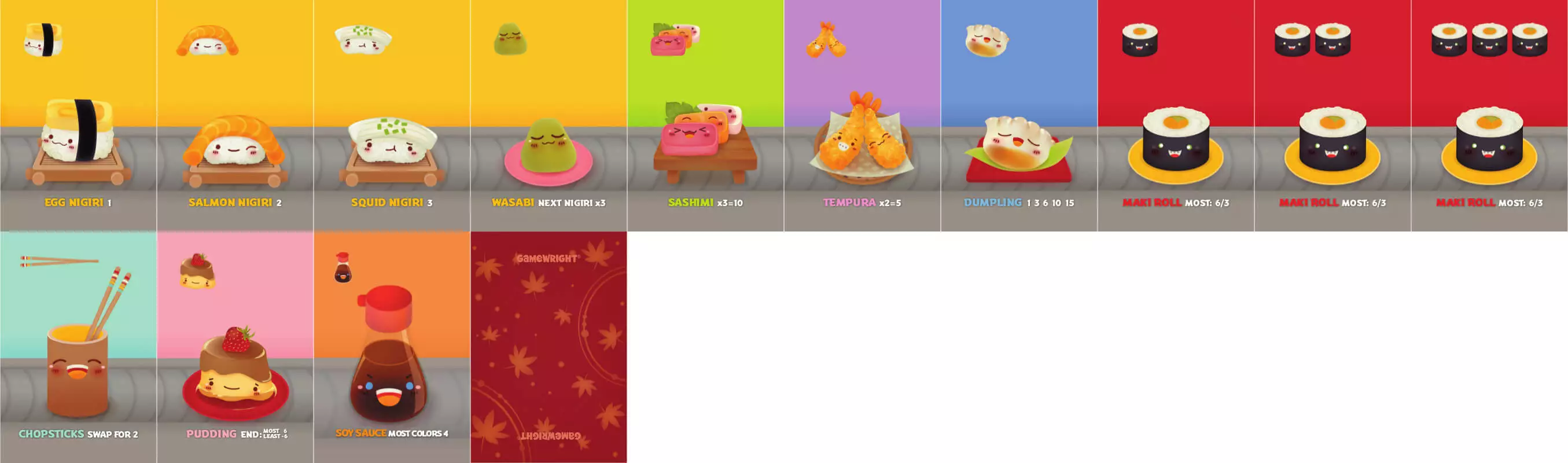
Nigiri & Wasabi = Yellow
Sashimi = Green
Tempura = Mauve
Dumping = Blue
Maki roll = Red
Chopsticks = Light blue
Pudding = Pink
Soy sauce = Orange
(That's what I see, I don't know how it's programmed.)
Re: Soy Sauce
Posted: 16 March 2025, 21:06
by ermocito
Here is a game whose outcome hinges on the color count for soy. Opponent wins because they have 4 colors and a soy card. I also had a soy card and 4-5 colors (Nigiri/Wasabi, Tempura, Maki & Soy - possibly 5 if above commenter is correct that sashimi is different).
I can see why opponent's dumpling offsets my maki, but if it is counting chopsticks and pudding separately, their count would seem to be FIVE, not FOUR. If those are grouped, then we are tied at 4 and I don't understand the tiebreaker.
How do we think the programming is counting colors? If this is a bug, I am unsure how to describe the error because I don't understand what the game is counting.
https://boardgamearena.com/14/sushigo?table=643889963
Re: Soy Sauce
Posted: 18 March 2025, 13:38
by bamb1n0
ermocito wrote: ↑16 March 2025, 21:06Here is a game whose outcome hinges on the color count for soy. Opponent wins because they have 4 colors and a soy card. I also had a soy card and 4-5 colors (Nigiri/Wasabi, Tempura, Maki & Soy - possibly 5 if above commenter is correct that sashimi is different).
I can see why opponent's dumpling offsets my maki, but if it is counting chopsticks and pudding separately, their count would seem to be FIVE, not FOUR. If those are grouped, then we are tied at 4 and I don't understand the tiebreaker.
How do we think the programming is counting colors? If this is a bug, I am unsure how to describe the error because I don't understand what the game is counting.
https://boardgamearena.com/14/sushigo?table=643889963
Like Jellby the above commenter said, it is counting chopsticks and puddings as two separate colours. Their count is six - wasabi/nigiri, tempura, dumpling, chopsticks, pudding, soy; your count is five - wasabi/nigiri, sashimi, tempura, maki, soy.
Re: Soy Sauce
Posted: 24 November 2025, 22:34
by galpalnykki
https://boardgamearena.com/17/sushigo?table=765517682
Here is another example of the soy sauce calculation being wonky, or at least the wording of the rule is unclear. End of round 1 I havev nigiri, sashimi, tempura, dumpling, maki, dessert = 6 colors
Opponent has nigiri, sashimi, dumpling, maki, dessert and soy sauce = 6. He gets 4 points even though we have the same amount of colors.
It's happened quite a few times today as I've been playing quite a bit, home sick from work lol. I've based some strategy off blocking those points but it seems like it never gets counted the way I'm expecting it to. Maybe I'm misunderstanding the rule?
Re: Soy Sauce
Posted: 25 November 2025, 11:09
by emfaa
The rules are very simple. You score points with soy sauce card if you have equal or higher amount of different colors than your opponents that round.
Re: Soy Sauce
Posted: 03 December 2025, 18:13
by galpalnykki
emfaa wrote: ↑25 November 2025, 11:09
The rules are very simple. You score points with soy sauce card if you have equal or higher amount of different colors than your opponents that round.
Like another comment says further up thread, the rule written for Sushi Go is “A soy sauce card is worth 4 points if you collected the most variety of card colors during a round. (All players count and compare cards.) "Color" refers to the main background color of each card. If multiple players play soy sauce cards and then tie for most variety, they split the 4 points equally, ignoring any remainder. Soy sauce and chopsticks cards count as colors but puddings only count if they were played during the round. Also, if you play multiple soy sauce cards, only 1 scores."
It says nothing about “equal” unless multiple players have played a soy sauce card. If one player plays a soy sauce, they need to have the “most variety of card colors”
Re: Soy Sauce
Posted: 03 December 2025, 21:12
by Jellby
If two players have 6 colors, and all others have fewer, "the most" is 6 colors. If only one of those players played soy sauce, they get the 4 points. If both players played it, they split it 2 and 2. If soy sauce was only played by players with less than 6 colors, they don't get anything.
There's some ambiguity whether "the most" means "more than everyone else" or "no one has more", it seems the implementation uses the latter, while
this BGG post suggests the former. Apparently Sushi Go Party! uses the latter too: "If a player has the most (or tied for the most) different colors and has also played a soy sauce card, it is worth 4 points", but it also scores multiple copies and does not split the points.