Page 3 of 4

Re: Information for Decision Making

Posted: 06 October 2022, 19:15
by DaffyVina
Ukraine regains Kherson villages from Russians
Published 1 day ago
By Paul Kirby
BBC News

Media caption,
Watch: Flags being raised in retaken areas of Ukraine


Ukrainian forces have liberated a key village in the southern region of Kherson, hastening another Russian military retreat.

The defence ministry in Kyiv posted a video showing the 35th marine brigade hoisting a Ukrainian flag above Davydiv Brid, amid reports of several other nearby villages being recaptured.

Russian forces have already been forced to retreat in Ukraine's north-east.

They are now being pushed back in the south as well.

Their latest setbacks came as President Vladimir Putin was due to sign into force decrees annexing four Ukrainian regions, while war was raging in all four.

The annexation has no legitimacy under international law and Ukraine's President Volodymyr Zelensky has declared them null and void.

President Joe Biden spoke with Mr Zelensky on Tuesday and assured him the US would never recognise Russian annexation. They also discussed $625m (£550m) of US aid, including Himars rocket launchers.

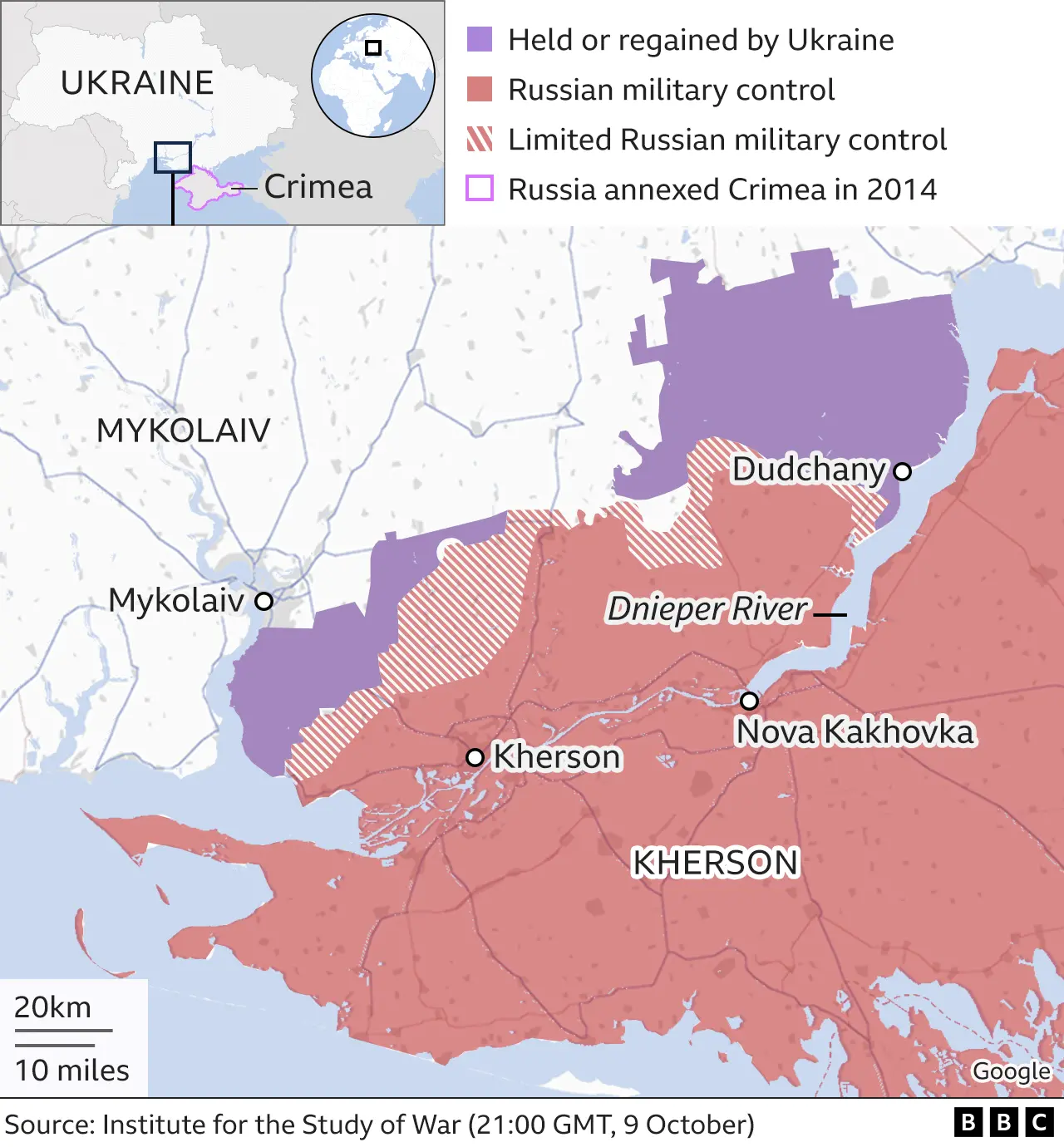
Russia still controls Kherson city, the regional capital, in the south. But its grip is looking increasingly shaky on the entire area north of the River Dnieper, known as Dnipro in Ukrainian.

In the past 48 hours, Ukrainian forces have pushed south along the west bank of the river, and Russian units have now been forced to pull back from several settlements in the north of Kherson region too.

Mr Zelensky said Ukrainian forces had made "fast, powerful movements" in southern Ukraine and liberated "dozens of settlements" this week alone.

"The Ukrainian flag flies again over the village of Davydiv Brid," Ukraine's defence ministry proclaimed on social media. Residents filmed Ukrainian soldiers walking through the village.

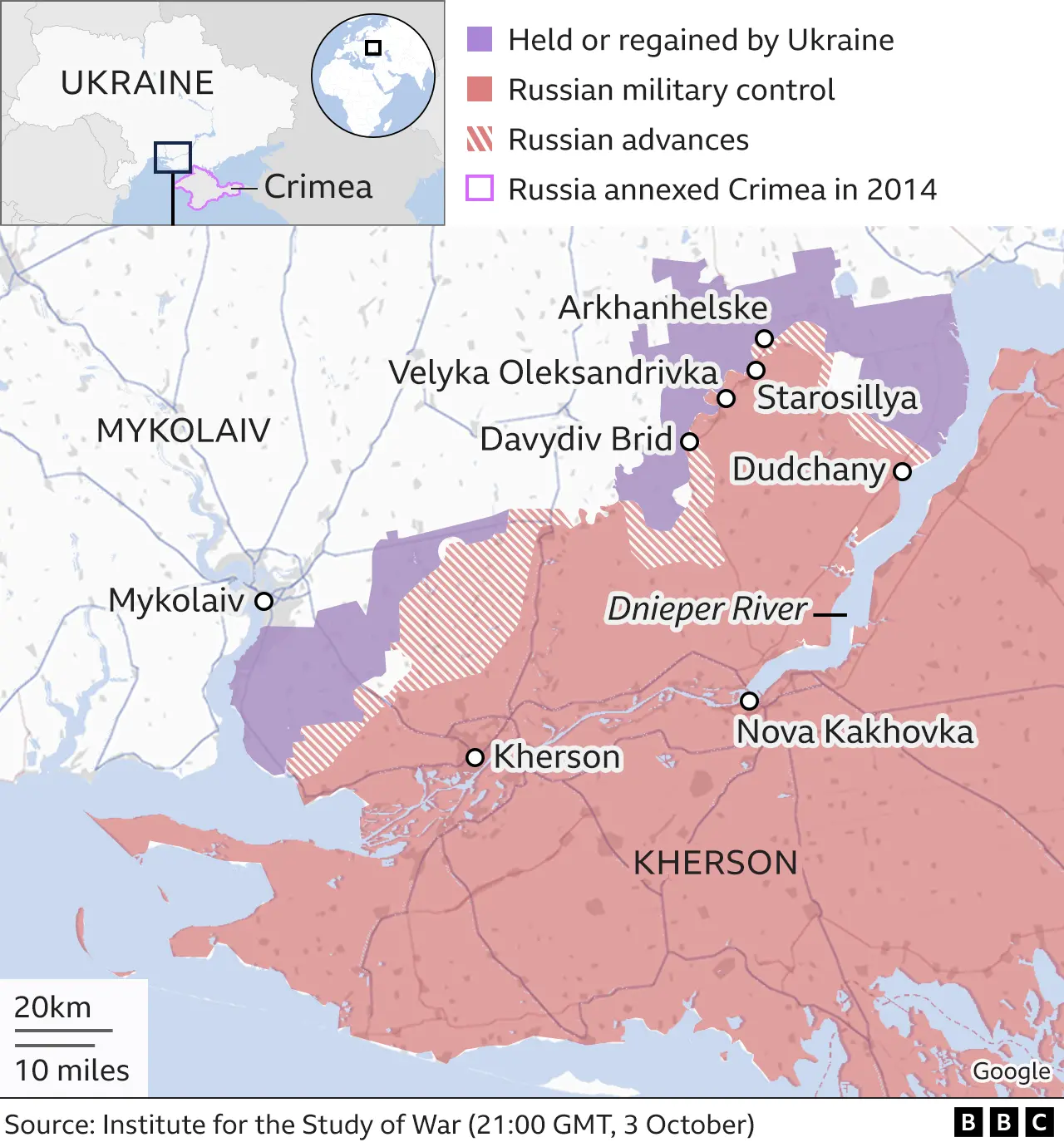
Map of Kherson
Image

In his Tuesday evening address, Mr Zelensky said the villages of Lyubymivka, Khreshchenivka, Zolota Balka, Bilyaivka, Ukrainka, Velyka Oleksandrivka and Mala Oleksandrivka had also been liberated, and that that was "far from being the whole list".

Ukraine's deputy interior minister Yevhen Enin said 50 towns and villages had been recaptured and some 3,500 citizens freed in Kherson, but did not say over what period.

The defence ministry said later that Russian forces were demoralised and trying to destroy bridges in an attempt to slow down the Ukrainian advance.

A Kremlin-installed official in Kherson, Kirill Stremousov, told residents: "There is no reason to panic."

There was no immediate confirmation that villages to the north-east of Davydiv Brid had also fallen and Russia's military spokesman made no mention of losses there.

But on maps used to illustrate Russian control, it was clear that it no longer included the villages of Arkhanhelske and Velyka Oleksandrivka in the north-east of the region, and of Dudchany on the bank of the Dnieper.

Russian military blogger Rybar said the army decided to pull back because it was at risk of being encircled. "It's not entirely clear where the new line of contact will be," he said.

Kherson exiled deputy Mayor Roman Holovnia said: "Many settlements were flattened - some settlements have almost no undestroyed buildings left."

He added that residents of the city were waiting for Ukrainian forces, in the knowledge they were advancing.

Of the 320,000 people living there before the war, only 100,000 were left, Mr Holovnia said.

Ukrainian forces have targeted Russian supply lines in the Kherson area for weeks, destroying the few bridges across the river. But their advance southwards until now has been slow. Kherson was swiftly captured by Russian forces at the start of the war, as they poured into the region from the Crimean peninsula, annexed in 2014.

Ukraine had more dramatic success in Kharkiv in the north-east and in Donetsk, seizing on Saturday the strategically important Lyman. The town is part of Donetsk but is seen as the gateway to Luhansk, a region under almost complete Russian occupation.

The BBC's Orla Guerin, reporting from Lyman, said few civilians remained there now, while the bodies of several Russian soldiers lay in their uniforms outside the town.

Kherson, Luhansk and Donetsk are among the Ukrainian regions being illegally annexed by Russia, but the triumphalism of Vladimir Putin's proclamation last Friday is looking increasingly premature.

Mother and son
Image caption,
There were few signs of normal life in Lyman when the BBC visited


A Russian blogger published accounts by two men he described as fighters from Luhansk's Russian proxy force who narrowly escaped being surrounded near Lyman last week.

"We left Lyman, but it was just us - no munitions, nothing. Everything was burned up. All our friends and comrades stayed there [dead]," said one of the men, named Mikhei.

Russia has so far mobilised more than 200,000 troops since President Putin gave the order last month, according to Defence Minister Sergei Shoigu. The initial target of the "partial mobilisation" is 300,000, but the recruitment drive has been overshadowed by stories of Russians trying to escape the draft or being given shoddy equipment when they join up.

Kazakhstan alone has reported that more than 200,000 Russians have crossed its borders in the past two weeks.

Media caption,
The BBC’s Abdujalil Abdurasulov reports from Ukrainian front line positions in the Kherson region
Re: Information for Decision Making

Posted: 06 October 2022, 19:20
by DaffyVina
Ukraine war: Putin signs Ukraine annexation laws amid military setbacks
Published 13 hours ago
By Elsa Maishman and Nathan Williams
BBC News

Ukraine says multiple explosions were heard in the southern city of Zaporizhzhia before dawn on Thursday
Image caption, Ukraine says seven Russian missiles hit residential buildings in Zaporizhzhia before dawn on Thursday


Russia's President Vladimir Putin has signed the final papers to annex four regions of Ukraine - even as his military suffered further setbacks.

The Luhansk, Donetsk, Zaporizhzhia and Kherson regions are "accepted into the Russian Federation" the documents say.

But in two of those areas - Luhansk and Kherson - Ukraine said it has been retaking more villages.

Mr Putin also signed a decree to formalise Russia's seizure of the nuclear power plant in Zaporizhzhia.

Last Friday, the Russian leader held a grand ceremony in the Kremlin, where he signed agreements with the Moscow-installed leaders of the four regions.

The move followed self-proclaimed referendums in the areas, denounced as a "sham" by the West.

But on the ground there appears to be a different reality, with Ukrainian forces making gains in both the south and the east.

Serhiy Haidai, Ukrainian governor of Luhansk, told the BBC on Wednesday that six villages in the region had been recaptured.

And President Zelensky later said Ukraine had liberated three more villages in the southern region of Kherson.

That followed a series of gains in Kherson the previous day, including the strategically key village of Davydiv Brid.

Meanwhile, the southern city of Zaporizhzhia was rocked by a series of huge explosions an hour or so before dawn.

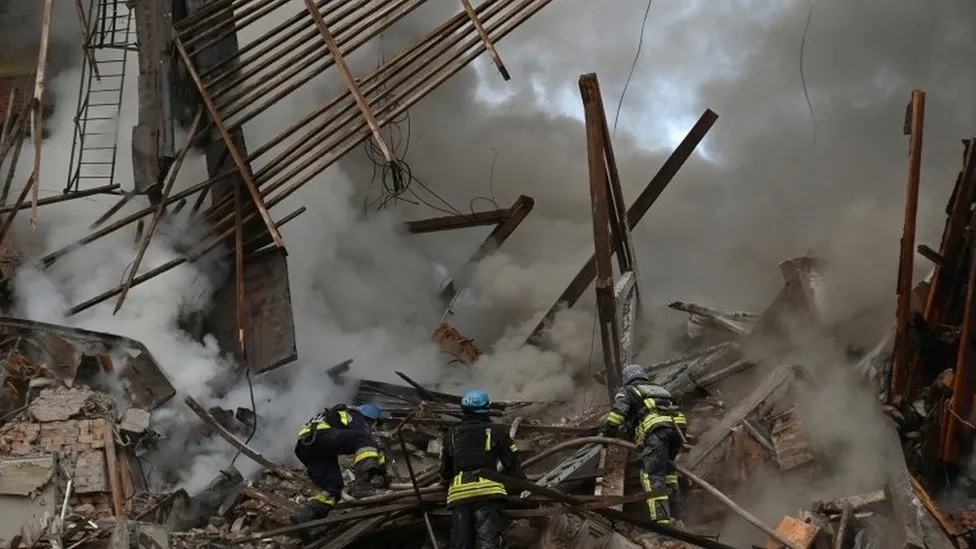
Local authorities say seven Russian missiles hit residential buildings and that people are under the rubble. There has been no information on casualties so far.

The BBC's Paul Adams, who is in the city, says rescue workers are combing through the shattered remains of an elegant five storey apartment building in the middle of the city.

Ukraine says multiple explosions were heard in the southern city of Zaporizhzhia before dawn on Thursday
Image caption, Zaporizhzhia was rocked by a series of huge explosions an hour or so before dawn on Thursday

Kremlin spokesman Dmitry Peskov said Russia would retake any territory that had been lost to Ukrainian forces.

Facing questions over the recent losses, he told reporters: "There is no contradiction here. They will be with Russia forever, they will be returned."

In a speech to teachers on Russian teachers' day, Mr Putin said he would "calmly develop" the annexed territories.

But Andrey Kartopolov, the chairman of the State Duma defence committee, told state media that Russia needed to stop lying about what was happening on the battlefield, saying that Russians were not stupid.

Russia is still working to mobilise reservists, after Mr Putin announced a call-up last month of 300,000 people who had completed compulsory military service.

But Mr Putin has rowed back on which groups will be affected, after strong opposition and protests in Russia against the move.

He has signed a decree exempting several categories of students, including first-time students at accredited institutions, and certain types of postgraduate students - such as those in the field of science.

In another move, President Putin has signed a decree to formalise Russia's seizure of the nuclear power plant in one of the annexed regions - Zaporizhzhia - which has been occupied by Russian troops since the early days of the war.

Russia says the plant - Europe's largest nuclear facility - will be operated by a new company, but Ukraine's nuclear operator has dismissed the move as "worthless".

Rafael Grossi, the head of the UN's nuclear watchdog, the IAEA, has said he will hold consultations with the two sides following the development.

He is heading to Kyiv and then Moscow, seeking to establish a protection zone around the plant, which is situated near the front line of fighting.

Reports of battles around the nuclear site have sparked international concern, and the last of its reactors was shut down last month.

Re: Information for Decision Making

Posted: 06 October 2022, 19:24
by DaffyVina
Ukraine war: 'Mother, I'm scared' - Zaporizhzhia city devastated by rocket attacks
Published 40 minutes ago
By Paul Adams in Zaporizhzhia and Yaroslav Lukov in London
BBC News

Media caption,
WATCH: Rescuers search rubble at missile-hit Ukraine building


At least five people have been killed in a series of Russian rocket attacks on Ukraine's southern city of Zaporizhzhia, local officials say.

They say the rockets hit residential buildings before dawn and then again several hours later. People are reported to be under the rubble.

Rescue workers are now combing through the shattered remains of one elegant five-storey apartment building.

Glass and rubble is strewn across, and nearby shops are wrecked.

Olha Chobotariova, who lives nearby, told the BBC: "My children were frightened. The windows blew out. My daughter got so frightened she hid in a corner and I couldn't drag her out.

"I told her, please come to me and she said: 'No mother, I'm scared.'

Zaporizhzhia resident Olha Chobotariova. Photo: 6 October 2022
Image caption,
Olha Chobotariova: "I will never forgive Russia for this"


"I don't understand how they could do it. There were all just people, children. We haven't done anything. Why are they torturing us like this?

"My soul aches for our Ukraine. I have no words. It really hurts me. I will never forgive Russia for this. I won't. We should take revenge and take it to the end. Because we're Ukrainians. We're a strong nation. I can't accept this."

Alla Yermachenko, another local resident, told the BBC her elderly relatives were in one of the destroyed buildings.

"There's very little hope that they're alive. Why are they doing this to us? What are they trying to prove? Killing old people. Why? For what?" Ms Yermachenko said.

"May our tears drop not on the ground but on the chests of those who launched that missile."

Rescuers search through the debris in Zaporizhzhia, southern Ukraine. Photo: 6 October 2022
IMAGE SOURCE,REUTERS
Image caption,
There are fears that the death toll will rise further

Image

Andriy Yermak, the head of Ukrainian President Volodymyr Zelensky's office reacted to the attack by saying that "Russian terrorists know how to fight only with peaceful people".
"Crazy cowards," he added.

Zaporizhzhia regional head Oleksandr Starukh said one woman was killed. Another seven people, including a three-year-old child, were injured.

Map showing the four regions Russia is annexing. Updated 3 October

Russia has so far made no comments on the issue.

The Ukrainian-held city is the capital of the eponymous Zaporizhzhia region, which Russian President Vladimir Putin earlier this week declared annexed, along with three other Ukrainian regions - Donetsk and Luhansk in the east, and Kherson in the south. Ukraine and its Western allies condemned the move.

Moscow does not fully control any of the four regions, and in recent weeks Ukrainian troops have made significant advances in the the country's north-east and south.

On Wednesday, Russia said it was now taking over the operation of the Zaporizhzhia nuclear plant, Europe's largest, located in the Moscow-occupied part of the Zaporizhzhia region.

Ukraine said it was still in charge, condemning the Russian move. It was unclear how Kyiv could still control the station seized by Moscow during the first days of its invasion launched on 24 February.

The head of the UN nuclear watchdog is currently visiting Ukraine and later Russia to try to defuse the crisis.

The station has been repeatedly shelled in recent weeks, with both Kyiv and Moscow accusing each other for such attacks. There are fears that a major incident at the plant could lead to radioactive contamination of much of Europe.

Re: Information for Decision Making

Posted: 22 October 2022, 19:34
by DaffyVina
Doctor's funeral in Kyiv brings home pain of Russian missile attacks
3 days ago - BBC News

https://www.bbc.co.uk/news/av/world-europe-63288127

The family of Oksana Leontieva gathered at her graveside to remember the doctor who died in a cruise missile strike on Kyiv.

The 36-year-old was killed on the way to work after dropping off her son at nursery.

The recent wave of attacks across Ukraine has once again brought home the harsh realities of war to many cities.


Ukraine war: Russians start leaving Ukraine's Kherson city
Published 3 days ago
By Paul Kirby & Paul Adams
BBC News

Russian TV channels showed footage of people gathering to cross the Dnieper river
IMAGE SOURCE,ROSSIYA 24
Image caption, Russian TV channels showed footage of people gathering to cross the Dnieper river


Tens of thousands of civilians and Russian-appointed officials are being moved out of Ukraine's southern Kherson region ahead of a Ukrainian offensive, says the Russia-installed local leader.

Vladimir Saldo said all Russian-appointed departments and ministries would cross the Dnieper river.

Some 50-60,000 civilians would also leave in an "organised, gradual displacement", he said earlier.

Ukraine has called on residents to ignore the Russian move.

The head of Kherson's regional administration said Russia wanted to take civilians hostage and use them as human shields. The transfer or deportation of civilians by an occupying power from occupied territory is considered a war crime.

In a separate development, Russia's Vladimir Putin said he had signed a decree imposing martial law on four Ukrainian regions, including Kherson, which Moscow annexed last month in a move rejected as illegal by the international community.

He told Russia's Security Council that it would give regional leaders additional powers to maintain social order and safeguard important facilities.

On Tuesday night, residents in Kherson started receiving text messages, urging them to evacuate immediately to avoid shelling of residential areas by Ukrainian forces.

The messages said transport across the Dnipro River would be available from 07:00 on Wednesday.

"They are told to evacuate because the evil Ukrainians are going to shell the city," one resident told the BBC, asking to remain anonymous.

"People are panicking because of propaganda."

Russian TV footage on Wednesday showed a number of people gathering near the west bank of the Dnieper. As they queued for boats, it was not clear how many were leaving.

But Ukrainian officials have questioned whether large numbers of people are actually being evacuated, suggesting that images of a crowd assembled by the river are largely for show.

Serhiy Khlan, an aide to the ousted head of the Kherson region, suggested the "deportations theatre" could be acting as cover for a much bigger Russian move: a complete military evacuation from the west bank of the river.

"I foresee the withdrawal of troops," he said, adding that he expected Russian forces to attempt to destroy the city after leaving.

Russia, he said, was planning to establish a new capital for the Kherson region at Henichesk, close to the Crimean Peninsula, adding that banks and offices related to the occupation of Kherson had already been evacuated.

One Kherson resident told the BBC's World Service that she was not going anywhere until Kherson was liberated by Ukrainian troops: "People are not panicking, nobody wants to be evacuated."

She said that Russian soldiers were now worried how they could survive in the city. "There are plenty of them here; they are dressed as civilians. We can see them - they are different to Kherson people. They walk in groups, their hair is cut short, they are dressed mainly in black."

Ukrainian officials have warned that this might represent the start of a forcible deportation to Russia.

In early September, the UN said there were already credible accusations of forced deportation of Ukrainian children from other Russian-occupied areas. Russia's ambassador to the UN, Vasily Nebenzia, called the allegations "unfounded".

Russian President Putin chairs a Security Council meeting outside Moscow
IMAGE SOURCE,REUTERS
Image caption, President Putin has also announced heightened security levels inside Russia


As part of the decree, President Putin announced three additional levels of heightened security inside Russia.

The highest level applies to Russia-annexed Crimea and other areas near the border with Ukraine, such as the regions of Belgorod, Kursk and Krasnodar.

In these areas, there will be more security, possible evacuation orders and some restrictions placed on travel. Regional authorities will be given more powers to ensure measures are implemented, establish territorial defence and "mobilise" the economy for the war effort.

In Moscow and surrounding central and southern regions, regional authorities have the power to introduce similar, but less severe, restrictions.

Ukrainian soldiers patrol around the site amid Ukraine's counterattack against Russian forces in the southern Kherson region
IMAGE SOURCE,GETTY IMAGES
Image caption, Ukraine said recently it had recaptured more than 400 sq km of territory in less than a week


Ukrainian presidential adviser Mykhailo Podolyak pointed out it was less than a month since Russia had held a ceremony to annex Kherson: "Reality can hurt if you live in a fictional fantasy world."

Late on Monday, Russia's new military commander in Ukraine, Gen Sergei Surovikin, had described the situation in Kherson city, the regional capital, as difficult.

A Russian-installed official, Kirill Stremousov, warned Kherson residents that Ukrainian forces would launch an assault on the city "in the very near future". "No-one is going to retreat, but we also want to save your life. Please move as quickly as possible to the left bank," he added.

Mr Saldo, who was appointed governor of the region by Moscow, told Russian TV that no-one was about to surrender, but it was "undesirable" for residents to remain in a city facing military action. "In the past two days, more than 5,000 people have left Kherson," he was quoted as saying.

The head of Ukraine's presidential office said Moscow was trying to intimidate residents with fake news that Ukraine's military was shelling their city. "It is a fairly primitive tactic, taking into account that the AFU [Armed Forces of Ukraine] do not shell cities," Andriy Yermak wrote on Telegram.

Earlier this month, Kherson's exiled deputy mayor said only 100,000 residents remained in Kherson city of the pre-war population of 320,000, with many fleeing Russia's occupation.

The mayor of Russian-occupied Melitopol, Ivan Fedorov, warned that Kherson's civilians were facing enforced deportation and being deprived of their homes so that Russia could populate the city with "soldiers and traitors". Last month, Ukraine said 2.5 million people had been forcibly deported from Ukraine to Russia.

The Russian-appointed governor accused Ukraine of building up for a large-scale offensive and planning to destroy the Kakhovka dam on the River Dnieper, flooding the area.

Media caption,
Watch: Gen Sergei Surovikin describes the situation in Ukraine as "tense"


Kherson was the first major city to fall to Russian forces when they invaded Ukraine in February. However, in just a few weeks, the Ukrainian military has recaptured territory in the north of the region and pushed as far as 30km (19 miles) south along the Dnieper, threatening to trap Russian troops.

Ukrainian officials said last week that 400 sq km (155 sq miles) of territory had been regained in less than a week. Russian forces have also been hit by damage to the bridge linking annexed Crimea to Russia. An explosion earlier this month has severely affected Russia's ability to resupply its troops.

Map showing a close-up of the Kherson region in Ukraine
Image

Re: Information for Decision Making

Posted: 22 October 2022, 19:46
by DaffyVina
Ukraine war: Zelensky accuses Russia of plot to blow up dam
Published 1 day ago
By Paul Kirby
BBC News

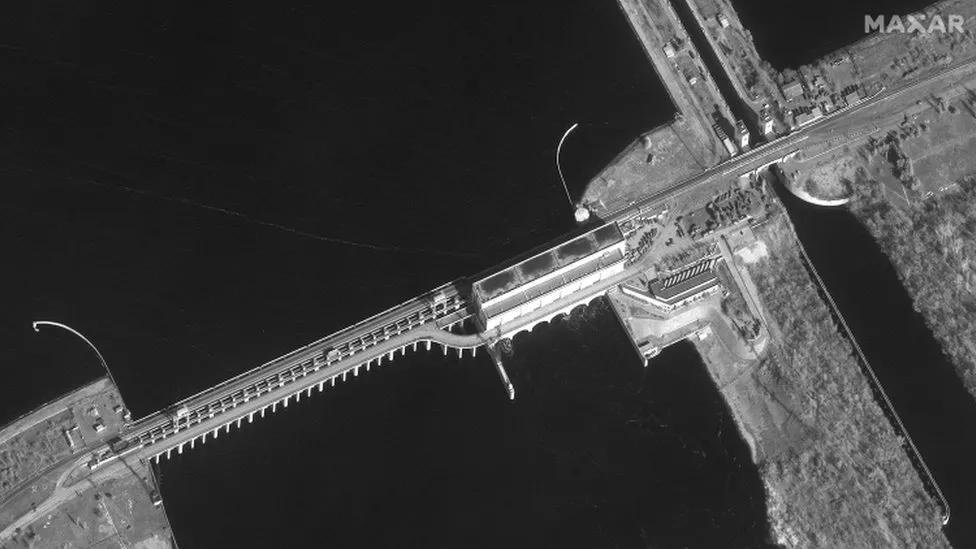
Russian troops swiftly seized control of Kakhovka dam after they invaded Ukraine on 24 February
IMAGE SOURCE,MAXAR
Image caption, Russian troops swiftly seized control of Kakhovka dam after they invaded Ukraine on 24 February

Image

Ukraine's President Volodymyr Zelensky has accused Russia of preparing to blow up a dam at a hydroelectric plant in southern Ukraine, which would lead to a "large-scale disaster".

In his overnight address he said the Kakhovka dam on the Dnieper river had been mined by Russian forces, according to Ukrainian information.

The dam is under Russian occupation, but Ukrainian forces are closing in.

Russia has already accused Ukraine of firing missiles at the Kakhovka dam.

The dam also provides Russia with one of the few remaining routes across the Dnieper river in the partially occupied Kherson region.

Russian-installed authorities in Kherson have rejected Ukraine's allegations of a plot to destroy the structure. They blamed Ukrainian forces for an attack on another key crossing, the Antonivskiy Bridge. Four people were killed, including the head of a TV channel, officials said.

Russia began evacuating its proxy authorities in Kherson this week but also said 50-60,000 civilians would leave too, a measure condemned as forced deportations by Kyiv authorities.

Russia's new military commander in Ukraine, Gen Sergei Surovikin, alleged that Ukrainian forces could be planning "banned methods of warfare" in Kherson city and the hydroelectric dam and argued that justified the "evacuation" of the civilian population.

Civilians from the Russian-controlled Kherson region of Ukraine arrive in Dzhankoi
IMAGE SOURCE,REUTERS
Image caption, Russian-appointed officials have moved civilians from the west bank of the Dnieper river - Ukraine says they are deportations


The Institute for the Study of War, an independent US-based think tank, has suggested Russia is "likely continuing to prepare for a false flag attack" on the Kakhovka hydroelectric plant, by creating "information conditions" for Russian forces to blow up the dam after they pull out of western Kherson and then accuse Ukraine of flooding the river and surrounding settlements.

President Zelensky told EU leaders by video on Thursday that Russia had already destroyed more than a third of Ukraine's energy infrastructure, with the aim of creating as many problems with electricity and heating as possible over the winter months. For the first time since the start of the Russian invasion, Ukrainians have been asked to use less electricity, with nationwide limits on usage between 07:00 and 23:00.

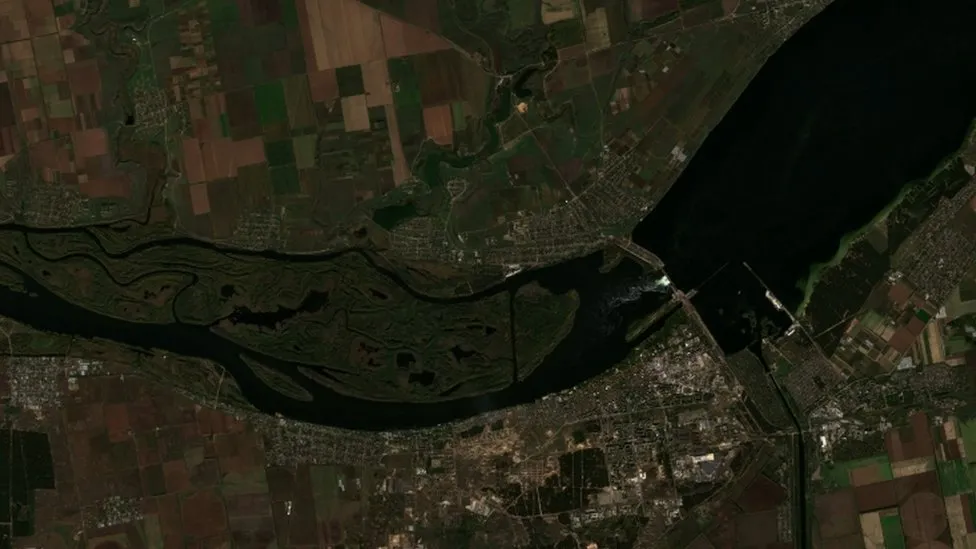
If the Kakhovka dam were destroyed, Mr Zelensky warned it could devastate the water supply to much of the south and leave Europe's biggest nuclear plant at Zaporizhzhia without cooling water.

"The dam of this hydroelectric power plant holds a volume of about 18m cubic meters of water," he said. "If Russian terrorists blow up this dam, more than 80 settlements, including Kherson, will be in the zone of rapid flooding. Hundreds of thousands of people could be affected."

The Ukrainian leader also said if the dam were destroyed then the North Crimean Canal would "simply disappear".

The canal, built in 1975, provides Russian-annexed Crimea with a reported 85% of its water supply. An early act in Russia's invasion of Ukraine in February was blowing up a dam that Ukraine had built in the canal after the peninsula was seized in 2014, accusing Russia of not paying for the water.

Several Russian commentators have pointed out that areas under occupation would be worst hit if the Kakhovka dam were destroyed, although dozens of communities under Ukrainian control would be badly affected too.

A satellite image shows a view of the location of the Kakhovka dam and the surrounding region in Kherson Oblast, Ukraine, October 18, 2022
IMAGE SOURCE,EU/COPERNICUS SENTINEL-2
Image caption, This 18 October image shows how much of the surrounding area to the west would be submerged if the dam were destroyed

Image

Pro-Kremlin newspaper Komsomolskaya Pravda said a dam explosion would prompt a 5m-high wave that would wash away all villages beside the Dnieper river at a rate of 25km/h. Within two hours it said the water would hit Kherson city and flood vast areas over three days.

However, presidential office adviser Mykhaylo Podolyak said that mining the dam was all part of a "Surovikin plan" that involved flooding territory to stop Ukraine's counter-offensive.

President Zelensky said that if the Russians were seriously considering blowing up the Kakhovka dam, it meant they realised they would not merely lose control of Kherson but the entire south including Crimea.


Ukraine war: 'I'd rather go to jail than fight in Ukraine', Russian man says
Published 23 hours ago
By Steve Rosenberg
Russia Editor (BBC)

Mikhail Ashichev
Image caption, "If I had to, I would choose prison. That's nothing to fear. We know that [in Ukraine] people are dying under the rubble and parents are burying their children," Mikhail says


The six-minute video is shaky. But the contents are fascinating.

In the town of Podporozhye, five hundred miles from Moscow, officials at the military draft office are meeting to decide whether local resident Mikhail Ashichev should be mobilised and sent to Ukraine.

Mikhail argues his case.

"I'm not a pacifist," he explains. "If a country was trying to occupy my Motherland, or commit aggression against Russia, I would go straight to the military enlistment office and sign up, without waiting for my call-up papers. But in this particular case I believe that there is no military threat to my Motherland."

"But our Motherland is in danger," one of the officials insists.

"My Motherland wasn't in danger before 24 February," replies Mikhail, referring to the date on which Russia invaded Ukraine.

Mikhail, 34, is a mechanic. Despite Russia becoming an increasingly authoritarian state, in which civil and human rights have been curtailed, Mikhail argues that the Russian constitution gives him the right to be a conscientious objector. He refuses to fight in Ukraine.

"While I was standing there saying those things I was very nervous," Mikhail tells me. "But when I watched the video back, on the contrary I saw fear in the eyes of the people who were listening to me. I think that's because they're used to treating people as objects which they can move from one place to another, or just order around. Suddenly there was I saying the things I was saying.

"Then came the threats. 'We'll tell the police about this and they'll investigate,' they said. I get the feeling that these people are terrified of losing control. They're used to controlling everything."

According to Vladimir Putin, more than 220,000 Russian reservists have been called up since the Russian president declared "partial mobilisation" last month. Although the Kremlin leader has indicated that the mobilisation drive will end soon, the Kremlin has declined to name a specific date.

In recent days Russian state TV has broadcast images of mobilised men undergoing training in Russia, complete with patriotic soundbites from some of the draftees. This week President Putin was shown allegedly meeting mobilised soldiers at a training ground in the Ryazan region, an attempt to rally public support for the mobilisation effort.

Putin with troops
IMAGE SOURCE,MIKHAEL KLIMENTYEV/SPUTNIK/KREMLIN POOL/EPA-EFE/RE
Image caption, The Russian president appeared on state television, reportedly at a training centre for recently mobilised troops


But there's little doubt that mobilisation has sparked deep alarm in Russian society. Back in March Vladimir Putin had declared that there would be no mobilisation. Only "professional soldiers", he promised, would take part in his "special military operation".

All that changed following his decision to announce "partial mobilisation." With the call-up of hundreds of thousands of Russian reservists, the war in Ukraine became much more real for the Russian public. Suddenly husbands, fathers and sons were being drafted into the army and despatched to the frontline: in some cases, without the necessary equipment or training. For weeks now, mobilised Russians have been posting videos on social media, in which they complain about poor conditions and a lack of resources.

"The people around me are terrified due to mobilisation," Mikhail tells me, "because now this affects everyone."

Following his refusal to fight, Mikhail has received some abuse on Russian social media.

"He's a coward and a rat fleeing the ship," reads one comment.

"A man who does this cannot call himself a man," reads another.

But what I find interesting is that Mikhail has received plenty of support, too, for the moral stand he is taking. Here are some of the positive comments:

"Well done, Mikhail, you are brave and honest."

"Refusing to kill is humane and courageous."

"Good man. You're not hiding or running away. You're asking the right question: who was actually planning to attack us before 24 February?"

Mikhail is determined to use all legal means to defend his position.

But if he loses his case?

"When mobilisation was only being talked about as a possibility, I had already decided and agreed with my family that, if such a situation arose, I would refuse to do this, even if they sent me to prison. If I had to, I would choose prison. That's nothing to fear. We know that [in Ukraine] people are dying under the rubble and parents are burying their children.

The state will consider me a criminal if I don't go and fight in this war. But I won't be a criminal from the point of view of humanity, or myself."


Ukraine war: Russia air strikes target more power facilities
Published 2 hours ago
By Henri Astier
BBC

Power plant damaged by a Russian strike in Kyiv, 18 October
IMAGE SOURCE,REUTERS
Image caption, Russia strikes have crippled power plants across Ukraine in recent days


Air strikes have hit critical infrastructure in central and western Ukraine, as Russia continues to target the country's energy grid.

Sites to the south and west of Kyiv have been struck and power cuts have been reported across the country.

President Volodymyr Zelensky condemned the "massive attack" but said most of the Russian rockets had been shot down.

Almost a third of the country's power stations have been destroyed in a wave of air strikes since Monday last week.

An aide to President Zelensky, Kyrylo Tymoshenko, said about a million and a half households were now without electricity.

The areas targeted by the latest attacks include the Cherkasy region, south-east of the capital Kyiv, and the city of Khmelnytskyi, further west.

Air strikes and power disruptions were also reported from Odesa in the south to Rivne and Lutsk in the north-west.

The national electricity operator, Ukrenergo, said the strikes may have caused more damage than intense bombardment earlier this month.

President Zelensky said: "The enemy launched a massive attack: 36 rockets, most of which were shot down. These are vile strikes on critical objects."

Home damaged in a missile strike near the Russian border in Kharkiv region, 21 October
IMAGE SOURCE,REUTERS
Image caption, The latest wave of strikes have also wrecked many homes


The deputy mayor of the western city of Lviv, Serhiy Kiral, told the BBC on Saturday that Russia's strategy was to damage critical infrastructure before the winter, and bring the war to areas beyond the front line.

"The more successes the Ukrainian armed forces are having at the front the worse it's going to be for people on the home front because Russia is going to do all it can to target civilians and to target critical infrastructure," he said in an interview with the Newshour radio programme.

On Friday Mr Zelensky accused Russia of planting mines at a hydroelectric dam in the Kherson region of southern Ukraine, which is under the control of Moscow's forces.
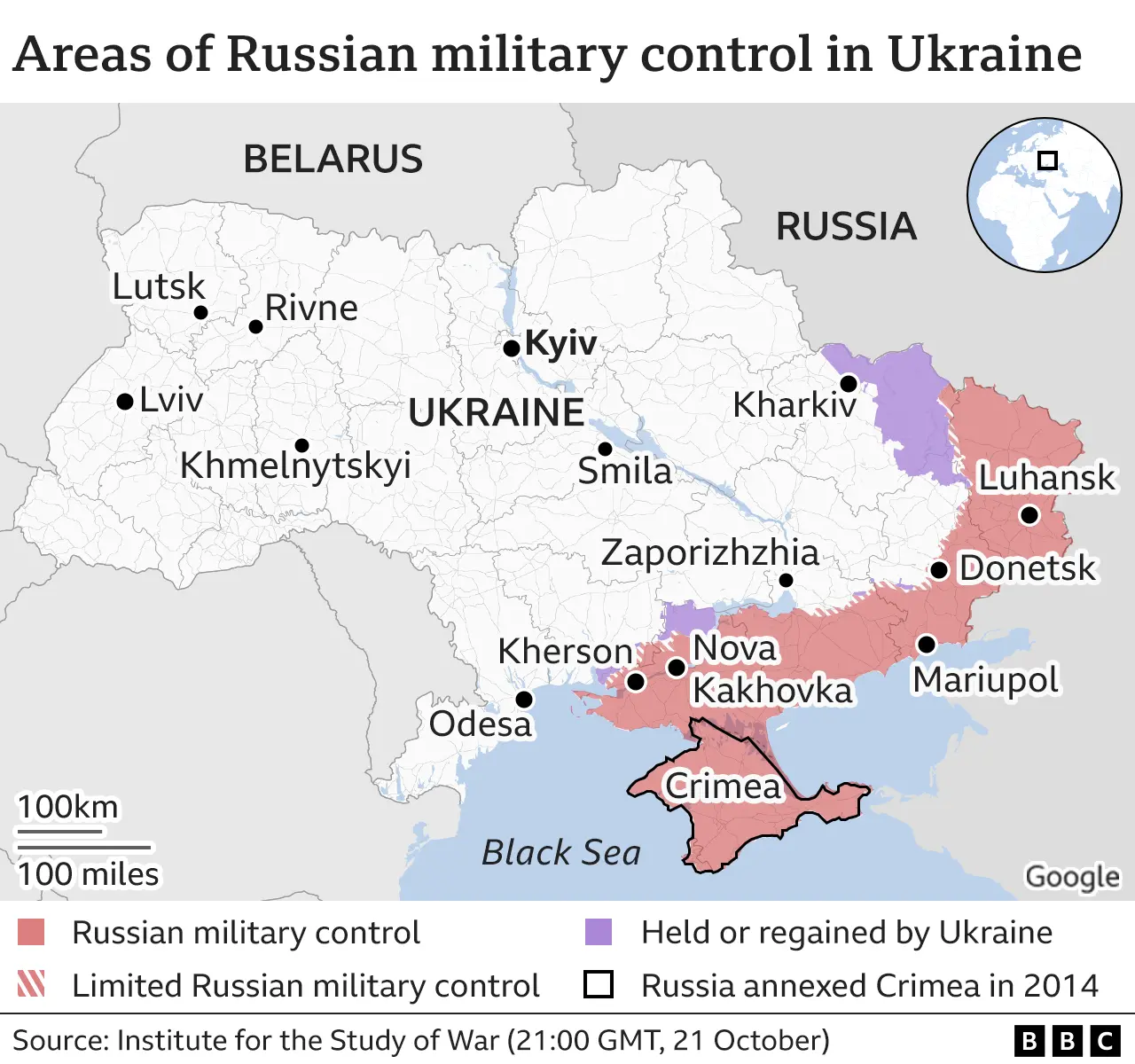
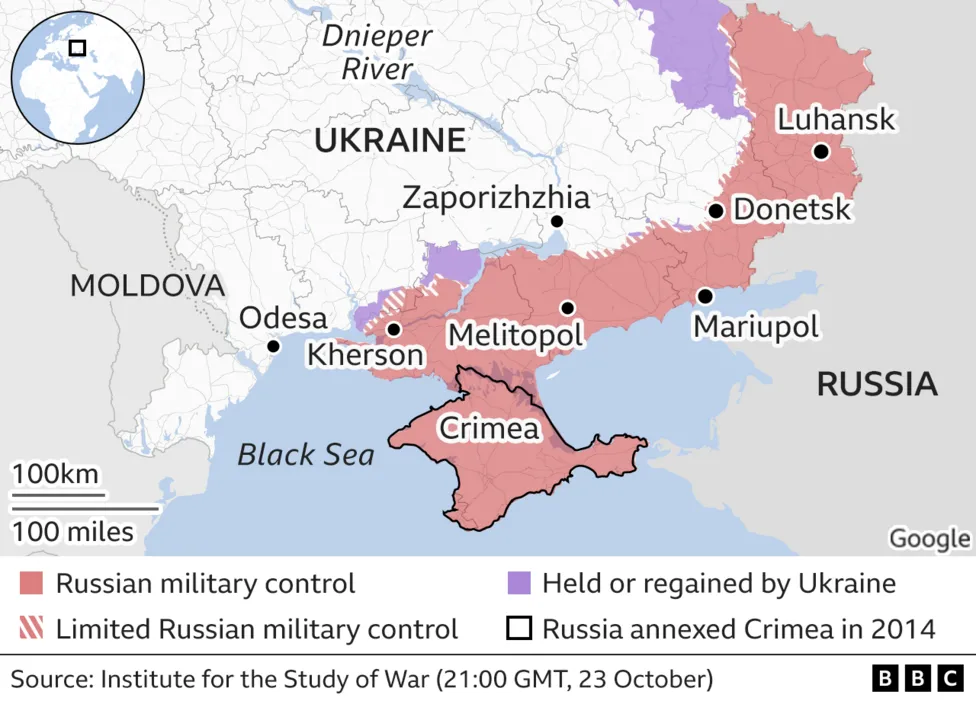
Map showing areas of Russian military control in Ukraine
Image

He said that if the Kakhovka hydropower plant was destroyed, hundreds of thousands of people would be in danger of flooding. Russia has denied planning to blow up the dam and said Ukraine was firing missiles at it.

The dam may provide Russia with one of the few remaining routes across the River Dnieper (called Dnipro by Ukrainians) in the partially occupied Kherson region.

Thousands of civilians have been leaving the city of Kherson in recent days, as Ukrainian forces advance. And on Saturday a new directive from occupying Russian authorities was released, renewing its appeal for civilians to leave "immediately".

Across the border, in Russia's Belgorod region, the local governor said two people had been killed in Ukrainian shelling.

Re: Information for Decision Making

Posted: 23 October 2022, 14:24
by DaffyVina
Ukraine war: Massive Russian strikes target energy grid - Zelensky
Published 6 hours ago
By Henri Astier & Yaroslav Lukov
BBC News

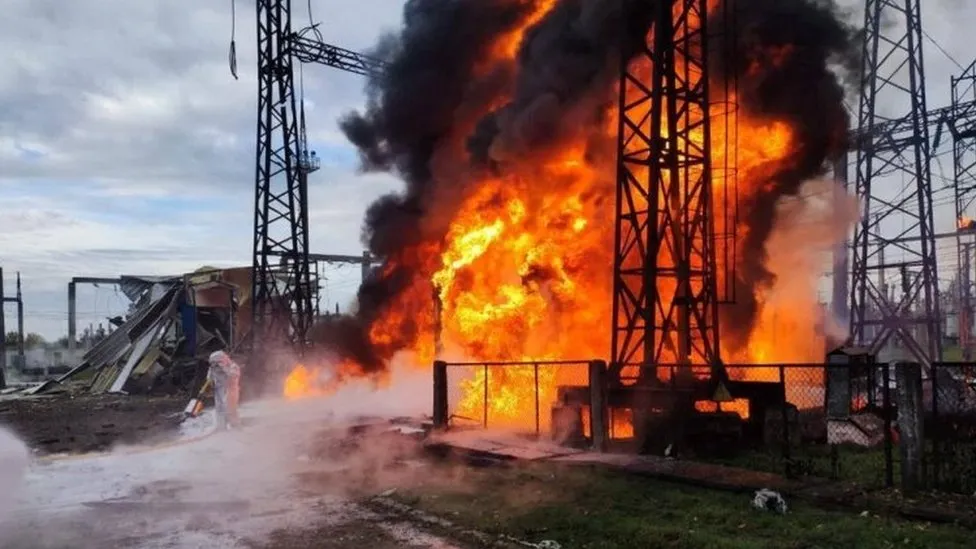
A fire at an energy-generating facility in Ukraine. Photo: 22 October 2022
IMAGE SOURCE,UKRAINIAN PRESIDENTIAL PRESS SERVICE VIA REUTERS
Image caption,
Russia strikes have crippled power plants across Ukraine in recent days

Image

Russia has launched a "new massive strike" targeting Ukraine's energy grid, Ukrainian President Volodymyr Zelensky has said.

He added that the attacks were on a "very wide" scale, hitting regions in Ukraine's west, centre, south and east.

In an evening address, Mr Zelensky said power had been restored in multiple areas where it had been cut off.

Officials had said earlier on Saturday that nearly 1.5 million households had been left without electricity.

In his video, Mr Zelensky added that most of the Russian missiles and drones were being shot down, and such strikes would not stop a Ukrainian military advance.

"Of course, we do not yet have the technical ability to shoot down 100% of Russian missiles and attack drones. We will gradually come to this - with the help of our partners, I'm confident of this," the Ukrainian leader said in a video.

Almost a third of Ukraine's power stations and other energy-generating facilities have reportedly been destroyed in a wave of air strikes since Monday last week.

The areas targeted by the latest attacks include the Cherkasy region, south-east of the capital Kyiv, and the city of Khmelnytskyi, further west.

Air strikes and power disruptions were also reported from Odesa in the south to Rivne and Lutsk in the north-west.

The national electricity operator, Ukrenergo, said the strikes may have caused more damage than intense bombardment earlier this month.

Mr Zelensky said that 36 rockets had been launched on Saturday, and most of them had been downed.

Home damaged in a missile strike near the Russian border in Kharkiv region, 21 October
IMAGE SOURCE,REUTERS
Image caption,
The latest wave of strikes have also wrecked many homes

Image

The deputy mayor of the western city of Lviv, Serhiy Kiral, told the BBC on Saturday that Russia's strategy was to damage critical infrastructure before the winter, and bring the war to areas beyond the front line.

"The more successes the Ukrainian armed forces are having at the front the worse it's going to be for people on the home front because Russia is going to do all it can to target civilians and to target critical infrastructure," he said in an interview with the Newshour radio programme.

On Friday Mr Zelensky accused Russia of planting mines at a hydroelectric dam in the Kherson region of southern Ukraine, which is under the control of Moscow's forces.
Map showing areas of Russian military control in Ukraine
Image

He said that if the Kakhovka hydropower plant was destroyed, hundreds of thousands of people would be in danger of flooding. Russia has denied planning to blow up the dam and said Ukraine was firing missiles at it.

The dam may provide Russia with one of the few remaining routes across the River Dnieper (called Dnipro by Ukrainians) in the partially occupied Kherson region.

Thousands of civilians have been leaving the city of Kherson in recent days, as Ukrainian forces advance.

And on Saturday a new directive from occupying Russian authorities was released, renewing its appeal for civilians to leave "immediately".

The transfer or deportation of civilians by an occupying power from occupied territory is considered a war crime. In September, the UN said there were already credible accusations of forced deportation of Ukrainian children from Russian-occupied areas.

Russia's ambassador to the UN, Vasily Nebenzia, said the allegations were unfounded.

Meanwhile, Ukraine's armed forces said that Russian troops on Saturday had left two villages - Charivne and Chkalove - in Kherson region. The claim has not been independently verified.

Across the border, in Russia's Belgorod region, the local governor said two people had been killed in Ukrainian shelling.

Re: Information for Decision Making

Posted: 23 October 2022, 14:32
by DaffyVina
Ukraine war: The cost of occupation in Kherson region
Published 1 hour ago
By James Waterhouse
BBC Ukraine correspondent

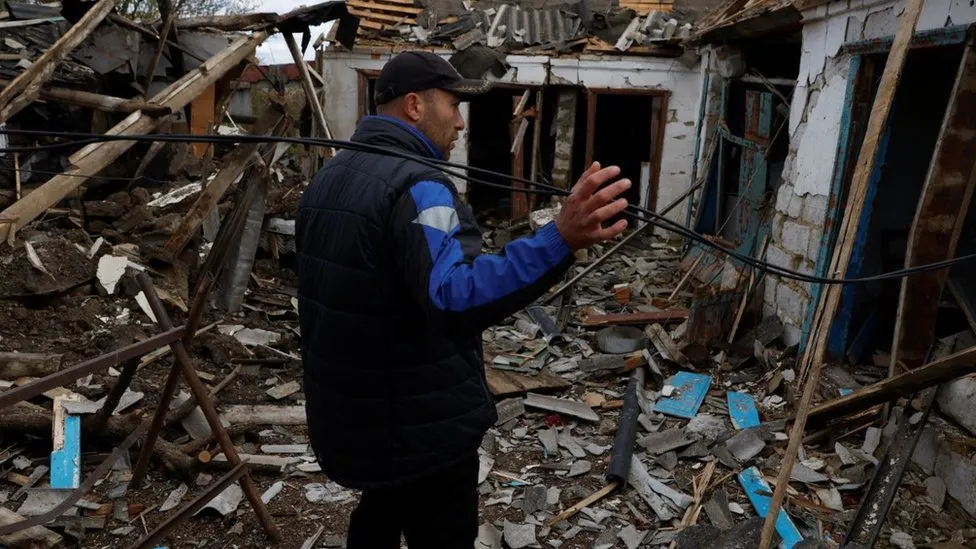
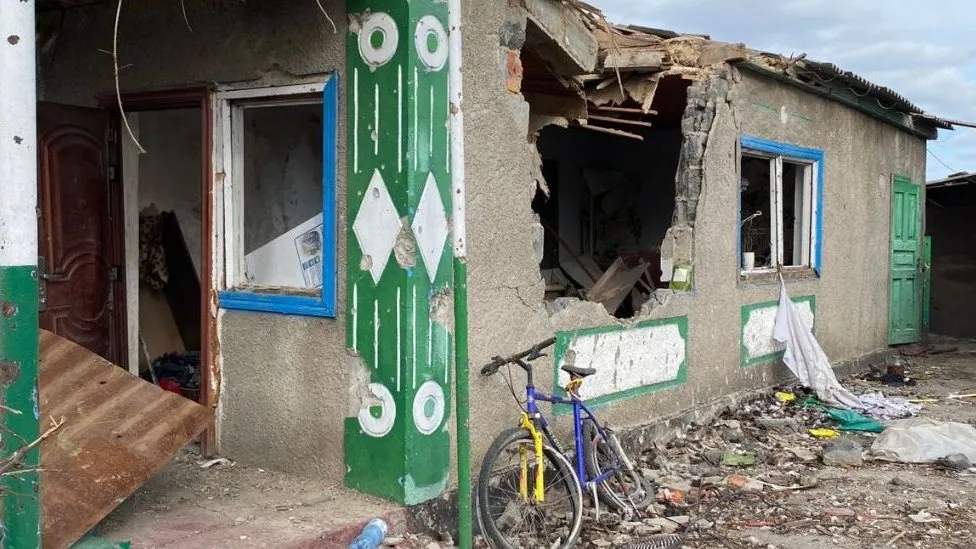
Destroyed home in Kherson region
Image caption, Many villages in Kherson region were turned into a battleground

Image

There are moments when this war feels utterly mindless. Witnessing the visible trauma in the village of Kreshchenivka is one of those instances.

"Those Russians said they were liberators, they just started robbing us!" says a tearful Fedir. He says they took his car, furniture and mattresses. Nearly every house on his street has been damaged.

The 69-year-old lives in a part of the southern Kherson region which has been liberated by Ukrainian troops earlier in October. "My head aches from all the shelling, we almost starved to death in the first few months," he said.

There is still no power, water, and the locals rely on volunteers for food.

Our journey to him took us along poorly surfaced roads, which only deteriorated as we continued south towards the front line.

To the right, piles of dug earth stretch for miles next to the road - a Ukrainian defensive measure to force Russian forces up a single route.

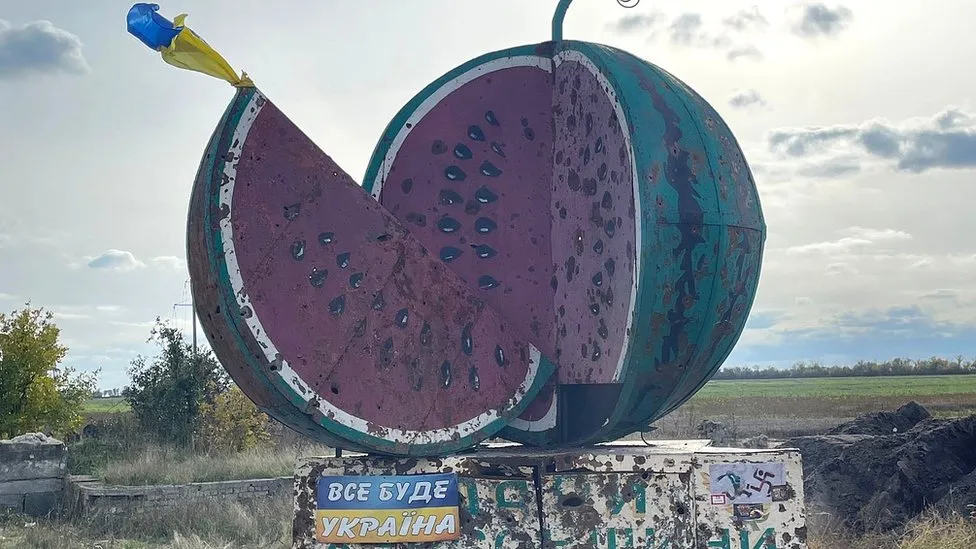
But they never made it this far. Twenty miles on, a rusty watermelon monument marks the tide mark of Moscow's advance.

Watermelon
Image caption, Watermelon is the Kherson region's symbol as it's mostly grown here

Image

The fields are dotted with Russian missiles that have remained unexploded because of the soft soil.

The villages here are mostly destroyed from both their occupation and recent liberation. Despite the eerie quiet and visible destruction, there is movement.

Ukrainian vehicles are repaired at the side of the roads. Personnel carriers and tanks occasionally roar back and forth from the direction of Kherson city.

There is significant military activity. A logistical supply line forms an artery towards Ukraine's continued counteroffensive.

It also brings life back to the villages it weaves through.

"A lot of people far away from the frontline are celebrating," one soldier tells us, who only wants to be known by his call sign "Gadfly".

Everybody is a bit nervous about going to the front, he says. "Your heart beats differently at times. But we signed up for this. We gave a pledge.

"Once the firing starts it's three deep breaths, a couple of swear words and you move on."

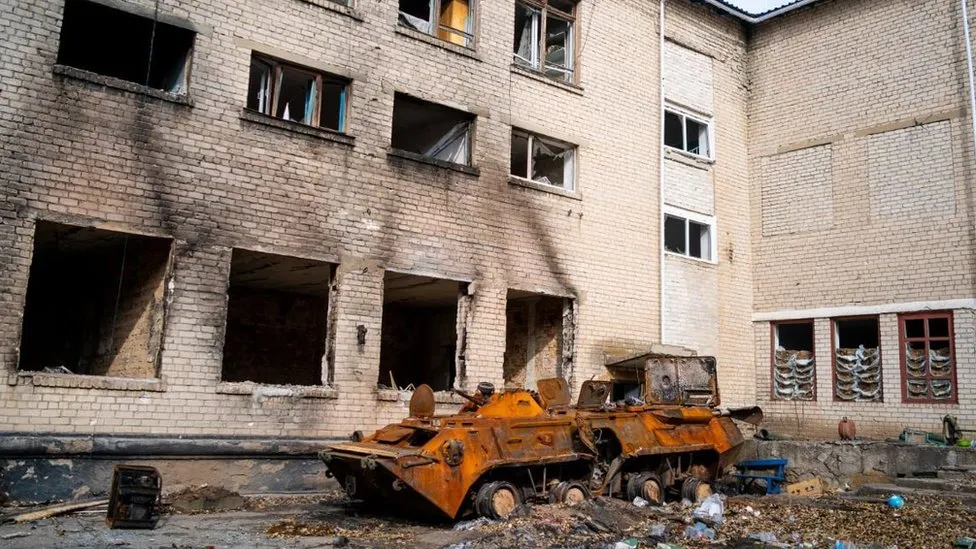
Russian headquarters
Image caption, This school in the village of Kreshchenivka was used as a Russian headquarters

Image

Gadfly was mobilised in March and isn't a professional soldier. His country has the current momentum, but he thinks they can only fully force Russia out if the West continues with its military support.

"The problem is that the villages are razed. There's no place to hide. If we don't have the air superiority, it's going to be difficult. We're running out of planes, three or four were shot down last week.

"All this military stuff is fun and games until it's not fun and games. My back is hurting already because of all the equipment!"

Despite having been forced out, you also learn a lot about the occupiers just by looking around.

In one school which they used as a base, their supplies, ammunition, and rubbish are scattered in all directions. These are not the traces of a disciplined force. It's evidence they'd been fighting in squalor and left in a hurry.

Ukrainian teacher Alyona Bilous
Image caption,
Alyona Bilous returned after liberation to find her nursery destroyed and her home looted

Image

Down the street we meet Alyona in the Kindergarten she used to run. She lived under occupation for two months before having to escape.

She'd been "blacklisted" by the Russians, allegedly because she supplied villagers with food and helped them evacuate.

"They just left a mess. Mess and pain," says Alyona. "When I came here for the first time after liberation, I just stood here and cried. It's really hard."

Alyona says when she first met a Russian soldier, he asked her "who allowed you to live so well?" Her family's wooden house was left nearly empty after the Russians took everything away.

Fighting is starting to concentrate around the city of Kherson. There's an almost constant rumbling of artillery about 10 miles (16km) away.

Map showing Kherson region and areas of control
Image

As Russia's grip on Kherson continues to weaken, fears grow of it deploying an "scorched earth" policy.

Moscow-installed politicians have recently been "evacuating" people. Ukraine has accused Russian troops of preparing to blow up the nearby Kakhovka dam. Russia denies this but if it happened Kyiv says it would lead to 80 settlements being flooded.

They believe it indicates an "if we can't have it, no one can" approach.

For Ukraine, liberation here is fiercely contested as well as complicated. Also, if achieved, it doesn't bring immediate relief.

Yet in the words of the Ukrainian soldier Gadfly, "what choice do we have"?

Re: Information for Decision Making

Posted: 25 October 2022, 09:40
by DaffyVina
Russia accused of sabotaging Ukraine water pipe to Mykolaiv
Published 2 hours ago
By Viktoriia Zhuhan & Nader Ibrahim
BBC News

Elderly residents in Mykolaiv say they have to queue for more than three hours for clean water
IMAGE SOURCE,EPA-EFE/REX/SHUTTERSTOCK
Image caption,
Residents in Mykolaiv say they have to queue for more than three hours for clean water


For six months, homes in Ukraine's southern coastal city of Mykolaiv have been without clean drinking water.

Military and UN experts have told a BBC investigation they believe Russian forces deliberately cut off the water supply last April.

Satellite imagery and data suggest the pipeline to the city was deliberately destroyed while under Russian control.

Destroying resources vital for civilian life is widely regarded as violations of international humanitarian law.

But in recent weeks Russia has further targeted Ukraine's power and water infrastructure, prompting shortages across the country.

Queuing in the street in Mykolaiv to collect clean drinking water is dangerous as the city is close to the front line and is often shelled. Since Russia's invasion it has remained under Ukrainian control.

"You are standing in line. It's terribly scary to go out, God forbid something will fly in now," says Anya, a 36-year-old mother who fled to Mykolaiv from the neighbouring Kherson region under Russian occupation.

Anya queuing for water in the street
Image caption,
In Mykolaiv, locals like Anya can collect up to 20 litres of clean water a day at distribution points


Residents like Anya, who also cares for four other members of her family, do have access to what is called technical water in their homes, but it can't be used for drinking or cooking.

Even washing in it inflames their skin. "It is really very salty. It has a brown, greenish colour," she says.

These are the conditions that residents have had to endure for six months after the water supply to the city was cut off.

Evidence collected by the BBC points to this being a deliberate act by Russian forces.

Water pipeline destroyed

Images showing damage to a pipeline
IMAGE SOURCE,UGC
Image caption,
These photos appear to show damage caused to Mykolaiv's water supply pipeline

Image

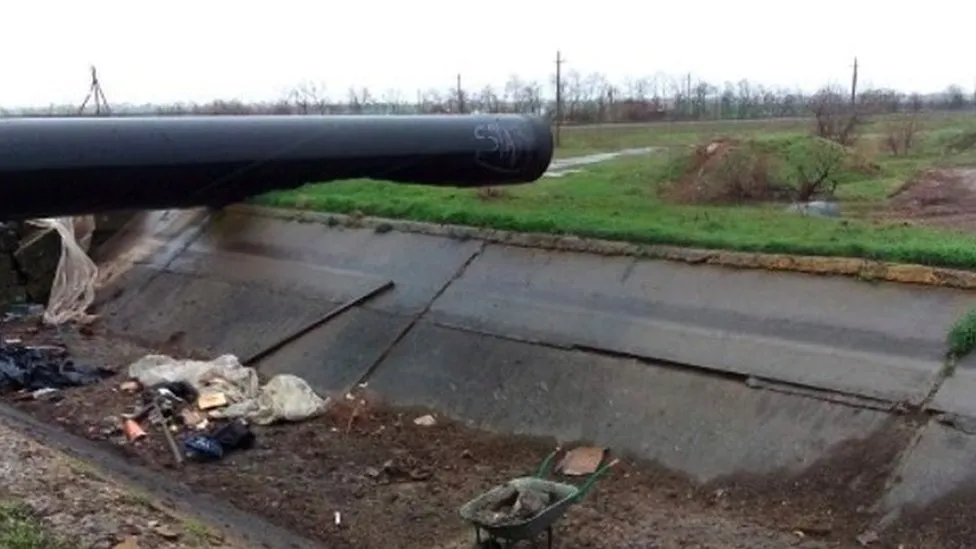
In April this year, a Ukrainian news outlet published the above images which it says show damage caused by Russian forces to Mykolaiv's only water supply pipeline.

The BBC has analysed satellite and social media pictures which back up this claim.

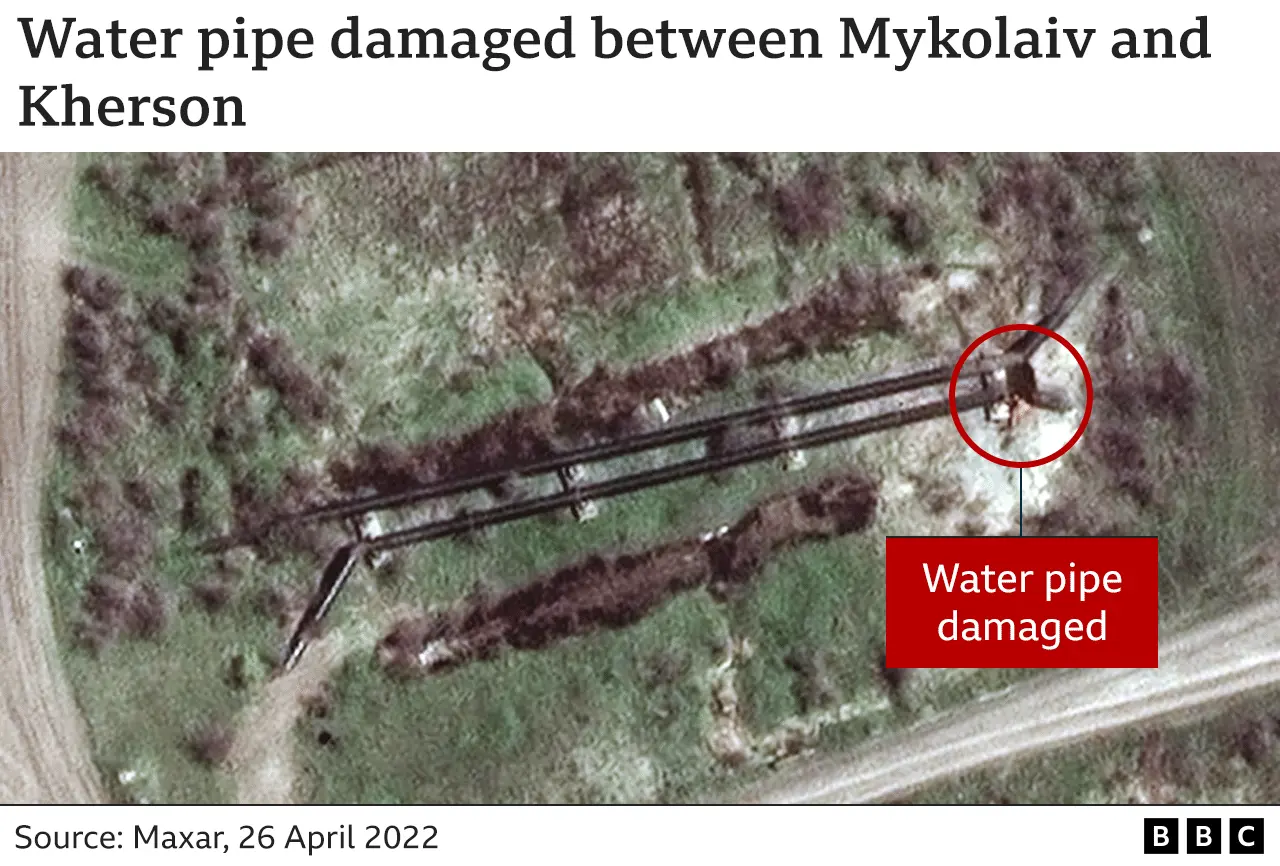
We obtained the satellite image below, which multiple sources confirm shows the same location as the Ukrainian news outlet's photos.

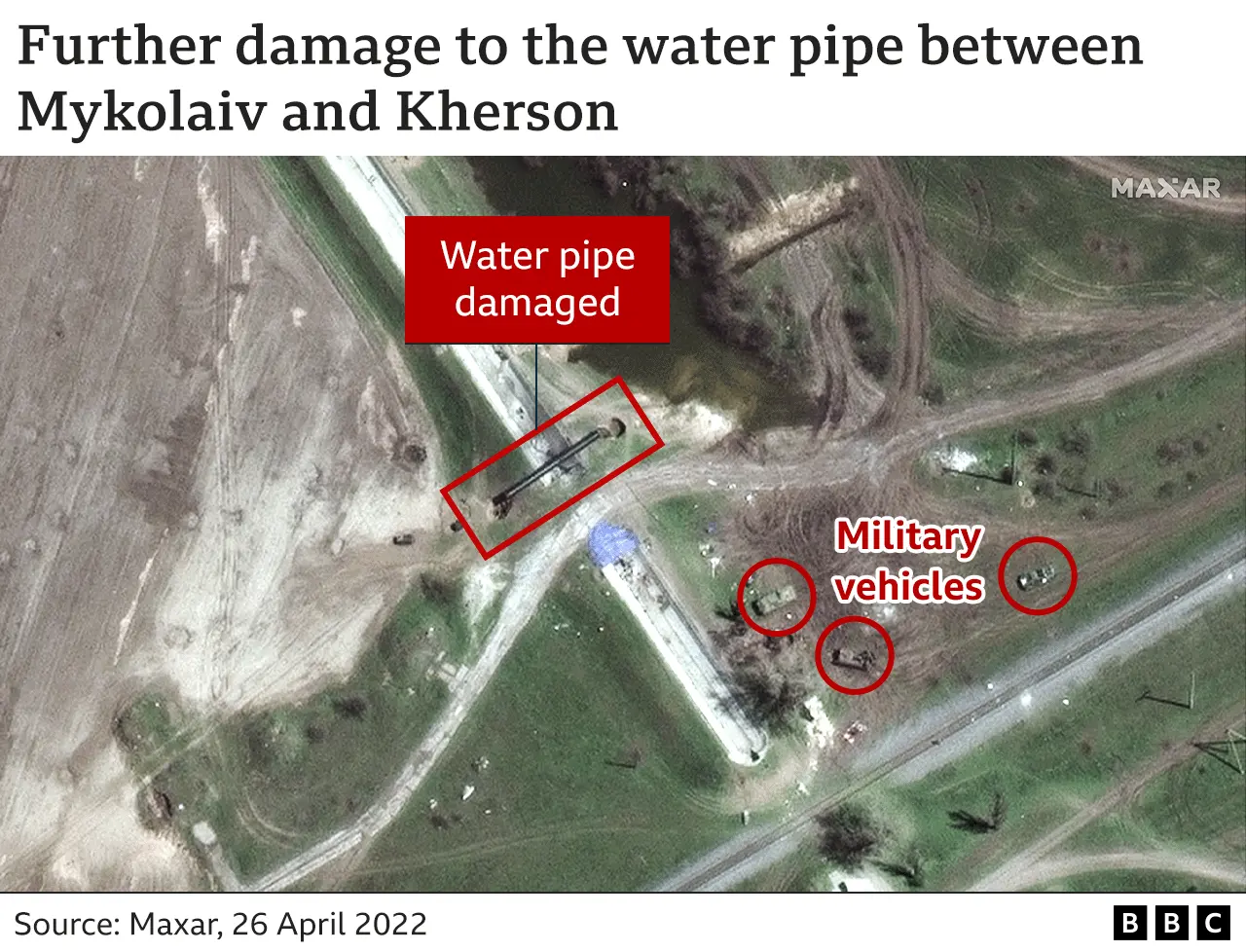
Water pipe damaged between Mykolaiv and Kherson
Image

It reveals that the pipeline was damaged at its most fragile point - where it comes to the surface from beneath the ground.

A source in Mykolaiv told the BBC that the pipeline had leaked for around eight hours after it was broken on 12 April, losing an estimated 40 million litres of water, before the supply to it was cut off.

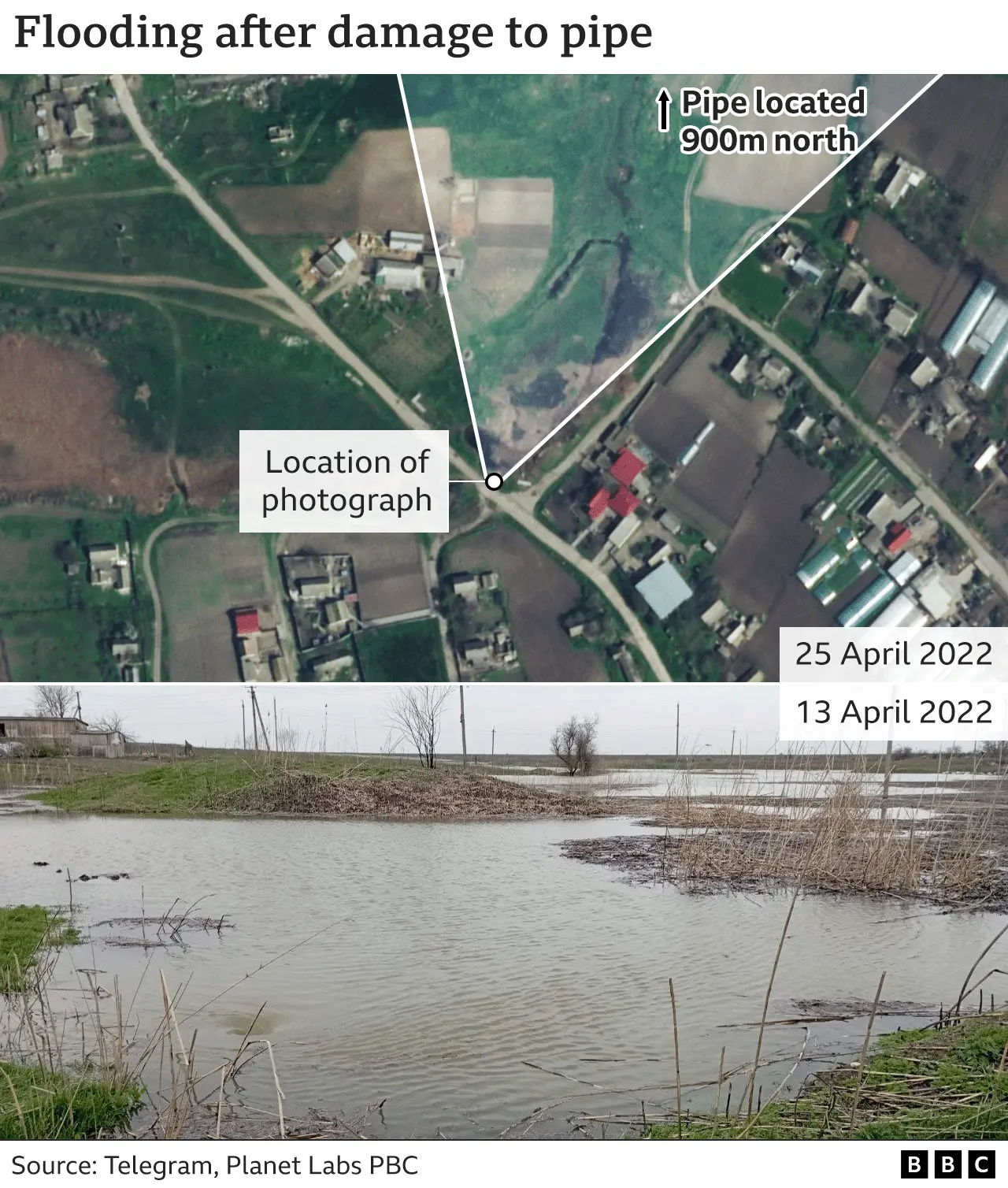
Analysis of the topography of the area indicates the water from the leak should have flowed south of the pipeline.

The below image, from the messaging app Telegram and geolocated by the BBC, confirms that an area in the path of the expected flooding was indeed saturated by a huge amount of water.

An image showing a flooded area
Image caption,
This image found on social media shows flooding south of the damaged pipe

Image

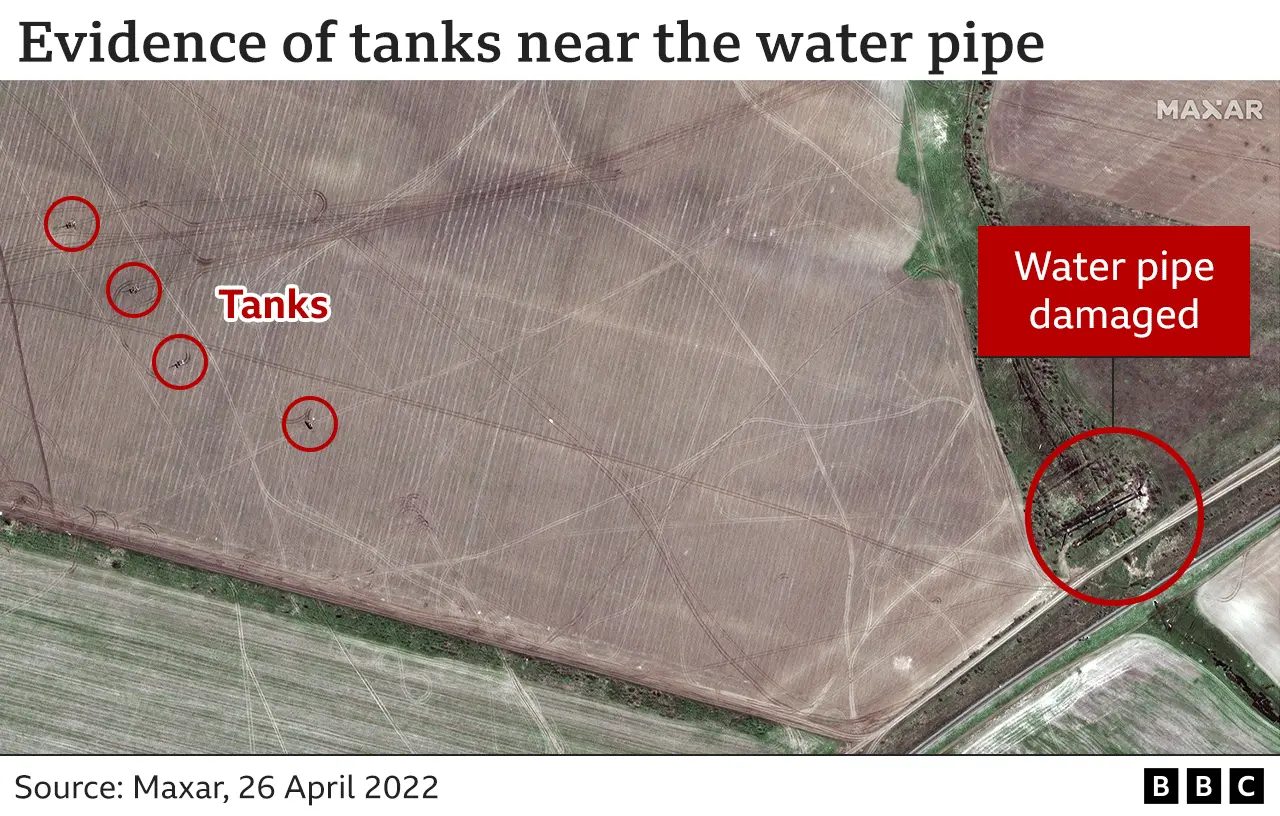
As well as confirming that this section of the pipeline was damaged, the BBC has also found satellite images showing Russian forces near by.

Four tanks can be seen close to the pipe in the image below, at time when the governor of Mykolaiv, Vitaly Kim, confirmed to the BBC that the area was under Russian control. He says plans had been made to repair the pipeline but they couldn't go ahead as it was "an active military position".

Tanks in the area
Image


The BBC also met Dmytro Butrii, who was at the time the exiled governor of the Kherson region, at a secret location. He gave us more details about the attempts to repair the pipeline saying "there were negotiations [with the Russians] conducted by the authorities in Mykolaiv" but occupying forces "did not allow the repair team to access the site".

So if the pipeline was damaged, and Russian troops were in the area, was it deliberate?

Use of explosives
The BBC showed the satellite photos and the open source images of the pipe to a security expert to assess if it was damaged by random shelling or intentional sabotage.

Chris Cobb Smith, a military forensics expert who served in the British Army as an artillery officer for over 20 years and spent three years as a UN weapons inspector in Iraq, said: "The chance that this was the result of one stray round is infinitesimal, and extremely unlikely that it was a result of an intended indirect fire strike."

He doesn't believe it was caused by shells fired by tanks, as there are no tell-tale craters nearby.

"I believe the destruction was caused by the intentional placement of an explosive charge either directly under the pipe or possibly on top of it, at the most vulnerable point."

The BBC also showed the images to Michael Whelan, a security expert who served in the British military for over 20 years. He agrees that the damage to the pipeline was deliberately caused by explosives.

Further damage
A photograph showing a section of damaged pipeline
Image caption,
The pipeline appears to have been damaged in a second area

Image

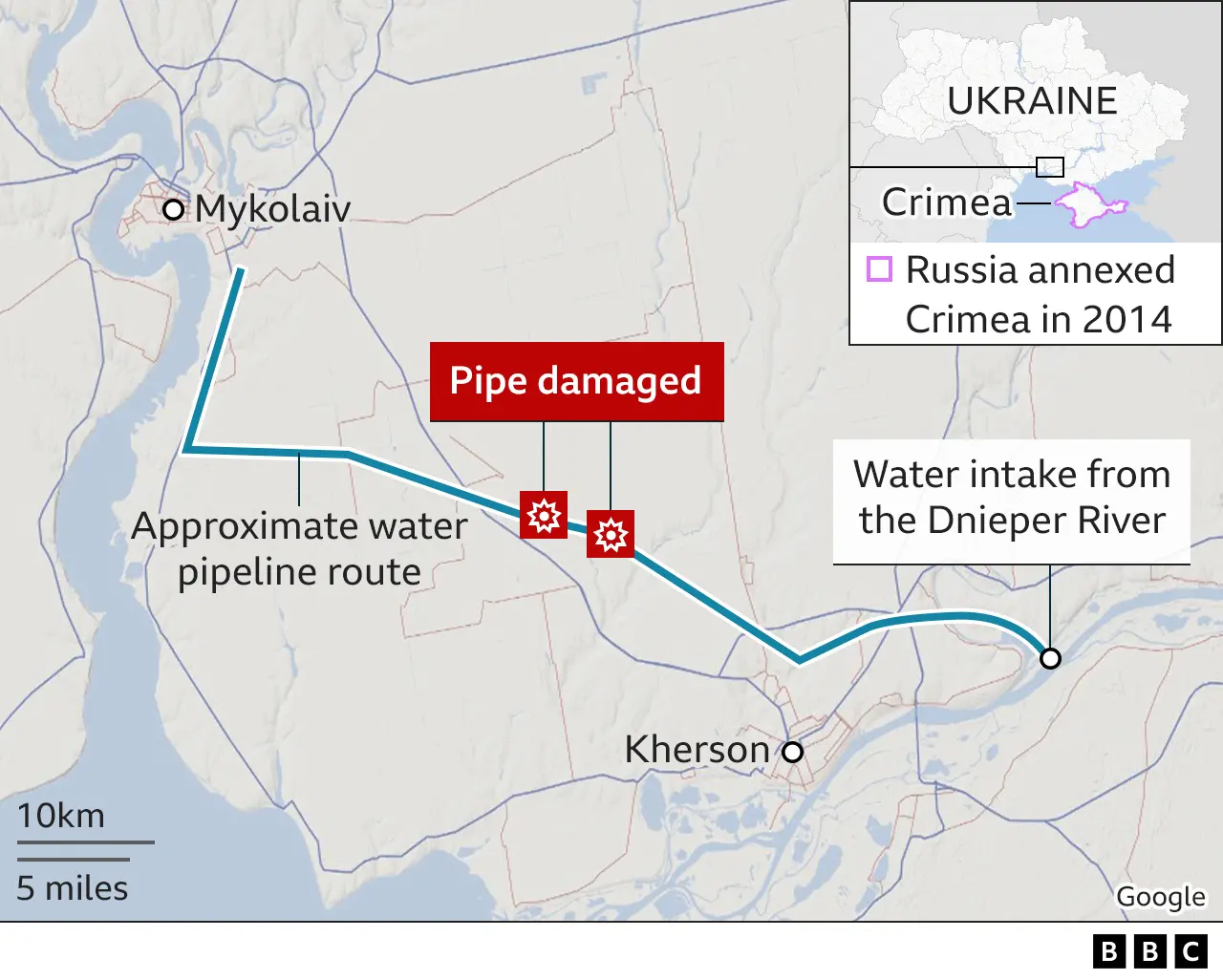
Whilst in Mykolaiv, the BBC was given an exclusive image (above) showing a second, unreported, section of the pipeline which had been damaged.

The photograph has been geolocated confirming that another part of the pipe has been cut and that satellite images from the area show that military vehicles were nearby at a time when the area was under Russian control.

Further damage to the water pipe between Mykolaiv and Kherson
Image

'A violation of humanitarian law'
That two separate points on the same pipeline have been damaged in ways that are consistent with sabotage points to occupying Russian forces deliberately cutting off the water supply to Mykolaiv.

The BBC shared its evidence with experts to assess the legality of such a move.

A UN expert, speaking anonymously because of having no authorisation to talk publicly on the subject, says the Mykolaiv water pipeline would be classified within the specially protected category of "objects indispensable to the survival of the civilian population" under international humanitarian law, making any sabotage of it illegal.

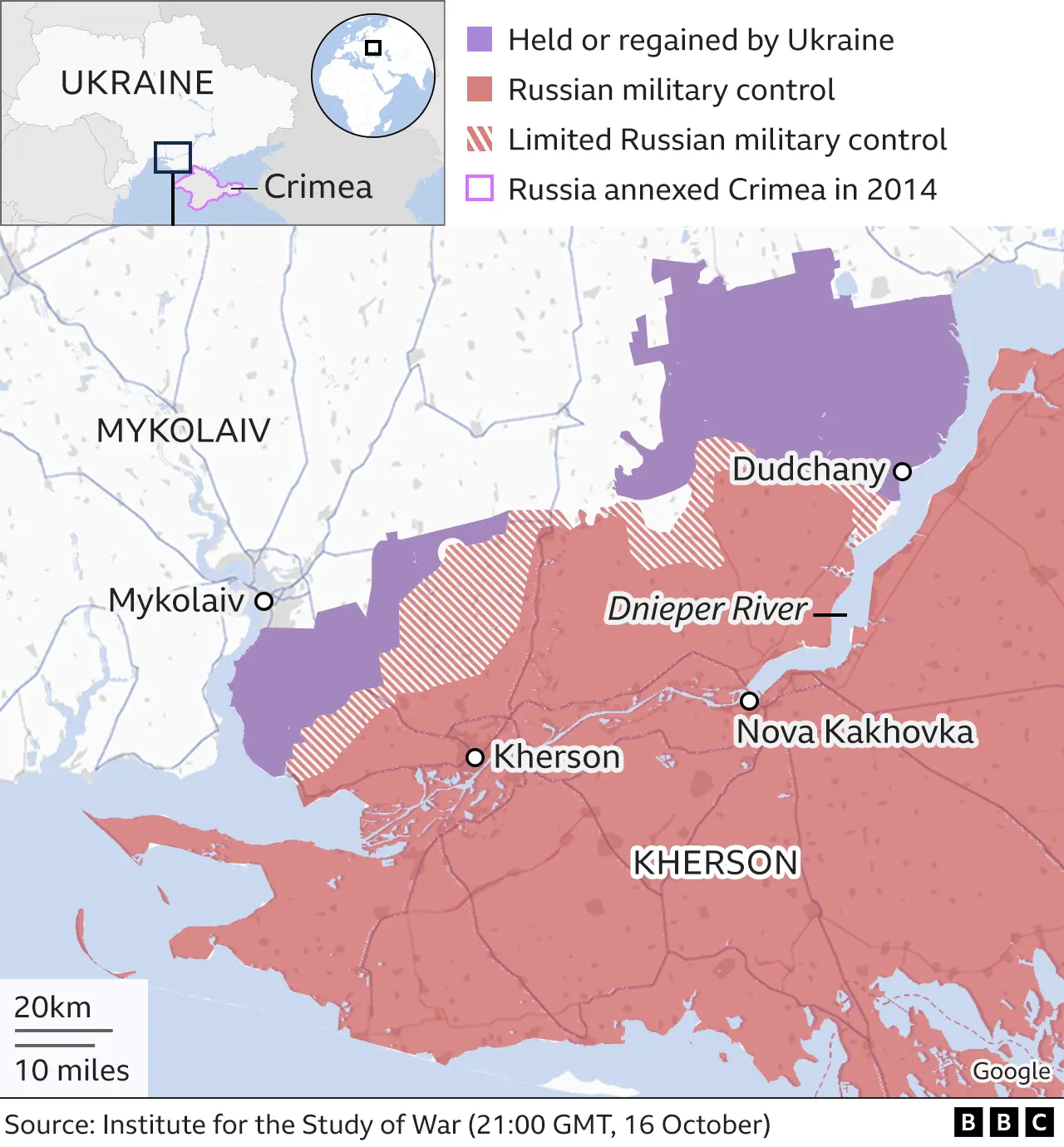
Map of the area
Image

Marco Sassòli, professor of humanitarian law at Geneva University, who was part of the OSCE Moscow Mechanism mission of experts sent to Ukraine to report on humanitarian violations following the Russian invasion, agrees: "This certainly shows a violation of international humanitarian law. Destruction of objects indispensable to the survival of the civilian population is prohibited."

The Russian Ministry of Defence has not responded to the BBC's request for comment on what happened.

A city still suffering
The front line close to the damaged pipeline has shifted back and forth following Ukraine's recent counterattack against Russian forces, giving hope to people in Mykolaiv that the pipeline might soon be repaired.

But weeks after the offensive started, and with winter approaching, the BBC visited the city again, where we met elderly people who were still queuing for clean water and humanitarian aid.

Residents in Mykoliav queue for humanitarian aid
Image caption,
Despite the risk of shelling, many residents in Mykolaiv continue to queue for water and humanitarian aid


Authorities in Mykolaiv say the area close to the pipeline needs to be safe from Russian artillery strikes and de-mined before the engineers can fix the damaged sections.

It's not clear when this might happen, and when the city's residents will get clean running water in their homes again.


Designed by Erwan Rivault and Becky Dale
Open source analysis by Sergio Voulker from SOAR.Earth, Rollo Collins and Wim Zwijnenburg
Edited by Peter Ball and Claire Press

Re: Information for Decision Making

Posted: 25 October 2022, 09:53
by DaffyVina
Ukraine war: UN nuclear watchdog to revisit sites amid Russia 'dirty bomb' claim
Published 1 hour ago

IAEA Director-General Rafael Grossi
IMAGE SOURCE,GETTY IMAGES
Image caption,
IAEA Director-General Rafael Grossi did not disclose which sites would be inspected


The UN's nuclear watchdog IAEA says its inspectors have regularly visited two sites in Ukraine at the centre of Russian claims that Kyiv is preparing a so-called dirty bomb.

Inspectors would return in the coming days following a Ukrainian request, director general Rafael Grossi said.

Russia has not offered any evidence for its allegations, which Nato dismisses.

Ukraine's President Volodymyr Zelensky warned it meant Russia itself could be preparing an attack of this kind.

So-called dirty bombs contain radioactive material, such as uranium, which is scattered through the air when its conventional explosive detonates. They don't need to contain highly refined radioactive material, as is used in a nuclear bomb, which makes them cheaper and easier to manoeuvre.

The IAEA [International Atomic Energy Agency] said it had received an invitation from the Ukrainian government to carry out "verification activities" at two unspecified locations, adding that the agency's inspectors have visited both sites regularly.

Mr Grossi said the IAEA "inspected one of these locations one month ago and all our findings were consistent with Ukraine's safeguards declarations."

"No undeclared nuclear activities or material were found there," he said.

Russia's state-run news agency, RIA Novosti, said it had identified two sites - the Eastern Mineral Enrichment Plant in central Dnipropetrovsk region and the Institute for Nuclear Research in Kyiv - as the locations central to the alleged Ukrainian operation.

Moscow is expected to repeat the allegation during a meeting of the UN's Security Council on Tuesday. In a letter to UN Secretary-General Antonio Guterres, the Russian representative to the council, Vassily Nebenzia, said his country would "regard the use of the dirty bomb by the Kyiv regime as an act of nuclear terrorism".

"Our Ministry of Defence has also received information that this provocation can be carried out with the support of Western countries," Mr Nebenzia wrote in his letter.

Moscow's allegations, made by Defence Minister Sergei Shoigu, have been rejected by Ukraine and its Western allies. In a joint statement on Monday, the US, UK and French foreign ministers condemned the claims as "transparently false" and said the "world would see through any attempt to use this allegation as a pretext for escalation".

Meanwhile, President Zelensky said during his nightly address on Monday that "if Russia calls and says that Ukraine is allegedly preparing something, it means one thing: Russia has already prepared all this".

President Volodymyr Zelensky
IMAGE SOURCE,GETTY IMAGES
Image caption, President Volodymyr Zelensky accused Russia of preparing to use dirty bombs


Western intelligence officials have been keen to stress that there is no indication that Russia is preparing to use so-called dirty bombs or other nuclear devices.

The Russian claims come as Ukrainian forces continue to gain ground in the southern Kherson region. Kyiv's forces launched a counter-attack in the region in August and its forces have slowly moved towards the regional capital of Kherson city.

In recent days, Moscow-installed officials have fled the city and urged civilians to evacuate over the Dnieper river into Russian controlled territory.

But Ukraine's military intelligence chief, Kyrylo Budanov, warned state media that Russian troops in the region were preparing the defend the city rather than retreat.

"They are creating the illusion that all is lost. Yet at the same time they are moving new military units in and preparing to defend the streets of Kherson," Mr Budanov said.

Regional authorities have said that some men who chose to remain behind in the city would have the option of joining local militias to defend it, raising fears that Moscow could force men into military formations. Such actions would constitute war crimes under the Geneva convention.

Kherson is the only major Ukrainian city - a regional capital - that Russian forces have managed to capture during its invasion.

Image

Re: Information for Decision Making

Posted: 31 October 2022, 22:24
by DaffyVina
Ukraine war: Kyiv locals queue for water after Russian strikes
Published 1 minute ago
By Hugo Bachega in Kyiv & James FitzGerald
BBC News


Media caption,
Watch: Kyiv locals seen queuing for water


People in the Ukrainian capital Kyiv had to queue for water after Russian missiles struck key facilities across the country on Monday.

An evening update from the city's mayor, Vitaliy Klitschko, said 40% of consumers in Kyiv remained without water, and 270,000 homes had no power.

Thirteen people were injured in the attacks nationwide, Ukraine said.

Russia said the strikes were aimed at Ukraine's military control and energy systems, and that all targets were hit.

They were partly in response to an attack on a Russian warship over the weekend, Russian President Vladimir Putin said on Monday.

In its evening update, the Ukrainian military said it had shot down 45 out of 55 missiles that were launched.

For security reasons, the outside world is rarely shown the destruction of Ukraine's critical infrastructure by Russian airstrikes.

Ukrainian officials say this is to avoid sharing information that could be used in future attacks, including locations hit - or potentially missed.

But the consequences of Monday's strikes were everywhere to be seen. Rolling power cuts have been introduced in several regions.

Ukrainians in general have been urged to reduce what is already an "extremely frugal" electricity consumption, in the words of President Volodymyr Zelensky.

In Kyiv, streetlights were turned off and trolleybuses replaced with conventional buses.

Long queues were seen across the city, as residents lined up to collect water from pumps after their own supplies were cut.

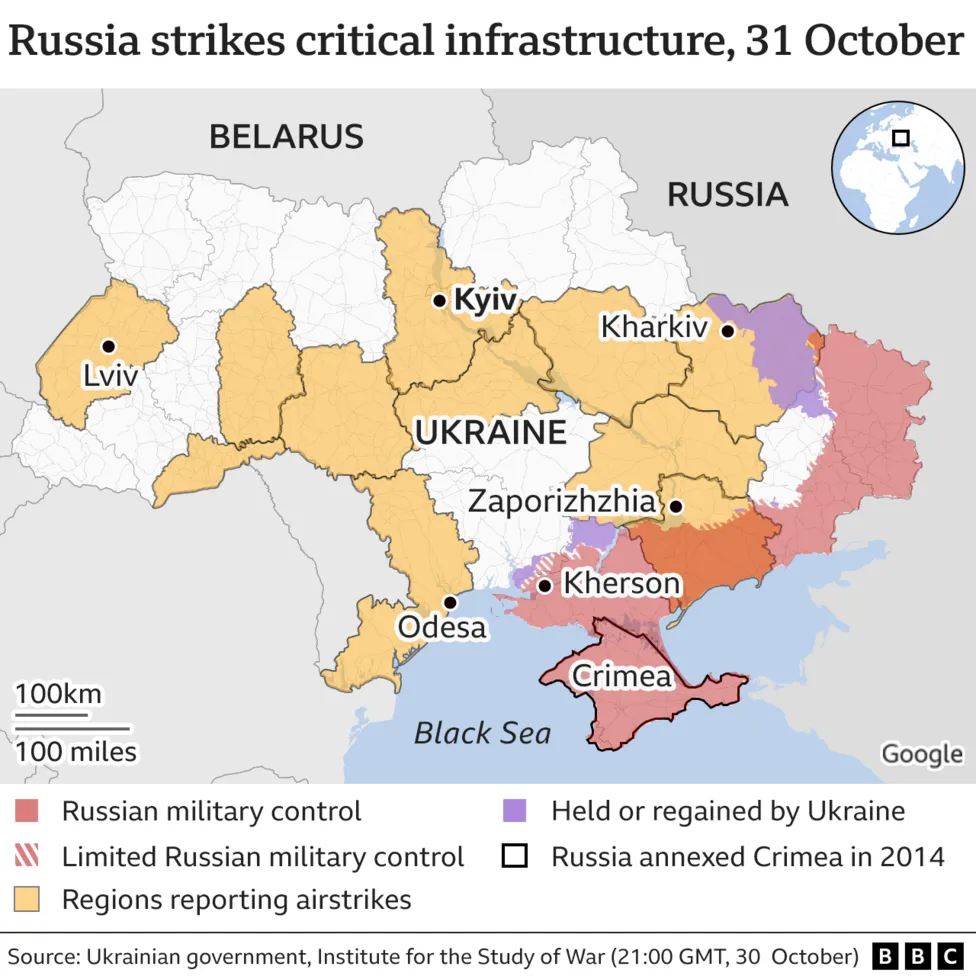
Mr Klitschko earlier said as many as 80% of Kyiv's consumers had been left without water in their homes, and urged fellow residents of the capital to head out and stock up.

In a later update, he said many households had been reconnected.

In addition to the capital, other areas affected by the strikes included Lviv, Dnipropetrovsk, Kharkiv and Zaporizhzia.

Overall, 18 facilities - most of them energy-generating - were hit by missiles and drones in 10 regions, Ukrainian officials said.

One of the missiles intercepted by Ukraine's air defences landed in a border town in Moldova, causing damage to houses but no casualties, according to authorities in the neighbouring country.

Moldova later said a Russian embassy employee in Chisinau had been told to leave its territory - without specifying who the individual was.

Image


Monday's strikes came after Russia blamed Ukraine for a drone strike on its Black Sea Fleet in the annexed Crimean peninsula over the weekend - a matter on which Kyiv has not commented.

Answering reporters' questions on Monday evening, President Putin confirmed that the strikes were partly intended as a retaliation.

He also said Russia had suspended, but not ended, its participation in a UN-brokered deal which allows safe passage to ships carrying grain from Ukrainian ports.

though Ukraine said earlier on Monday that ships were continuing to depart, despite Russia's withdrawal from the deal.

The fresh wave of attacks was the latest example of what has become Russia's strategy in Ukraine: the targeting of the important infrastructure before winter, when temperatures can drop to -20C.

Ukraine says this is Russia's response to its military defeats, as the Ukrainian army takes back territory in a successful counter-offensive.

The Ukrainian defence minister Oleksii Reznikov has linked the Russian campaign to General Sergei Surovikin - who was appointed by President Putin as his new commander in Ukraine earlier this month.

In a rare news conference last week, the minister said Russian forces had "changed their tactics" after the arrival of Gen Surovikin - whose nickname is Gen Armageddon - and "started openly fighting with the civilian population, not with the armed forces of Ukraine".

The goal, he said, was to inflict "chaos and panic" in the population, "when it's very cold and dark".

President Zelensky has described this tactic as "terrorism". Many Ukrainians say they are not afraid - though many are angry that civilians have, again, become the target.

Western leaders, including European Commission President Ursula von der Leyen, have recently pointed out that deliberate strikes on key civilian infrastructure would constitute war crimes under treaties that define the "rules" of war, known as the Geneva Conventions. Moscow, however, denies culpability for any war crimes.

"Instead of fighting on the battlefield, Russia fights civilians," Dmytro Kuleba, the Ukrainian foreign minister, said on Monday morning - echoing a view shared by many of his compatriots.

Ukraine says it needs more air defence capabilities to defend its cities. Germany has already sent equipment, and the UK and the US have announced they will do so.