Re: Catan Is Broken. Unplayable
Posted: 04 December 2023, 08:20
The developers of CATAN on BGA could just add statistics for each number (2 - 12). That should easily prove over time that the distribution of numbers is just as expected.
You're being rude and condescending. If I say I know how random numbers work, believe me. I find the games I play on BGA do not match the distribution of rolls of the games I play in real life.Stroom wrote: ↑04 December 2023, 07:33 You clearly don't know how randomness works
There are probably hundreds of Catan games being played on BGA. And a few of them have skewed distributions. Those are what are posted about. People get angry but they don't mention the majority of somewhat OK distributions.
70 trials is not very few. 4 is few. 70 is a lot and you should expect the numbers to approximate a bell curve.Stroom wrote: ↑04 December 2023, 07:33 If you do a coin flip 4 times and you get 3 heads, 1 tails or even 4 heads, it would seem very irregular. But in the grand scheme, it is expected to happen quite often. Similarly, a game of Catan lasts for about 70 rolls. Which is about 2 sets of combinations for 2 die rolls. Very few turns so you won't get a perfect bell curve in every game.
These are some wild generalizations.
I'm not saying it's not fair, I'm saying it's not seeming to behave as though it's random based on my experience in 150 games. And what I'm hearing from folks responding is you have faith in the RNG technology on BGA, and no faith in people's experiences so you blindly trust that the RNG will produce a normal distribution over time, but nobody has actually verified that.Stroom wrote: ↑04 December 2023, 07:33 For sure, over thousands of games, the averages of dice roll results will resemble a bell curve. Enough has been done already to display the fairness of RNG. But every few weeks another person comes and asks us to re-do these tests. It's like hitting refresh and expecting a different result.
I could really dispense with the condescension, thanks.RobertBr wrote: ↑03 December 2023, 22:33The only thing it tells anyone is that you do not understand random numbers. Unfortunately like many people you use your lack of understanding to try and interpret things - there is nothing odd about such a distribution in this situation because as has already been pointed out to you if you generate enough parcels of random numbers some will inevitably deviate by this amount from the expected values.yfimc wrote: ↑03 December 2023, 20:17 I'm not sure why the folks who have responded here keep trying to belittle the extraordinariness of the distribution I posted. It's not that 7 and 8 are rolled less than 5, 6 or 9. That's fairly unsurprising. They're rolled less than half as much as 11 and 3!! That is not the same as them rolling less than 5 or 9.
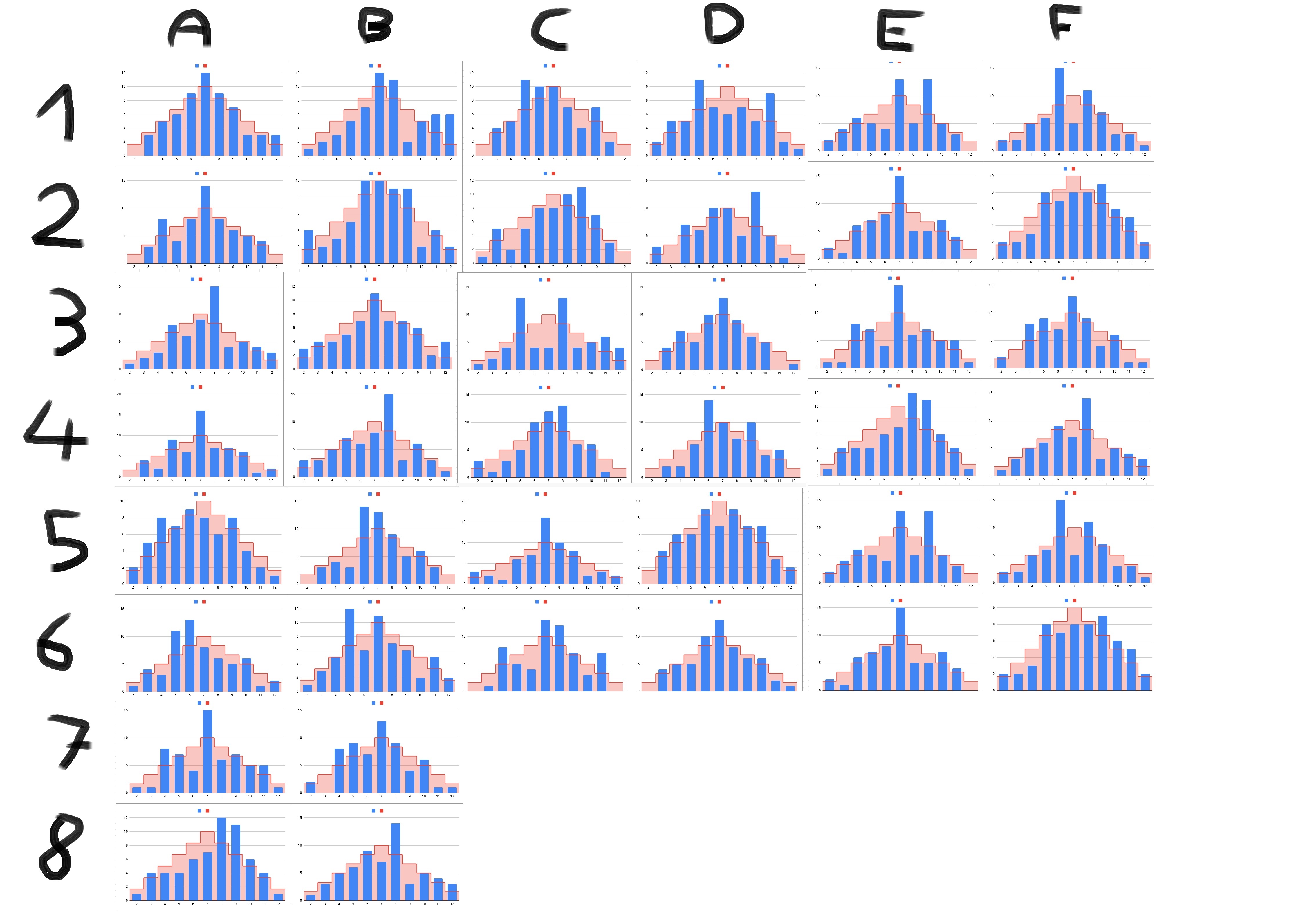
these are great, and also, not one of them approaches what i postedRomain672 wrote: ↑03 December 2023, 22:48 Here is some random distributions with 60rolls:
https://www.zupimages.net/up/22/29/xu8k.jpg

You are not the first person and you won't be the last. And every time I see people like you claim that they understand randomness. And it appears that they have no clue how many biases they have about how randomness "must" work.yfimc wrote: ↑04 December 2023, 16:42You're being rude and condescending. If I say I know how random numbers work, believe me. I find the games I play on BGA do not match the distribution of rolls of the games I play in real life.Stroom wrote: ↑04 December 2023, 07:33 You clearly don't know how randomness works
There are probably hundreds of Catan games being played on BGA. And a few of them have skewed distributions. Those are what are posted about. People get angry but they don't mention the majority of somewhat OK distributions.
70 rolls IS very few for Catan. I specifically used 4 coin flips vs 70 die rolls. Because if you roll 2 dice then you get one full set of all possibilities in 36 die rolls. x2 = 72 so it is comparable to 4 coin flips as one coin flip has 2 possibilities. If you roll dice 36 times, would you get every possible combination? No. 2 or 12 can clearly be missing at such a small set of results. And even with x2 as many rolls, some of those can be missing.yfimc wrote: ↑04 December 2023, 16:4270 trials is not very few. 4 is few. 70 is a lot and you should expect the numbers to approximate a bell curve.Stroom wrote: ↑04 December 2023, 07:33 If you do a coin flip 4 times and you get 3 heads, 1 tails or even 4 heads, it would seem very irregular. But in the grand scheme, it is expected to happen quite often. Similarly, a game of Catan lasts for about 70 rolls. Which is about 2 sets of combinations for 2 die rolls. Very few turns so you won't get a perfect bell curve in every game.
And like I said that is not the first game where I got a strange distribution, that's just the one where I finally came to the forums.
Not wild at all. This is how people who don't understand randomness, often think.
I have learned enough about different RNGs, including the one BGA uses, from the previous 10 times I have had this conversation on different platforms. RNG systems are random enough for a dice roll that is rounded down to 1-6 while it could be used for a random number in the billions. You should be much more worried about your physical dice and the way you roll them.yfimc wrote: ↑04 December 2023, 16:42I'm not saying it's not fair, I'm saying it's not seeming to behave as though it's random based on my experience in 150 games. And what I'm hearing from folks responding is you have faith in the RNG technology on BGA, and no faith in people's experiences so you blindly trust that the RNG will produce a normal distribution over time, but nobody has actually verified that.Stroom wrote: ↑04 December 2023, 07:33 For sure, over thousands of games, the averages of dice roll results will resemble a bell curve. Enough has been done already to display the fairness of RNG. But every few weeks another person comes and asks us to re-do these tests. It's like hitting refresh and expecting a different result.
This reminds me of a discussion a couple month back in the backgammon sub-forum where someone claimed certain rolls *never* happened with "real" dice. Well, it just so happens that in real life tournament backgammon they do track the rolls (just as you record moves in tournament chess) and not surprisingly the "anomaly" was also found in recorded games using real dice.
Just a minor nitpick: the limit distribution of 2-dice rolls is not a bell curve, it's a perfect triangular shape; no "round" top, no long tails, just a trivial 1-2-3-4-5-6-5-4-3-2-1 shape. If it's a bell, it's a bell like this: https://fortandfield.com/products/5-1-4 ... ass-finish
I don't know if this would help or cause more issues. On the one hand, people could see the "global" statistics, but if they think someone has gone through the effort of making the Catan dice not truly random for some reason, despite "RND(1,6)" being incredibly easy to code, they're just going to question the global stats.