Page 38 of 67

Re: Freedom of Information

Posted: 10 April 2022, 12:05
by DaffyVina
11:17
Red Cross evacuation effort unable to reach Mariupol

The head of the International Committee of the Red Cross in Ukraine said his team was unable to reach the besieged port city of Mariupol last week despite trying for five days.

Pascal Hundt told Sky News the security conditions were not good which led to the team turning around 20km from the southern city.

He said they collected refugees on the way and private cars joined the convoy under the Red Cross flag, with more than 1,000 people finally reaching Zaporizhzhia.

Many more similar operations will need to take place in the coming days and weeks, he said, adding that the organisation was in touch with Russian and Ukrainian authorities to ensure safe passage was agreed.

The deadly missile attack on a railway station at Kramatorsk on Friday had also made things more difficult with many people using private cars rather than trains, he said.


11:29
Pope Francis calls for Easter truce in Ukraine

Image caption: Pope Francis leads the Palm Sunday Mass in Saint Peter's Square at the Vatican
Copyright Reuters

Pope Francis has called for an Easter truce in Ukraine, leading to negotiations and peace.

"Put the weapons down!", he said at the end of a Palm Sunday service for tens of thousands of people in St Peter's Square at the Vatican.

"Let an Easter truce start," he said.

"But not to rearm and resume combat but a truce to reach peace through real negotiations."

Re: Freedom of Information

Posted: 10 April 2022, 15:35
by DaffyVina
12:08
Two bodies recovered from mass grave near Kyiv, says local official
Earlier we reported that Ukraine said it discovered another mass grave near Kyiv, in the village of Buzova.

A Ukrainian official has since told the Reuters news agency that at least two civilian bodies have been found at the site.

"There are other people who we cannot find," said Taras Didych, head of the Dmytrivka community that includes Buzova.

"They could be in different places, but this doesn't lessen the pain of the loss of loved ones," he added.

There's been no independent confirmation, but several mass graves have so far been found in areas around the Ukrainian capital previously occupied by Russian troops.

There's been international condemnation of Moscow over alleged war crimes, but Moscow denies targeting civilians.


13:20
Ukraine says Russians stole lethal Chernobyl substances

Ukraine says Russian forces who occupied the former Chernobyl nuclear plant stole radioactive substances from research laboratories that could potentially kill them.

Ukraine's State Agency for Managing the Exclusion Zone said on Facebook that Russian troops entered a storage area of the Ecocentre research base and stole 133 highly radioactive substances.

"Even a small part of this activity is deadly if handled unprofessionally," the agency said, adding "the location of the stolen substances is currently unknown."

The BBC has not been able to confirm this independently.

Earlier this week Ukraine's energy minister German Gulashchenko said Russian soldiers exposed themselves to a "shocking" amount of nuclear radiation, saying some of them may have less than a year to live.

"They dug bare soil contaminated with radiation, collected radioactive sand in bags for fortification, breathed this dust," Gulashchenko said on Facebook on Friday after visiting the exclusion zone.

The BBC's Yogita Limaye was among the first journalists to look inside the former nuclear power plant since the Russians left - you can read her report here. (earlier post)


13:40
What victory is there in planting a flag on a pile of rubble? - Pope Francis
Pope Francis celebrates Palm Sunday Mass in Saint Peter's Square, Vatican City, 10 April 2022
Copyright: EPA

More now on Pope Francis' call for an Easter ceasefire to allow for a push for peace in Ukraine.

Speaking at a service for tens of thousands of people at Saint Peter's Square in the Vatican today he said the war was a "folly" that was leading to "heinous massacres" and "atrocious cruelty" against defenceless people.

Pope Francis celebrates Palm Sunday Mass in Saint Peter's Square, Vatican City
Copyright: EPA

Without naming Russia directly, he asked: "What victory is there in planting a flag on a pile of rubble?"

On Wednesday, the Pope condemned the targeting of civilians in Ukraine, calling the discovery of bodies in Bucha near Kyiv a "massacre" and embracing a Ukrainian flag from the "martyred town".

Russia has denied responsibility for the apparent killings of civilians in Bucha, accusing Ukraine of staging them.

Pope Francis leaves after leading the Palm Sunday Mass in Saint Peter's Square at the Vatican
Copyright: Reuters

The Pope has also expressed his willingness to contribute to halting the fighting in Ukraine and said he would be ready to travel to Kyiv.

Re: Freedom of Information

Posted: 10 April 2022, 15:49
by DaffyVina
14:26
Russian convoy pictured east of Kharkiv

Satellite image of Russian military convoy
Copyright: Maxar Technologies

Satellite imagery firm Maxar Technologies has shared pictures of what it says is a large Russian military convoy, located east of Kharkiv.

The images, taken on 8 April, show hundreds of armoured vehicles trucks with towed artillery, and other military vehicles - stretching for at least eight miles (12km) and moving south through the Ukrainian town of Velykyi Burluk.

In a tweet, military analyst George Barrow - with the Institute for the Study of War (ISW) - said the convoy was likely heading south to the city of Izyum.

The BBC has not been able to independently verify this claim.

Russian forces seized the town of Izyum last week and have been using it as a staging ground for an apparent drive toward Slovyansk, a town critical to Moscow’s objective of capturing all of eastern Ukraine.

The ISW says if Ukraine holds on to Slovyansk, Russia's campaign to seize the eastern regions of Donetsk and Luhansk "will likely fail".

Satellite image of Russian military convoy
Maxar Technologies


14:42
Picking up the pieces after deadly missile strike

Jonathan Beale
BBC defence correspondent

A day after more than 50 people died in a missile strike on a train station in the eastern Ukrainian city of Kramatorsk people attempted to pick up the pieces.

The bodies of the dead were soon removed from the scene but you could see the dried blood and some evidence of human remains 24 hours later.

The uncollected travel bags of those who did not survive had been gathered together and lay in an empty ticket office.

Sergei, a volunteer with the Ukrainian Army, is used to death. He's been recovering the bodies of Ukrainian soldiers killed in battle.

But on Friday, he was having to gather the corpses and the remains of unarmed civilians - the innocents of this war. He has no doubt that Russia is to blame for the attack that has left more than 50 people dead and many more injured.

Watching mothers grieve over children killed in the blast had clearly taken its toll on Sergei.

"When you see our future, the future of Ukraine being killed, you can't control your emotions," he said. He calls it a genocide.

"You just don't understand the motivation of the people who did this. What was this for?"


14:57
Dnipro airport 'completely ruined' by Russian missile strike
Russian missile strikes have hit the airport in the central-eastern Ukrainian city of Dnipro and a village in the region, the head of the regional military administration, Valentyn Reznichenko, said on Telegram today.

"There has been another attack on Dnipro airport. It had been completely ruined already, both the airport and infrastructure nearby. But missiles keep flying," Reznichenko said.

He added that an infrastructure facility had been hit in Zvonetske, adding that the authorities were trying to get more information about the damage and casualties.

Re: Freedom of Information

Posted: 10 April 2022, 16:43
by DaffyVina
Ukraine, the UN and history's greatest broken promise
Published1 day ago

A child looks out the window of a train as it arrives in Lviv from Zaporizhzhia on 5 April 2022
IMAGE SOURCE,GETTY IMAGES

Accounts of atrocities committed by Russian troops against Ukrainian civilians are emerging daily. There are calls for President Putin and others to be prosecuted for war crimes - but how likely is that to happen? Given its past record, and failure to stop this war which has seen more than 11 million people flee their homes, the BBC's Fergal Keane considers whether the international community will be able to unite.

Even when the spring sunlight fills the little park, it remains an unsettling place. The Jewish world commemorated at Arsenalna Square in central Lviv was destroyed by genocide. The people who worshipped at the Golden Rose synagogue were either exiled or killed. There is no escape from history here. It is present in the memorial stones for the dead and in the void left by a murdered generation.

In western Ukraine's biggest city, the past collides with the present in other ways too. You can hear it in the rattle of today's refugee suitcases being pulled across the same cobblestoned streets where, in the high summer of 1941, the Germans and their Ukrainian collaborators chased Jews to their deaths. The photos of those days are some of the most terrible of the Holocaust - women being stripped and beaten before jeering mobs, eyes wide in horror, mouths frozen in mid-scream.

We are not in the middle of a new world war, or a Holocaust, but the lessons for the world of that terrible conflict - and the promises made in its aftermath - have a relevance we cannot ignore today. It was a reality framed in scathing terms by the Ukrainian President Volodymyr Zelensky when he addressed the Security Council of the United Nations this week. He reminded his audience that the UN had been established in 1945 to guarantee peace after the horrors of World War Two.

Ukrainian President Volodymyr Zelensky addresses a UN Security Council meeting in New York, 4 April 2022
IMAGE SOURCE,GETTY IMAGES
Image caption, Russia was turning 'the right of veto in the UN Security Council into a right to kill' - President Volodymyr Zelensky told the council on 4 April

Listing allegations of war crimes by Russian troops in Ukraine - summary killings, torture, rape - he called for the council to order a war crimes investigation.

"Are you ready to close the UN?" he asked. "Do you think that the time of international law is gone? If your answer is no, then you need to act immediately."

The threat to the peace of Europe is greater now than at any time since the end of the Cold War in 1989. For nearly a month, I watched families flee westward from Lviv in trains, cars and buses as Russia waged war on their homeland. I listened to survivors from the besieged port of Mariupol talk of a hell on earth with bodies lying in the streets and the cityscape they knew, of shops, restaurants, the Hurov Park with its spectacular fountains, reduced to rubble.

Less than a year ago, I walked through the Hurov with Lyubov Vasilievna and Dominic, her two-year-old grandson. I have known Lyubov for eight years, since the day she was wounded and two other grandchildren - Nikita, 10, and Karolina, six - were killed at the war's beginning in 2014 after Russian-backed forces staged a rebellion in eastern Ukraine against the Kyiv government.

The three of them had been out walking when a shell exploded. In hospital, Lyubov told me she blamed herself for their deaths. "I don't know how I am going to survive this. The images of them are always in front of my eyes," she said.

So, it was heartening to meet her again last year, in a time of relative peace, with a new grandchild. "I am smiling because I live for him now," she told me. "I have someone to take care of. He brings me joy."

Now, as Mariupol is being destroyed, I do not know what has happened to Lyubov and Dominic. I have called and called, but her phone no longer rings.

Aerial view of devastated area of Mariupol, 29 March
IMAGE SOURCE,MAXAR/ GETTY IMAGES
Image caption, A bird's eye view of dozens of destroyed homes in Mariupol

Every day at Lviv railway station I watched for their faces in the crowds of refugees, but there was no sign. Lyubov and Dominic, and the dead Nikita and Karolina, are among many millions failed by history's greatest broken promise. It was made in the aftermath of World War Two and is firmly rooted in the story of Lviv.

In the far western corner of Ukraine, Lviv is a city to remind us of the worst of mankind, but also of what can be done to protect us from the consequences of aggression.

Walk five minutes west from the ruins of the synagogue and you reach a squat two-storey building that was the cradle of the world's most important human rights legislation - the very principles under which President Putin and his armies might yet face judgement.

The law faculty of the University of Lviv was the alma mater of Raphael Lemkin who invented the word genocide to describe the attempt to exterminate "in whole or in part" a national, religious or racial group. Aghast at the Nazi Holocaust Lemkin coined the term in 1944 and, four years later, succeeded in having the UN define genocide as a crime under international law.

His fellow alumnus, Hersch Lauterpacht, was instrumental in bringing about the legal concept of crimes against humanity which was first used to prosecute Nazi leaders at the Nuremberg trials in 1945-46.

Both men were Jewish and studied in Lviv in the early decades of the 20th Century. Lviv was called Lemberg then and was a city of the Austro-Hungarian Empire, home to a cosmopolitan mix of Poles, Ukrainians, Russians and other nationalities from across the empire.

World War One destroyed Austria-Hungary and ushered in an age of instability as Poles, Ukrainians, the Soviet Union and Nazi Germany fought for control of the city. The majority of the remaining Jewish population was wiped out in the Holocaust, among them the relatives of Lemkin and Lauterpacht.

Lviv's Jewish ghetto, created by the Nazis, during WW2 - when nearly all the city's Jews were murdered
IMAGE SOURCE,ALAMY

At the end of World War Two, Lviv came under the rule of the Soviet Union, where it remained until the fall of communism and the creation of an independent Ukraine in 1991.

Although they differed in important respects - Lemkin argued in favour of group protections, Lauterpacht focused on individual rights - their legacies were enshrined in the 1945 UN Charter, which promised to "save succeeding generations from the scourge of war which, twice in our lifetimes, has brought untold sorrow to mankind, and to reaffirm faith in fundamental human rights, in the dignity and worth of the human person…"

Now, Lviv finds itself once more at the centre of a great historical trauma.

I think of that phrase - "the dignity and worth of the human person" - after watching people fight to board trains in the early days of the evacuation of Ukraine. I remember it when I see the images of executed civilians in Bucha, and I wonder what has happened to the dream of the lawyers from Lviv?

We are living in an age where millions are displaced by war. I have seen them jumping from smugglers' boats into the shallows on a Greek beach, shouting with joy that "God is Great". In the Democratic Republic of Congo, Myanmar and Yemen, I have heard civilian victims describe cruel military campaigns.

According to the most recent UN statistics - gathered before the Russian invasion of Ukraine - 84 million people are now forcibly displaced worldwide. The figures reflect an international order in crisis with the UN unable to prevent the murder and abuse of civilians in many regions of the world.

To understand how we have come to this point it is necessary to go back a little to one of the most terrible crimes of our modern era.

Map showing how Ukraine compares to other refugee crises - including Syria, Yemen and Rwanda
Estimated Number of People forced from their home:
  • Ukraine: 11.4m (2022*)
  • Bosnia: 2.1m (1992-5)
  • Syria: 13.7m (2011-2021**)
  • Yemen: 4.1m (2014-2021**)
  • Rwanda: 2.6m (1994)
  • Myanmar: 1.7m (2017-2021**)
* As of 6 April 2022
** Figures up to mid-2021
Source UNHCR

It all happened in Rwanda - genocide, crimes against humanity and mass rape as a weapon of war. In late spring of 1994, I was sent to the small, central African country that had become a vast open-air cemetery. The dead flowed down rivers. They lay piled up in churches. The smell of decomposing bodies hung over abandoned villages.

In the space of 100 days, up to 800,000 people are estimated to have been murdered in the Rwandan genocide. It also sparked one of the worst refugee crises in living memory.

Rwanda happened because a hate-filled elite decided that the solution to the country's problems was to exterminate the Tutsi ethnic minority.

Two weeks into the genocide, with tens of thousands already slaughtered, the UN Security Council voted to reduce the peacekeeping force from over 2,000 members to 270. This came after 10 Belgian peacekeepers were attacked and killed by the Rwandan army. The great powers abandoned Rwanda to its fate.

Refugees at a border crossing between Rwanda and Zaire (now the Democratic Republic of Congo) in 1994
IMAGE SOURCE,GETTY IMAGES

Skulls lined up outside a chapel in Rwanda - as authorities tried to determine the extent of the genocide, 1994
IMAGE SOURCE,GETTY IMAGES

Unlike Ukraine now, Rwanda was a country with little geo-political importance. The US and other powers on the Security Council refused until it was too late to use the word coined by the Lviv lawyer, Raphael Lemkin, because describing the slaughter as "genocide" might have created a responsibility to intervene and protect the victims under Article 1 of the Genocide Convention.

I cannot ever forget the sight of Tutsi refugees huddled a few yards from me outside a municipal office in Butare - a city in southern Rwanda - surrounded by extremist militia and soldiers, and wondering if they would live or die. Many were ultimately slaughtered.

In July 1995, one year after the Rwandan genocide ended, Bosnian Serb forces under General Ratko Mladic murdered 8,000 men and boys when they overran the town of Srebrenica. It happened under the eyes of Dutch UN peacekeepers.

Exhausted and emotional refugees from Srebrenica arriving at a camp in Tuzla, July 1995
IMAGE SOURCE,GETTY IMAGES

A UN camp provided shelter for people who had fled, July 1995
IMAGE SOURCE,GETTY IMAGES

The two genocides of the 1990s - in central Africa and the former Yugoslavia - showed what happened when the Security Council was challenged to live up to words of the UN charter. The promise of 1945 was frustrated by lack of political will and division.

But those terrible years of the 1990s would come to have a profound effect on international law. If there was a failure to prevent genocide it could at least be punished. Tribunals were set up to try the accused of Rwanda and the former Yugoslavia. There were also courts to try those accused of responsibility for mass killings in Cambodia and Sierra Leone.

There were UN military operations to stop the killing of civilians in Sierra Leone and Nato forces intervened to end the expulsion of ethnic Albanians in Kosovo. Although, the latter provoked an ominous confrontation with Russia, an ally of Serbia and already wary of Nato encroachment to the east.

Fergal Keane reporting from Rwanda in 1994

The world moved to establish a permanent court to try cases of genocide and crimes against humanity. The International Criminal Court - the ICC - was set up in 1998 to try the most serious cases of human rights abuses. It is not part of the UN but was created by UN members and works closely with the organisation.

In 2009, in a landmark moment, President Omar al-Bashir of Sudan, became the first sitting head of state to be indicted for genocide by the ICC, for the killing of civilians in Darfur.

Just as at the end of WW2, the idea was that prosecutions might not only provide accountability but would make future war leaders think twice before abusing the rights of civilians.

But there was a problem from day one, and it is one that shadows the current debate about war crimes in Ukraine.

Neither the US, China or Russia ratified the Rome Statute - the treaty that established the court. This means the three biggest military powers are not subject to ICC jurisdiction.

The only way they could be is if the Security Council votes to refer them. But as each nation has a veto, that is never going to happen. It means the ICC would be powerless if it wanted to indict President Putin and his senior generals for the crime of waging an aggressive war against Ukraine. Aggression was described by the Nuremberg tribunal after WW2 as "the supreme international crime differing only from other war crimes in that it contains within itself the accumulated evil of the whole".

It is worth remembering what happened when the court tried to investigate alleged war crimes by all the parties in Afghanistan. The Trump administration went as far as placing sanctions on the chief prosecutor of the ICC to signal its opposition to any judicial pursuit of US forces.

And - in China's autonomous region of Xinjiang - an attempt to investigate Chinese officials for the alleged genocide against the Uyghurs failed because China was not an ICC member.


Photo: Philippe Sands QC
International lawyer and author
Alamy
A lopsided international order - one rule for the weak, one rule for the strong - is ultimately not a sustainable legal order

The war crimes lawyer, Prof Philippe Sands QC, believes the attitude of the superpowers creates "lopsided justice" where the only prosecutions are those involving less powerful nations.

"One rule for the weak, one rule for the strong - is ultimately not a sustainable legal order or even really a legal order," he says.

Prof Sands' grandfather came from Lviv, and his great-grandmother was murdered by the Nazis. He is among those looking at the possibility of setting up a special international tribunal to indict the Russian president and his commanders.

But the legal framework is not the only issue that hangs over the current debate about the Russian invasion of Ukraine. Even some supporters of prosecuting President Putin acknowledge a charge of double standards against the US and the UK.

Prof Sands points out that the invasion of Iraq in 2003 by a US-led coalition polarised world opinion. The then UN Secretary General Kofi Annan would later call the invasion illegal. "You reap what you sow - and what you sow includes your own double standards," he says.

The British and American governments insisted the invasion was legal.

But President Putin used the Iraq example as a rhetorical stick to beat the US and UK when he announced his decision to attack Ukraine, declaring that there was a "special place" for the invasion of Iraq - which had been carried out "without any legal grounds".

In reality, there has never been a golden age of post-war peace guided by international diplomacy. The big powers have not fought an apocalyptic nuclear war but millions have died in wars big and small - in Korea, Algeria, Congo, Cambodia, Vietnam, Algeria, Indonesia, Angola, Ethiopia, Afghanistan, Iraq, Syria, Libya and many other battlegrounds. Some of those wars have been - at least partly - proxy conflicts between superpowers. More than 4,000 UN peacekeepers have lost their lives in different conflict zones trying to protect civilians and act as a buffer between warring parties.

US soldiers in a burning village during the Vietnam War, circa 1965
IMAGE SOURCE,GETTY IMAGES

Rather than being a place where the great powers consistently work for peace, the Security Council, too often, became a forum of superpower rivalry. Ukraine is just the latest dangerous example.

On 26 February, two days after the Russian invasion began, the Security Council met to discuss a resolution calling on Moscow to stop its attack and withdraw all troops. Russia vetoed that move for peace.

In a singularly ominous moment, President Putin implicitly threatened to use nuclear weapons to deter any intervention by Nato. Whether he intends to deploy nukes or not, the simple issuing of such a threat reflects the perilous state of human affairs in the 21st Century.

The current UN Secretary General, António Guterres, sounded almost forlorn when he declared: "We must never give up. We must give peace another chance." But even some of those critical of the Security Council, argue that this can also be a moment of possibility - if, for example, a special tribunal can be set up to investigate a superpower like Russia for its actions.

"I am partly fearful but also partly optimistic," says Prof Sands. "This period could destroy the [legal] order created by the 1945 moment [the defeat of Nazism] or it might develop and strengthen it. I am inclined to the latter view. It's a long game. Two steps forward and one back, then another forward. We just have to stick to a principled approach."

In mid-1945, delegates from 50 nations met in San Francisco to agree the UN Charter - and it was where Sir Anthony Eden, who led the British delegation, learned of the death of Adolf Hitler
IMAGE SOURCE,GETTY IMAGES

There have also been important signs of change at the UN in recent days. The General Assembly - the body made up of all 193 UN members - condemned the invasion and voted to remove Russia from the UN Human Rights Council. China voted against the move and India abstained - between them they represent a third of the world's population. And while the decision doesn't affect what the Security Council does or does not do, the moral signal from more than two thirds of UN members was clear.

One former UN official with experience of genocide and war crimes told me that it was a mistake to see the present world order solely through the lens of big power politics. Prof Mukesh Kapila of the University of Manchester is a former UN representative in Sudan and was instrumental in the campaign to have the killings in Darfur recognised as genocide.

"In the struggle between right and wrong, good and evil, there is a lot of activity. It is not all going on the side of the bad guys," he says. He points to the case against Myanmar at the International Court of Justice - a UN court established in 1945 where one state can bring action against another. Myanmar is being pursued by the small west African nation of The Gambia for alleged persecution of the Rohingya Muslims.

Prof Kapila also cites the development in recent years of "universal jurisdiction" - where individual nations can try alleged war criminals from other countries if they arrest them on their soil. The successful German prosecution last January of a Syrian officer for murder, torture and sexual assault is recent example.

If the Security Council is deadlocked, then why not create a mechanism where one member can take it to a bigger jury - the General Assembly
Photo: Prof Mukesh Kapila
Former UN representative in Sudan
Getty Images

Calls for reform of the UN Security Council are not new. It has long been criticised for representing the imperial and superpower realities that prevailed at the end of WW2. There is no permanent representation for Africa, the Indian sub-continent or Latin America.

Expanding the UN's top body would not at a stroke remove the potential for great power rivalry. But Prof Kapila suggests one way around the stalemates created by veto powers would be to strengthen the role of the General Assembly - the body that has just acted against Russia.

"If the Security Council is deadlocked, then why not create a mechanism where one member can take it to a bigger jury - the General Assembly. It is more democratic, and it also increases pressure on the Security Council to reach an agreement."

There seems little prospect at the moment of the "Permanent Five" - China, France, Russia, the UK and US - agreeing to dilute their influence. "Turkeys don't vote for Christmas," as Prof Kapila puts it. But he argues that civil society movements have established powerful pressure for progress in recent years - in the area of climate change, for example. "Things which seem improbable now can become real."

A protester with a Ukrainian flag demonstrates outside the UN headquarters in New York
IMAGE SOURCE,GETTY IMAGES

At the heart of the promise made in the UN Charter was the idea that countries must work together to avoid war. If armed conflict did break out they would send forces to try to keep the peace and the world would ensure abuses were prosecuted - both for the sake of justice and to deter future crimes.

It is possible - no more than that - that the crisis in Ukraine becomes one of those moments where the high stakes of conflict create a genuine moment of international reflection and generate a momentum for change. Before she stepped down from power, the German Chancellor Angela Merkel wistfully reflected on a world where unilateral action by states threatened peace and stability.

Mrs Merkel, who grew up in East Germany before the fall of the Berlin Wall and in the looming shadow of superpower rivalry, warned of the dangers of forgetting - especially as those with lived experience of WW2 died away.

"We have to take care now not to enter a historical phase in which important lessons from history fade away. We have to remind ourselves that the multilateral world order was created as a lesson from the Second World War."

Remember where we have come from, was the message, and act so that we are not dragged backwards.
Re: Freedom of Information

Posted: 10 April 2022, 18:43
by DaffyVina
16:19
More than 1,200 bodies discovered in Kyiv region
Ukraine's prosecutor general says 1,222 bodies have been found in the Kyiv region since Russian forces withdrew from the area.

Iryna Veneditktova told Sky News, Ukrainian authorities are investigating 5,600 cases of alleged war crimes committed by Russian troops since the invasion began, and it had identified over 500 suspected war criminals, including top military and government officials in Russia.

"What we see in all regions of Ukraine is war crimes, crimes against humanity, and we do everything to fix it," she says.

She adds that Ukraine has evidence that Russia carried out a missile attack on a train station in the eastern city of Kramatorsk, which killed more than 50 people who were waiting for a train to take them west, to relative safety.

Russia has denied it was responsible for Friday's attack and claims that it wasn't their missile. It has also denied targeting civilians.


16:43
More than 4.5 million refugees have fled Ukraine
Ukrainian refugees walk after crossing the Ukraine-Poland border, amid the Russian invasion of Ukraine, in Medyka, Poland, April 10, 2022
Copyright: Reuters

More than 4.5 million Ukrainian refugees have fled their country since the Russian invasion on 24 February, according to the United Nations refugee agency (UNHCR).

The UNHCR said there were 4,503,954 Ukrainian refugees on Sunday - 62,291 more than the previous day.

It says Europe has not seen that number of refugees since World War II.

90% of those who have fled are women and children, as most men aged 18-60 are not allowed to leave Ukraine as they must stay and join the resistance.

According to the UN's International Organization for Migration (IOM), around 210,000 non-Ukrainians have also fled the country, sometimes encountering difficulties returning to their home countries.

A further 7.1 million people have been displaced within the country, according to figures published by the IOM on 5 April, meaning more than a quarter of the population have been forced to flee their homes.

Poland hosts by far the largest number of refugees from Ukraine, with 2,593,902 people crossing into Poland since the start of the war, the UNHCR said.


17:00
Russia boosts conscription efforts in Donbas region
BBC Monitoring

Russia has stepped up its "mobilisation" campaign in the eastern Donbas region and started to draft men who are not eligible for conscription, the Ukraine's military intelligence service has said on the online messaging platform, Telegram.

The agency said that employees of "strategic enterprises", who had previously been exempt from military service, were now being drafted.

It noted that the Russians plan to mobilise about 1,700 employees of the Alchevsk steelworks alone, and workers responsible for maintaining power lines were no longer off the hook for military service.

According to the Main Intelligence Directorate, several mobile brigades are operating in the self-proclaimed Luhansk People's Republic, where they stop men and issue them with a summons to come to a military enlistment office.

Earlier, the UK's Ministry of Defence said in its latest public intelligence update that Russia was trying to boost troop numbers with personnel discharged since 2012.


17:24
BREAKING
Austrian Chancellor to meet President Putin in Russia on Monday
Austrian Chancellor Karl Nehammer will travel to Russia tomorrow to meet President Vladimir Putin, an Austrian government spokesperson has said according to the Reuters news agency.

It follows Nehammer's visit to Kyiv on Saturday to met Ukrainian President Volodymyr Zelensky.

We've got a little more now on Austrian Chancellor Karl Nehammer's trip to meet Vladimir Putin in Moscow on Monday.

"He is going there, having informed Berlin, Brussels and Ukrainian President Volodymyr Zelensky" to encourage dialogue, a spokesman for Nehammer said.


Posted at 18:2918:29
Red Hot Chili Peppers show support for Ukraine
Boxer turned Ukrainian fighter Wladimir Klitschko has thanked US rock band the Red Hot Chili Peppers for their support for Ukrainian refugees.

Referencing their song Can't Stop, which he used as his entrance music for part of his boxing career, the brother of Kyiv mayor Vitali Klitschko says: "The world 'Can't Stop' caring, all support matters."

The Californian rockers had called on world leaders and people around the world to support refugees in a tweet.

Re: Freedom of Information

Posted: 11 April 2022, 07:46
by DaffyVina
18:57 10 Apr
Russia declares overnight missile strikes in Ukraine regions
The Russian Ministry of Defence claims it carried out attacks on 86 military units in Ukraine on Saturday night, in a statement released on Sunday.

They were in the central-eastern city of Dnipro, the southern Ukrainian city of Mykolaiv, and Ukraine's second-largest city, Kharkiv.

According to spokesman Major General Igor Konashenkov, the list of affected sites includes:

two control points
two ammunition warehouses
three combustion warehouses
49 Ukrainian military equipment and support points
It said eight Ukrainian unmanned aircraft were shot down in the air.

The BBC has not been able to independently verify the claims.


19:29 10 Apr
Chernobyl finally has a staff change
There have been concerns about safety at the former plant since the Russian occupation
Copyright: Getty Images

A staff rotation has been carried out at the Chernobyl nuclear power plant for the first time in three weeks, Rafael Mariano Gross - the Director General of the International Atomic Energy Agency (IAEA) - told Ukrainian officials today.

The former nuclear power plant - and the site of the world's worst nuclear disaster in 1986 - was taken over by Russian forces on the first day of the invasion. About 170 Ukrainian national guards were held captive in the basement and used to secure the facility, which is now back under Ukraine's control.

Workers told the BBC that they struggled to maintain the plant, sleeping in makeshift dormitories and stealing Russian fuel to keep the generator running and the station safe.

Gross said the IAEA would send a mission to Chernobyl soon to do a radiological assessment.

Earlier, we reported that Russian forces occupied the defunct power station and stole radioactive substances from research laboratories that could potentially kill them.

However, Ukraine's state nuclear energy company, Energoatom, said in early April the Russian forces had left the plant.

On Sunday, the IAEA said it had received more information about damage to the site's radiation monitoring labs, saying the premises were "destroyed and the analytical instruments stolen, broken or otherwise disabled".


19:58 10 Apr
BREAKING
Death toll after train station attack rises to 57

The death toll from a missile attack on a train station in the city of Kramatorsk has risen to 57, the regional governor has said.

Pavlo Kyrylenko added that a further 109 people were wounded in the strike.

"Those with minor injuries have been released to go home, the heavily injured are being transported to safe regions and being provided with the necessary aid," he said.

The attack took place as thousands of Ukrainians - mainly women and children - were waiting for a train to take them west, to relative safety.

Russia has denied accusations that it was responsible. Instead it suggests that the missiles were Ukraine's.


20:30 10 Apr
First EU leader to meet Putin since invasion began

The Austrian Chancellor, Karl Nehammer, will travel to Moscow tomorrow for talks with Vladimir Putin.

He'll be the first EU leader to meet the Russian president in person since the invasion of Ukraine.

Austrian officials say Nehammer wants to promote dialogue between Moscow and Kyiv and will also raise the issue of war crimes.

He met his Ukrainian counterpart, Volodymyr Zelensky on Saturday.


21:26 10 Apr
Ukraine's economy to shrink by 45% - World Bank

The World Bank says it expects Ukraine's economy to shrink by 45% this year as a result of the war.

It's also forecasting that there will be greater economic damage than was caused by the Covid-19 pandemic across eastern Europe and central Asia, with unprecedented sanctions leading to a steep recession in Russia too.

Much of Ukraine's workforce has been forced to flee or fight.

Businesses have closed, while roads, factories and other infrastructure has been destroyed and the World Bank says many years of progress have been undone.

Ukraine was a major source of crops such as sunflowers and wheat but with exports brought to a halt global food prices have risen and Ukraine has lost an important earner.

Sanctions against Russia mean the World bank is forecasting its economy to shrink more than 11% this year.


22:18 10 Apr
UK armoured trucks delivering aid to Ukraine
Photo of armoured trucks in Gloucester
Copyright: Alastair Chambers

A pair of armoured trucks - formerly used to transport diamonds and other valuable items - are being used to take aid from the UK to the front-line in Ukraine.

The vehicles were bought with donations organised by two Gloucester City Council members, and left the English city on Friday afternoon for the long trip across Europe.

They've been fitted with bullet-proof glass and stacked "top to bottom" with items including combat tourniquets, mine detection kits and bulletproof vests.

"We are here to save lives," said Councillor Alastair Chambers, who helped raise money to buy the trucks.


0:30
Russia is afraid to admit 'cowardly' mistakes - Zelensky

In his nightly Facebook address on Sunday, Ukraine's President, Volodymyr Zelensky, leveled accusations of torture and cowardice at invading forces and told his citizens to prepare for Russia to conduct "even larger operations in the east of our state".

"They can use even more missiles against us, even more air bombs," he said. "But we are preparing for their actions. We will respond."

He dismissed Russian claims that civilian deaths across Ukraine were the result of Ukraine's own military strikes, calling them a sign of Russia's weakness.

"They say about the murders in Bucha that it is not them, but allegedly us," he said. "Do you know why this is so? Because it's cowardice."

He added: "They are afraid to admit that Russia's entire policy toward Ukraine has been erroneous for decades."

The Ukrainian leader said that in order not to admit mistakes, Russia had made new mistakes: "They deprived themselves of any political tools and, unwilling to give up unrealistic ambitions, started this war."

"It all came from cowardice," he continues.

"When cowardice grows, it turns into a catastrophe. When people lack the courage to admit their mistakes, apologise, adapt to reality, learn, they turn into monsters. And when the world ignores it, the monsters decide that it is the world that has to adapt to them.

"Ukraine will stop all this."


2:22
Unverified video shows Mykolaiv explosion
Video posted online purports to show the moment a large explosion hit the southern city of Mykolaiv.

The footage has not been verified by the BBC.

On Sunday, Russia announced strikes against the cities of Mykolaiv and Kharkiv - Ukraine's second-largest city.

Re: Freedom of Information

Posted: 11 April 2022, 07:49
by DaffyVina
3:01
MSF hospital train conducts rescue mission to Ukraine's east

Evhen Perepelytsi lost a leg outside his home
Copyright: Getty Images
Image

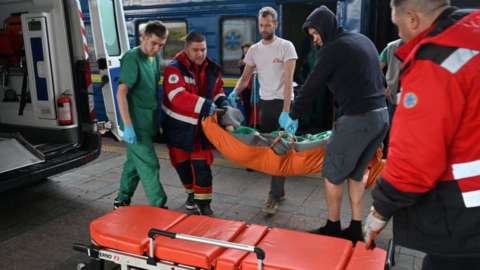
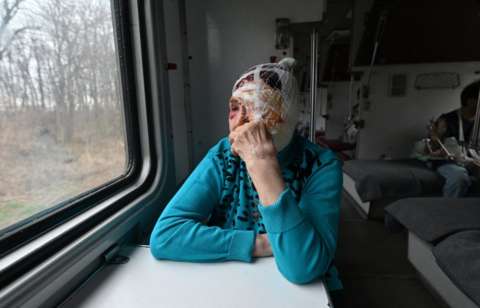
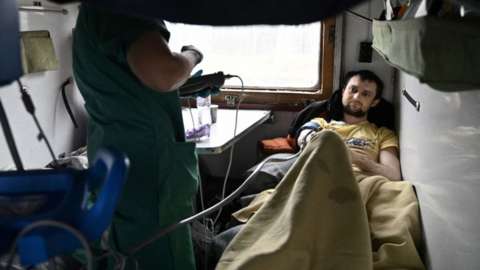
A train-turned-hospital has rescued 48 wounded and elderly patients from eastern Ukraine, in the first such evacuation from the east since a missile killed 57 people at a train station in Kramatorsk on Friday.

The train journey was organised by charity Doctors Without Borders (MSF), and was their fourth operation of the war.

Evhen Perepelytsi, 30, was on the train, after losing a leg to Russian shelling outside his home in Hirske in eastern Luhansk.

"We hope that the worst is over - that after what I've been through, it will be better," he told AFP News.

Perepelytsi said the shell landed near him just as he was discussing leave home to join his three children who had already fled west.

"We couldn't save his leg, but we saved his life," added his wife Yuliya.

Of the 13 medical staff members on board the train, most were Ukrainian. MSF said they plan to send the rescue train east again as soon as Sunday night.

Patients that couldn't walk were carried onto the train
Copyright: Getty Images
Image

MSF plans to send the train east for more patients as soon as Sunday night
Copyright: Getty Images
Image

Re: Freedom of Information

Posted: 11 April 2022, 07:56
by DaffyVina
4:01
Air raid sirens go off across Ukraine - local media
It's just past 06:00 in Kyiv - and in a scene that is now familiar to many in the country, air raid sirens have sounded across Ukraine, including the regions of Lviv, Kyiv, Dnipro, and Zaporizhzha, say local media reports.

This comes as Ukrainian President Zelensky has warned his countrymen to prepare for Russia to conduct "even larger operations in the east of our state".


5:42
Chechen leader says Russia aiming to take Kyiv
The head of Russia's republic of Chechnya Ramzan Kadyrov said that an offensive will be unleashed not only on Mariupol but on the capital Kyiv and other Ukrainian cities.

In a video posted on his Telegram channel early on Monday, Kadyrov said he would "fully liberate [the eastern regions of Luhansk and Donetsk]... and then take Kyiv and all other cities.

"I assure you, not one step will be taken back," he said.

This comes as the conflict in Ukraine has shifted east where Ukrainian forces are battle-hardened and well-prepared.

Russian officials have said that the focus of its forces is now the "complete liberation" of the Donbas, broadly referring to Luhansk and Donetsk.


6:56
Russia likely to carry out 'provocative actions' in Moldova - Ukrainian military
In its daily military update. the Ukrainian armed forces have said Russian forces will continue to strike transport infrastructure facilities in order to disrupt the flow of goods to the country. Here's what else they've said:

Russian forces could carry out "provocative actions" in the Transnistria region of the breakaway state of Moldova in order to accuse Ukraine of aggression against a neighbouring state
Russian troops continue to have a partial blockade in Kharkiv, with shelling continuing in some parts of the city
In the besieged port city of Mariupol, Russian forces have continued storming the Azovstal plant, one of the country's largest iron and steel plants
In the past 24 hours, Ukrainian forces have repelled four enemy attacks in the Donetsk and Luhansk regions
They have also destroyed five tanks, eight armoured units, six vehicles and eight enemy artillery systems
In a separate update, Ukrainian military say Russian forces have lost around 19,500 personnel in combat since 24 February
The BBC has not been able to independently verify these claims.


7:27
Russia could use phosphorus munitions in Mariupol - UK

The UK has warned of a possible use of phosphorus munitions by Russia as fighting intensifies for the besieged Ukrainian city of Mariupol.

In its regular morning briefing, Britain's Ministry of Defence said such weaponry had already been used in the Donetsk region.

These arms are noted for the "severity of the injuries" they cause, according to Human Rights Watch (HRW). Phosphorus bombs behave the same way as incendiary weapons, says HRW, which are banned from use in urban areas under international law.

The British update also said Russia was “greatly risking the risk of further civilian casualties”, due to its “continued reliance on unguided bombs” which made pinpointing exact targets difficult.

The UK added that shelling was continuing in the eastern Donetsk and Luhansk regions. But it said Ukrainian forces had repulsed several assaults.

Re: Freedom of Information

Posted: 11 April 2022, 08:01
by DaffyVina
Ukraine village scarred by aftermath of occupation
By Mark Lowen
BBC News, Andriivka
Published9 hours ago

Photo: destroyed building
Image caption, Many buildings in Andriivka are a mess of rubble

The day after Anton Ischenko celebrated his 23rd birthday, he was taken by the Russians, led away at gunpoint from his home in the village of Andriivka, west of Kyiv.

His family found his body a month later, once the Russian troops were driven out. He was so badly mutilated that they had to identify him by his clothes.

As Russian forces retreat to eastern Ukraine, horrors are being uncovered in the villages which they left.

About 1,000 people lived in Andriivka, some 60km away from the capital. At least 40 of them were killed.

"He was a very nice boy, very clever - he recited poetry," recalls Anton's grandmother, Tetiana, sitting outside the family house. Suddenly, her exhausted face crumples.


Photo: Tetiana being comforted
Image caption, Tetiana is grieving for her grandson

"Maybe if he had gone to fight somewhere else, he would have returned here in one piece," she says, struggling to speak through her tears. "When my husband told the Russians, 'Take me instead,' they pointed a machine gun at him and said, 'Go home - or we will take you both.'"

Andriivka, on the route up to the Belarus border, has been blighted by battle and the month-long occupation. Buildings are ripped apart amid a mess of rubble and mangled metal.

Craters lie in the dirt road where tanks were blown up. Remnants of artillery lie beside corpses of chickens and rabbits.

Burnt-out armoured vehicles lie at either end of the village. It is a scene of utter devastation.


Photo: Grigoriy
Image caption, Grigoriy Klymenko stayed throughout the occupation

With the Russians pushed out, some residents are beginning to return - or emerge from shelters. On the main road, beside wooden boxes that contained grad missiles, Grigoriy Klymenko is taking in the sight of destruction.

He decided to stay throughout the occupation to be with his 90-year-old mother, who is bedridden. They had watched in terror as tanks encircled the village.

"They're animals," he says of the forces that moved in. "Humans don't behave like this. My parents told me about the war and the fascists didn't even do such things."

Next door, Leonid Koval and his son are beginning to repair their damaged house, retiling the roof and fixing plastic sheeting into blown-out windows. Russian soldiers stayed in his home - and looted it.


Photo: Leonid on a ladder
Image caption, Leonid Koval and his son have begun repair work

Inside, the cupboards lie wrenched apart by the Russian occupiers, boxes of photographs and clothes turned upside down. Cushions were ripped from the sofa. The soldiers emptied everything they could find.

When the Ukrainian army began to push towards Andriivka, the Russians staying there moved out of the main house and into the tiny cellar to hide.

Leonid takes me down to the cold and dark space, the mattresses and blankets they used still stuffed against the wall. To one side are the open packets of biscuits and jars of pickled fruit they feasted on.

As he surveys the damage to his home, Leonid breaks down. "I don't know what they were looking for," he says, "they just destroyed everything. I have no words to describe what they did."


Photo: Destroyed oven
Image caption, Andriivka is a scene of devastation

The scarred villages and towns near Kyiv and Chernihiv in northern Ukraine, from where the Russians have retreated, are now sites of possible war crimes. Andriivka joins a growing list - with Bucha, Irpin and others - which bear the hallmarks of deliberate targeting of civilians and other atrocities banned by the rules of war.

And they are grim omens of what may be in store in the east, where Russian forces are now intensifying their attacks ahead of a new offensive. What nightmares will be found there once the shroud of war finally lifts?

On the edge of Andriivka cemetery, the remains of Tetiana's grandson, Anton, lie in a fresh grave. His family have only now been able to bury him. The 23-year-old was studying to become an electrician.

"We wanted to bury him separately and with a priest, not just in a mass grave," she says. "I had two daughters, so he was our boy. We only had one boy."

Re: Freedom of Information

Posted: 11 April 2022, 12:50
by DaffyVina
8:50
New Zealand sends team to help Ukrainian aid effort

Further support for Ukraine will arrive from afar – after New Zealand said it was sending a defence force plane and 58 personnel to Europe.

The team planned to transport equipment and supplies throughout the continent, but would not enter Ukraine itself, a government statement said.

Referring to the Russian invasion, Prime Minister Jacinda Ardern said: “Such a blatant attack on a country’s sovereignty is a threat to all of us.”


9:11
Two Ukrainian aircraft among latest Russian targets
Russia has shot down two Ukrainian aircraft near the city of Izyum, the Russian defence ministry is quoted as saying.

And missile systems provided to Ukraine by an unnamed European country have been destroyed near Dnipro, with 25 Ukrainian soldiers hit as well, according to the Interfax news agency.

Four Ukrainian drones and a helicopter are said to have been taken out in other eastern areas of the country as well.

The BBC has not been able to independently verify the claims.


9:48
Nine humanitarian corridors agreed for Monday
Emergency workers remove debris of a destroyed building in Mariupol
Copyright: Reuters
Image caption: An exit route from the besieged city of Mariupol has been agreed

More Ukrainians are set to leave besieged eastern regions today after nine humanitarian corridors were agreed between Ukrainian and Russian officials.

The routes will be used to evacuate people from Mariupol and other south-eastern cities to Zaporizhzhia, and from multiple cities in the Luhansk region to Bakhmut.

A further six trains have been scheduled to move people out of Donetsk and Luhansk.

Ukrainian authorities have stepped up their efforts to evacuate residents in the Donbas, as Russia's military offensive shifts to the east of the country.

Earlier, a hospital train run by the medical charity Doctors Without Borders evacuated 48 wounded patients to Lviv in the west.


10:10
Tough month ahead for Kharkiv - Ukrainian security analyst
A building destroyed after shelling in Kharkiv on 10 April
Copyright: EPA
It will be a tough month for Kharkiv, according to a Ukrainian security analyst who lives in Ukraine's second-largest city.

Speaking on BBC Radio 4's Today programme, Maria Avdeeva said there had been intense shelling in the north-eastern city and surrounding towns for the last three days, with 11 people killed so far, including a seven-year-old child, according to official reports.

"They're using new types of bombs, these are the bombs that will be dropped down with parachute at midnight, that mean that you will not hear the sound of the bomb coming down, so that makes it especially dangerous," she said.

She fears that Russian troops will advance from the city of Izyum - which is under Russian control - in the south east and take Kharkiv.

But she added that Russian troops are struggling with shortages of resources and military personnel, and so it is uncertain whether they will attempt to take the city.

However, even if troops decide not to take the city on the ground, she said they will continue attacking the city from the air, "attacking civilians deliberately."