Page 59 of 67

Re: Freedom of Information

Posted: 14 May 2022, 18:26
by DaffyVina
Bloody river battle was third in three days - Ukraine official
By Sophie Williams and Olga Pona
BBC News, Lviv
Published 23 hours ago

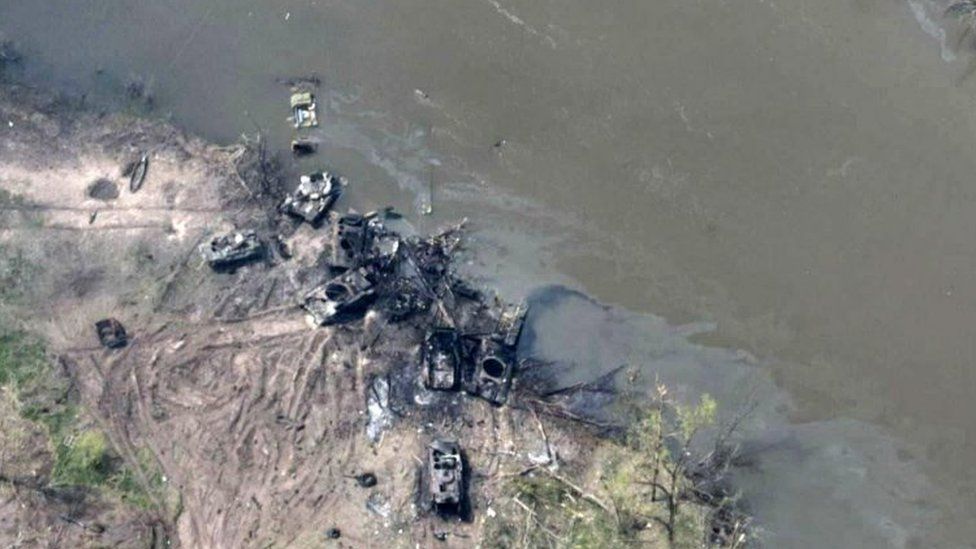
A photo allegedly showing burnt out Russian tanks
Image source, Ukrainian Airborne Forces Command
Image

A failed river crossing where a Russian battalion lost almost all its armoured vehicles was the third such attack in three days, a Ukrainian army official has told the BBC.

Serhiy Hayday, head of the Luhansk Regional Military Administration, said Russia was trying hard to cross the Siversky Donets in order to encircle a strategic east Ukrainian city.

But he claimed that in days of intense battles, local forces had destroyed speed boats and helicopters and "ruined Russian boat bridges three times".

Images from the scene show dozens of burnt-out armoured vehicles on the banks of the river.

Ukrainian information service, InformNapalm, said that Russia began its crossing attempt on 8 May.

But as soon as they crossed, Ukrainian forces destroyed the pontoon bridge in the water, and Russian troops "fell into the trap", it said.

The UK ministry of defence claimed on Friday that the incident - which it said was a "highly risky" attempt to cross the water - revealed the pressure Russian commanders were under to make progress.

The river flows through the Donestsk and Luhansk regions - both major Russian military targets.

Moscow has not yet commented on the attacks, and the BBC has not independently verified Mr Hayday's account of the battles.

But the official described "a great accumulation" of Russian troops making repeated attempts to encircle Ukrainian forces.

"We still can't bring down Russia's offensive pace," he said. "Russia continues to attack in this direction, and we are forced to defend ourselves."

In repeated attacks, Ukrainian troops had "eliminated approximately 70 units of Russian heavy weapons and equipment", disrupting attempts to cross.

It isn't clear how many Russian soldiers were killed in the battalion, which would typically consist of more than 500 troops.

Image

Crossing the river, is a vital move to surround Ukrainian troops and take important cities such as Severodonetsk, according to analysts.

Oleh Zhdanov, a Ukrainian military expert told the BBC: "If they take this crossing, cross the river in this area, it allows the Russian Federation to further advance to the estuary. The advance towards Severodonetsk is the plan they have come up with."

Severodonetsk is important to the Russians because controlling it would enable Russia to drive west and link up with Russian forces pushing south-east of Izyum.

Despite the destruction on the banks of the Siversky Donets, Russian troops are making progress in nearby areas.

Mr Hayday said Moscow's forces had taken the town of Rubizhne and that the national guard was attempting to defend the outskirts of the town.

"Russians are doing their best to eliminate our fighters, but they are not able to do this," he said. "Ukrainian positions are still very strong there," he said.

Meanwhile, in another area of eastern Ukraine, Ukrainian forces have driven back Russian troops from the second-largest city of Kharkiv.

It is thought to be the fastest advance since Russian forces pulled away from Kyiv more than a month ago.
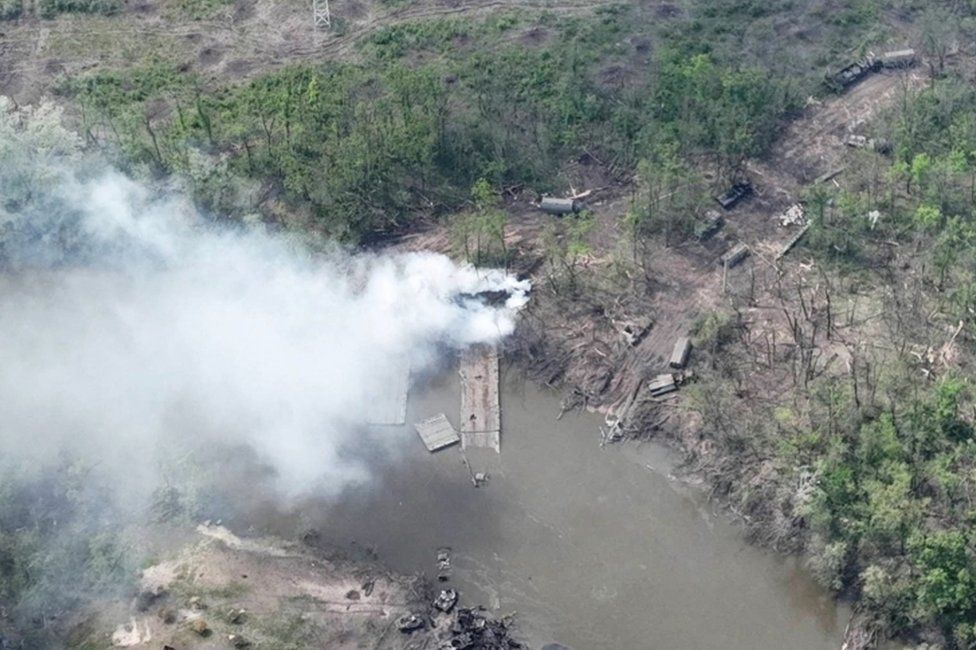
Image
Photo showing destroyed pontoon bridgeImage source, Reuters
Image caption, Crossing the river, is a vital move to surround Ukrainian troops and take important cities such as Severodonetsk, according to analysts


Ukraine war round-up: Carnage at the river and a war crimes trial
By Patrick Jackson
BBC News
Published 19 hours ago

A woman shows damage at her house as Russian attacks continue in Chernihiv Oblast, Ukraine on May 12, 2022.
Image source, Getty Images

The toll of the fighting on both Ukraine's health sector and Russia's invading army made sobering reading on the 79th day of the war.

Russian forces were accused by Ukrainian MPs of completely destroying more than 100 healthcare facilities since the invasion started on 24 February.

British military intelligence said a single Russian battalion had recently lost almost all of its armoured vehicles during a failed attempt to cross a river in the eastern war zone. Aerial images showed dozens of burnt-out tanks and the remains of a pontoon bridge.

BBC News Russian has been able to verify the deaths of 2,336 Russian service personnel since the start of the invasion.

Moscow's forces made gains elsewhere, reportedly taking the strategically important town of Rubizne.

In Kyiv, Ukraine started its first war crimes trial since the beginning of the invasion, putting a 21-year-old Russian soldier in the dock and accusing him of killing an unarmed civilian.

Western sanctions on Russia got more personal when the UK placed travel bans and asset freezes on Russian President Vladimir Putin's former wife, Lyudmila Ocheretnaya, and his alleged current girlfriend, Alina Kabaeva.

And a Russian energy supplier said it would suspend deliveries of electricity to Finland from Saturday, one day after the Finnish president said he supported an application for Nato membership.
Re: Freedom of Information

Posted: 14 May 2022, 18:54
by DaffyVina
9:38
People returning to homes in Kharkiv region - governor
Sophie Williams
Reporting from Lviv
A local woman and a girl walk past a residential building damaged during shelling in Kharkiv,
Copyright: EPA

The governor of the Kharkiv region in the east of Ukraine says that armed forces are pushing back the Russians and people are beginning to return to their homes.

But Oleh Synyehubov also warned that the situation there is still dangerous and people should consider their safety before returning.

He added that Russian troops had heavily mined the region.

Synyehubov also said that Russian troops did not attack the city but targeted other communities in the region.


"This indicates that it is too early to relax," he said. "I urge everyone to respond adequately to alarms and not to be on the streets unnecessarily."

10:01
What's been happening?
A part of damaged Russian tank the village of Mala Rohan, near Kharkiv
Copyright: EPA

It's just after midday in Ukraine. If you're just joining our coverage, or want a recap, here's a summary of how things stand:

Ukraine has "likely won the battle of Kharkiv", a well-known military think-tank, the Institute for the Study of War, says. Russian forces which had been trying to encircle the north-eastern city seem to have given up and left the area, it says
Russian forces have been pushed back from Kharkiv towards the border - and the Ukrainian military leadership now says the "enemy's main efforts are focused on ensuring the withdrawal of its units" above anything else
The governor of the Kharkiv region says that residents have started returning to the city to deal with the destruction left in the wake of the battle - but warns it may not yet be safe
Separately, the head of Ukraine's military intelligence predicts the war will be over by year's end; in an interview with Sky News, Major General Kyrylo Budanov said the turning point would be mid-August
And Sweden and Finland are both invited to attend a meeting of Nato foreign ministers on Saturday as guests - while the Kremlin repeats its warnings of unspecific consequences if they go ahead with joining the Western military alliance

Stick with us as we follow developments.

10:24
Russia focused on Kharkiv withdrawal - Ukraine

In its daily update, the Ukrainian military said that Russian troops are focused on withdrawing troops from the city of Kharkiv.

Efforts focused on maintaining occupied positions and supply routes, the general staff of the armed forces said.

Russia's "main goal is to establish full control over the territory of Donetsk, Luhansk and Kherson oblasts and ensure the stability of the land corridor with the temporarily occupied Ukrainian Crimea," it said on Facebook.

10:48
Why Kharkiv is important
We've been covering the news today that Ukraine seems to have won the battle for Kharkiv - at least for now.

For those unfamiliar with the city or its importance, here's a quick run-down.

The city of Kharkiv in north-east Ukraine is only about 50km (30 miles) from the Russian border, and not too far from the Donbas region that is home to pro-Russia separatist groups fighting on Russia's side in the war.

It is major city - Ukraine's second-largest - and before the war was home to an estimated 1.4 million people, with the surrounding province of the same name home to at least a million more.

That made it a key strategic target of Russia's invasion since the early days of the war - but the Ukrainian defensive line withstood weeks of attempts to breach it. Instead, Russia resorted to heavy artillery shelling of the city, as it did with other key targets such as Mariupol, causing widespread damage.

Video content
Video caption: Footage of shelling hitting Kharkiv back in late FebruaryFootage of shelling hitting Kharkiv back in late February

But in recent weeks, a bid by Ukrainian forces to re-capture towns north of the city has accelerated into a successful counter-offensive, pushing Russian forces back towards the border.

Some reports suggest that Russian artillery guns have now been pushed back far enough that they do not threaten the city centre - though the local governor is still warning that it's not safe to return, as we reported earlier.


11:16
Breaking
Russian forces withdraw far from Kharkiv, mayor tells BBC
Sophie Williams
Reporting from Lviv

The mayor of Kharkiv, Ihor Terekhov, has told the BBC that the Russians have withdrawn from the Kharkiv city area in the direction of the Russian border.

He says that Russian troops had only ever managed to enter a small part of the key north-eastern city once, and were not there for a long time.

"The Russians were constantly shelling Kharkiv because they were staying very close to the city. And due to the efforts of Kharkiv territorial defence and Ukrainian Armed Forces, the Russians have withdrawn out far from the city area in the direction of the Russian border,” he says.

"Now it is calm in Kharkiv and people are gradually coming back to the city. We provide water, gas and electricity supply to all the citizens. However, unfortunately, many residential buildings are destroyed or damaged. So, in the future we will have to do huge reconstruction.

"There was no shelling in the city for the last five days. There was only one attempt from Russians to hit the city with a missile rocket near Kharkiv airport, but the missile was eliminated by Ukrainian Air Defence."

Re: Freedom of Information

Posted: 14 May 2022, 19:10
by DaffyVina
12:37
World's most powerful nations 'will never recognise' Ukraine border change

Some of the world's most powerful industrialised nations - the Group of Seven - have declared they will never recognise new borders as a result of Russia's invasion of Ukraine.

"We will never recognise borders Russia has attempted to change by military aggression, and will uphold our engagement in the support of the sovereignty and territorial integrity of Ukraine, including Crimea, and all states," the G7 said in a statement after a meeting of their foreign ministers.

The statement also says the G7 will expand sanctions and keep supplying Ukraine with weapons, AFP reports.

The G7 are: Canada, Germany, France, Italy, Japan, the UK and the US. The EU also has a seat at the table, but is not counted in the seven.

Russia used to be involved, but was expelled over the 2014 annexation of Crimea.

13:01
Finnish leader calls Putin to tell him Finland will join Nato

The Finnish president called his Rusian counterpart Vladimir Putin today to tell him Finland would apply for Nato membership in the next few days.

In a statement, Sauli Niinistö said he told Putin how recent moves by Russia, along with the invasion of Ukraine, "have altered the security environment of Finland".

“The conversation was direct and straight-forward and it was conducted without aggravations. Avoiding tensions was considered important,” Niinistö says.

Russia has long threatened consequences if its nearby neighbours join Nato, a Western military alliance founded in part to ward off threat from the Soviet Union in 1949.

But Niinistö and the country's prime minister both called for Finland to join on Thursday, and Sweden is widely expected to follow suit in the next few days.

13:15
Putin warns Finland joining Nato would be a mistake

More on that phone call from Finland's president to Vladimir Putin, telling the Russian president about plans to join Nato.

Russian media are reporting Putin's side of the conversation.

He told Sauli Niinistö there were currently no threats to Finland's security, and that Finland abandoning its long-standing neutral status would be a mistake.

The change would damage relations between the two countries "which for many years have been built in the spirit of good neighbourliness and partnership cooperation, and were mutually beneficial".

Moscow described the conversation as a "a frank exchange of views".

13:42
'Ukraine launches counteroffensive in Izyum' - official
Sophie Williams
Reporting from Lviv

Ukrainian forces have launched a counteroffensive in Izyum, according to Oleh Synegubov, head of the Kharkiv Regional Military Administration.

Speaking in a video posted to telegram, he said that Russian forces were retreating in some directions.

The General Staff of the Armed Forces of Ukraine has not confirmed the move.

Russia seized control of the city of Izyum on 1 April and has occupied it since.

Maxym Strelnik, an official at Izyum city council, previously told the BBC that he estimated 80% of the city had been destroyed.

Between 10,000 and 15,000 civilians remain in Izyum, he believes.

14:00
G7 warns China not to 'undermine' sanctions

We mentioned earlier how the G7 - some of the world's most powerful nations - says it will never accept new borders formed by Russian military advances.

But that statement also warns China against undermining Western sanctions designed to hurt Russia, or offering any direct assistance to Moscow.

China has tried to stay neutral in the conflict, saying it hopes for a peaceful solution - but is also a major trading partner for Russia.

14:36
Kharkiv is a major victory for Ukraine
Joe Inwood
Reporting from Lviv

Dergachi's Palace of Culture
Copyright: BBC
Image caption: The Palace of Culture, in the town of Dergachi, lies in ruins after being hit by artillery

On the outskirts of Kharkiv the retreating Russians left a parting gift.
Dergachi's Palace of Culture is now a smouldering ruin, thanks to a final barrage of rocket artillery.

But, it may be one of the last buildings in Ukraine's second city to suffer this fate.
Kharkiv is called a fortress, and with good reason. It has withstood more than two months of constant bombardment.
Its buildings and people have been battered, but never broken. Its defences never were breached

The city's mayor, Ihor Terekhov, told the BBC people are starting to return – and that the battle has been won.

"There were no Russian troops inside the city of Kharkiv. Russian tanks and armoured fighting vehicles were eliminated by Ukrainian fighters.
"And due to the efforts of the Kharkiv territorial defence and Ukrainian Armed Forces, the Russians have now withdrawn far from the city – towards the border," Terekhov said.

But, this was not a full-blown retreat as was seen around Kyiv. The Russian forces will hold lines further back, or re-join the fight elsewhere.
This is not a turning point in the war for Ukraine, but it is still a major victory.

14:58
How long is the war going to last?
Eighty days since Russia launched its invasion of Ukraine, Russian Foreign Minister Sergei Lavrov says it is hard to predict how long the war will last.

On this point, at least, he appears to be in rare agreement with Ukraine's president who said in a speech yesterday: "No-one today can predict how long this war will last. But we are doing everything we can to liberate our land quickly. This is our priority to work every day to make the war shorter."

Not long after Volodymyr Zelensky's remarks, however, Ukraine's head of military intelligence, said that the war could be over by the end of the year.

A local man reacts near his destroyed tractor on a farm in the village of Mala Rohan, near Kharkiv, Ukraine, 13 May 2022
Copyright: EPA
Caption: The destruction of parts of Ukraine is almost total

Re: Freedom of Information

Posted: 14 May 2022, 19:13
by DaffyVina
15:50
Ukrainians prepare for Eurovision
Sophie Williams
Reporting from Lviv

Later today, all eyes will be on the Eurovision Song Contest in which Ukraine is among those tipped to win.

Usually, as anywhere, many people would watch the event in public places such as bars and restaurants.

But with Ukrainian cities under various curfews, it's more likely that people will be watching from their homes.

Despite this, the mood here is still very positive. There is a lot of hope that Ukraine will win the competition and also put the situation here in the spotlight.

Support for the country's entry, performed by Kalush Orchestra, has swelled since Russia's invasion of Ukraine in February.

Russia is banned from performing this year following the invasion.

https://www.bbc.co.uk/news/av/world-europe-61424173

Re: Freedom of Information

Posted: 15 May 2022, 10:49
by DaffyVina
17:10 14 May
The BBC continues to verify Russian military losses in Ukraine
Olga Ivshina
BBC News Russian

A woman leans over the coffin of a dead soldier
Copyright: AFP

Since the start of the war, our team has been following and verifying reports of losses among Russian troops fighting in Ukraine by following official announcements, local media reports as well as social media and speaking to the relatives of Russian servicemen.

Up to this moment BBC News Russian has been able to verify the deaths of 2,336 Russian servicemen. We have been able to establish their names, ranks and military units where they served.

This is nearly twice the latest official figure released by the Russian Defence Ministry in March.

It is likely that the real figure of the Russian military in Ukraine is far higher than we have been able to establish. But our data analysis helps to see the trends of what is happening with the Russian army fighting in Ukraine.

Nearly 20% of all confirmed military casualties are officers. This proportion has remained unchanged for the past three months. Experts say that Russian officers may have to risk more on the frontline because of persistent problems with communications.

Over 25% of all losses are paratroopers and marines. These units are often used in reconnaissance and storming operations. However they often don’t get enough operational support and evacuation opportunities for the wounded.

Most of the casualties, confirmed by us, came from the least developed and economically deprived regions of Russia. There are only three confirmed deaths of servicemen from Moscow, even though the capital makes up almost 9% of the Russian population.

Ukrainian authorities now say that nearly 27,000 Russian soldiers have been killed.

Read the full story on the BBC's Russian service here.
https://www.bbc.com/russian/features-61432852
Use a VPN to see this article in full if you need to (first post on here details how).

Аллеи на кладбищах и сотни офицеров: что известно о потерях России в Украине

Ольга Ившина
Би-би-си

13 мая 2022

Приложение Русской службы BBC News доступно для IOS и Android. Вы можете также подписаться на наш канал в Telegram.
Женщина склоняется над гробом погибшего военнослужащего

Автор фото, AFP

На основе открытых источников Русская служба Би-би-си установила, что подтверждены имена уже 2336 российских военных, погибших в ходе боевых действий в Украине. Это почти в два раза превышает последнюю цифру потерь, официально озвученную минобороны России.

Би-би-си основывает свой анализ только на сообщениях, содержащих конкретную информацию о погибшем, включая полное имя и звание и, по возможности, место захоронения.

Чаще всего о погибших сообщают местные власти, образовательные учреждения, где учились военные, а также родственники. Но о некоторых потерях не сообщают публично, поэтому наш список явно неполный, а реальные потери российской армии и Росгвардии в Украине выше.

Тем не менее объем собранных данных помогает нам выявлять основные тенденции и анализировать, что происходит с российской армией, воюющей в Украине.
Новые аллеи на кладбищах
кладбище
Подпись к фото,

В марте новый ряд могил появился на кладбище близ Ставрополя

Поскольку власти не сообщают о некоторых потерях публично, Би-би-си изучает новые могилы, появляющиеся на кладбищах в различных городах России.

Мы заметили, что отдельная аллея с захоронениями военных, погибших после 24 февраля 2014 года, появились на кладбище города Михайловска Ставропольского края. На данный момент на этой аллее - уже 26 свежих могил. На каждой лежат венки от минобороны России и цветы, ко многим крестам прикреплены флаги ВДВ и военной разведки.

Имена по меньшей мере семи военнослужащих, погибших после начала вторжения России в Украину и похороненных на этой аллее в Михайловске, ни разу не назывались публично.

Отдельный участок для захоронений военнослужащих выделен и на кладбище Краснодара в районе хутора Копанского. Об этом местным журналистам рассказал сотрудник кладбища. Би-би-си изучила эти могилы военных и обнаружила захоронения по меньшей мере 11 солдат и офицеров, которые могли погибнуть в Украине. Им было от 19 до 37 лет, на крестах установлены фотографии в военной форме, рядом лежат венки от минобороны России. Ни одно из 11 имен этих погибших не называлось публично.
кладбище
Подпись к фото,

На кладбище Краснодара отвели отдельный участок для захоронения военнослужащих

На этом кладбище также побывали местные журналисты, они насчитали 26 могил военнослужащих, появившихся после начала вторжения России в Украину. Однако возраст некоторых усопших превышает 60 лет, поэтому мы не стали учитывать их в наших подсчетах.

Аллея с новыми захоронениями появилась и на кладбище "Курган" в Казани - там Би-би-си обнаружила девять могил военных, погибших в Украине. Фамилии двоих не назывались публично.

Последний раз минобороны России официально отчиталось о потерях 25 марта, сообщив о гибели 1351 военнослужащего. Список, собранный Би-би-си при помощи команды волонтеров, содержит в 1,8 раз больше фамилий.

Генштаб Украины называет куда большую цифру - более 26 тыс. погибших российских военных.

Каждый пятый - офицер. О чем говорят подтвержденные потери России в войне с Украиной
В России засекретят данные о родственниках погибших в Украине военных

Смерти офицеров

443 из 2336 погибших - это офицеры в звании от младшего лейтенанта до генерала. Это 19% от числа всех военнослужащих в списке подтвержденных потерь российской армии, который Би-би-си ведет с начала войны.

Схожая тенденция наблюдалась и в ходе предыдущих подсчетов Би-би-си. Доля офицеров от общего числа установленных погибших не меняется и уже третий месяц составляет 19-20%, несмотря на то, что в Россию привозят все больше тел военнослужащих, убитых в Украине.

Это может означать, что процент офицеров от общего числа погибших действительно довольно высокий.

"Сержанты и другие младшие командиры в российской армии чаще всего лишь управляют техникой или исполняют приказы, они практически никем не руководят. Это значит, что офицеры вынуждены брать на себя больше функций по руководству боем на передовой. Следовательно, российский офицер имеет больше шансов погибнуть в бою, чем офицеры многих других армий", - отмечает Самуэль Кренни-Эванс из британского Королевского института исследований в области обороны.

Российским офицерам также приходится рисковать и проводить больше времени на опасных участках из-за проблем со связью, отмечает эксперт.

Сейчас в списках подтвержденных потерь российских военных - два генерала, 16 полковников (включая одного капитана первого ранга), 37 подполковников, 67 майоров и 321 офицер в звании от младшего лейтенанта до капитана.
Орден мужества

Автор фото, Andrei Samsonov/TASS
Подпись к фото,

Многие погибшие российские военные получили государственные награды - ордена Мужества
Пропустить Подкаст и продолжить чтение.
Подкаст
Что это было?
Что это было?

Мы быстро, просто и понятно объясняем, что случилось, почему это важно и что будет дальше.

эпизоды

Конец истории Подкаст

Судя по публикациям, в которых указана дата гибели бойцов, российские военные понесли серьезные потери уже в первый день войны, отмечает в своем исследовании "Медиазона" (признана российскими властями СМИ-иноагентом).

Количество потерь в день по этим данным едва ли отражает реальную картину, однако позволяет предположить, в какие дни бои были самыми напряженными. По подсчетам "Медиазоны", Россия могла понести большие потери 12 марта - это может быть связано с боями за Мариуполь, а также 24 февраля - в первый день вторжения.

Эти данные трудно сравнить с потерями российской армии в других конфликтах XX и XXI века, поскольку ни Россия, ни СССР не опубликовали детальной информации о погибших в ходе войн в Чечне и Афганистане.

Различаются даже общие оценки потерь в предыдущих конфликтах с участием России. Например, по официальной версии, в ходе войн в Чечне Россия потеряла около 11 тысяч военнослужащих. По данным Союза комитетов солдатских матерей, в ходе первой и второй чеченских кампании было убито более 20 тысяч солдат и офицеров.
Новая категория: "добровольцы"
Похороны погибшего в Украине военнослужащего из Татарстана, 3 марта 2022 года

Автор фото, Yegor Aleyev/TASS

С начала мая в российские региональные СМИ стали писать о россиянах, погибших в Украине, воюя вне состава официальных частей российской армии. Таких погибших стали упоминать в своих заявлениях даже главы некоторых регионов.

До мая таких публикаций - ни от местных СМИ, ни от властей - не было. В предыдущие семь лет российские чиновники практически не упоминали о смерти россиян, воевавших в составе подразделений самопровозглашенных республик Донбасса. Зато теперь местные власти ​​берут на себя организацию похорон и присутствуют на церемонии прощания.

За последние 10 дней Би-би-си обнаружила публикации о гибели 16 россиян, которых местные власти и СМИ называют "добровольцами, которые решили принять участие в спецоперации".

Из них четверо являлись офицерами запаса, еще трое - членами казачьих объединений. Все 16 ранее отслужили в вооруженных силах. В некоторых статьях упоминается, что отправкой желающих воевать в Украину занимаются местные военкоматы.
Похороны

Автор фото, chelny-biz.ru
Подпись к фото,

Наиль Халиуллин отслужил по призыву в Харькове во времена СССР. 8 апреля он уехал воевать в Украину, 1 мая стало известно о его смерти.

Например, 49-летний Наиль Халиуллин из Набережных Челнов оказался в Донбассе в составе "добровольческого отряда, отправленного из военного комиссариата Комсомольского района".

Попасть на Донбасс из России самостоятельно сейчас практически невозможно. Из-за введенных еще в 2020 году коронавирусных ограничений из России в сторону самопровозглашенных республик официально пропускают только тех, у кого есть местная прописка, родственники или контракт на работу.

В начале марта тех, кто пытался в индивидуальном порядке проехать из России в Донецк, чтобы поучаствовать в боевых действиях, разворачивали российские пограничники. Мужчины, поехавшие в Донбасс в составе отрядов, собранных российскими военкоматами и казачьими объединениями, таких проблем, по-видимому, не имели.

Поскольку такие группы формировались и отправлялись на территорию Украины при участии российских властей, Би-би-си решила включить этих погибших в общий список установленных потерь, выделив их в отдельную категорию. Мы не учитываем тех, кто уехал воевать на Донбасс до начала полномасштабного вторжения России в Украину, а также тех, кто воюет в составе ЧВК - известно об участии ЧВК Вагнера.
Десантники, мотострелки и маленькие аптечки

Изучая список подтвержденных российских потерь, мы заметили, что 20% - то есть каждый пятый из подтвержденных погибших - служил в воздушно-десантных войсках.

Еще 18% всех установленных погибших были в составе мотострелковых войск. Эксперты отмечают, что именно на эти рода войск российские генералы обычно возлагают наибольшую нагрузку при проведении боевых операций.
Российские боевые потери в Украине по родам войск

Но столь высокий уровень потерь среди десантников и мотострелков также может быть связан с проблемами в обеспечении солдат современными личными аптечками и плохо налаженной системой эвакуации раненых с линии фронта.

"Об этом редко говорят, но уровень медицинского обеспечения солдат, их оснащение для оказания быстрой и грамотной помощи раненым на поле боя, а также реально работающая система эвакуации играют огромную роль в войне. От этого напрямую зависит количество потерь и число выживших. Опыт войны в Чечне это только подтвердил. Но сейчас не похоже, что Россия учла ошибки в вопросах медобеспечения", - отмечает профессор Сара Эшбридж из Королевского института исследований в области обороны.

Продолжают поступать сведения о гибели военных пилотов. Известно о похоронах 29 военных летчиков (включая штурманов и бортмехаников самолетов и вертолетов). Это штучные специалисты и элита любой армии. Подготовка одного летчика может занимать до 10 лет и стоит от 3 до 7 миллионов долларов.

В списке потерь, которые нам удалось подтвердить, 63 представителя отрядов спецназа, в том числе 20 бойцов ГРУ. Среди погибших есть подполковник спецназа ФСБ "Альфа" и четыре бойца отряда Росгвардии "Витязь". Эти подразделения считаются одними из сильнейших в России.
Армия - работодатель
Похороны

Автор фото, Aleksandr Garmaev/Tass
Подпись к фото,

Мать целует флаг, закрывавший гроб ее сына Цырена Балданова. 24-летний старший лейтенант погиб при вторжении России в Украину

Большая часть установленных погибших - это выходцы из депрессивных или полудепрессивных регионов России. Чаще всего о потерях сообщают в Дагестане (146 погибших) и Бурятии (105 погибших);

Известно лишь о трех погибших из Москвы, хотя жители столицы составляют почти 9% населения России.

"Армия - это важный работодатель для тех территорий, где заработать деньги почти невозможно. Найм в армию дает вам стабильную заработную плату и обеспечение", - пояснила ранее Би-би-си специалист в области социально-экономического развития регионов, профессор Наталья Зубаревич.

Гробы с российскими военными, погибшими в Украине, приходят не только в регионы России, но и в страны бывшего СССР.

Би-би-си знает о четырех солдатах российской армии, которых похоронили в Таджикистане. Два гроба увезли в Кыргызстан. Еще троих похоронили в Цхинвали - столице отколовшейся от Грузии Южной Осетии.

Эксперты отмечают, что теперь (в отличие от начала 2000-х) служба в российской армии не дает выходцам из постсоветских стран возможности получить гражданство России по упрощенной схеме. Но армия остается привлекательным работодателем для некоторых мигрантов, а другие подписывают контракт под влиянием пропаганды.
Как мы считаем потери

В России каждый день публикуются все новые имена погибших и фотографии с похорон. Чаще всего фамилии называют главы российских регионов или представители районных администраций, местные СМИ и учебные заведения, где ранее обучались погибшие.

Би-би-си и команда волонтеров изучает эти данные и вносит их в список, который мы ведем с начала российского вторжения в Украину.

Мы не учитываем сообщения СМИ о десятках, а иногда и сотнях погибших, если в них нет конкретной информации об именах и фамилиях. Мы также не учитываем сообщения о гибели наемников так называемой ЧВК Вагнера.

Мы продолжаем собирать данные о погибших военнослужащих. Если вы хотите поделиться информацией по этой теме, пожалуйста, свяжитесь с нами по ссылке.

Re: Freedom of Information

Posted: 15 May 2022, 10:53
by DaffyVina
18:03 14 May
Wondering what's been happening today in Ukraine? Here are some of the key events:

It's 80 days since the invasion began, and Russia's Foreign Minister Sergei Lavrov says it is hard to predict how long the war will last
But earlier, in an interview on Sky News, a Ukrainian intelligence official predicted it would be over by the end of the year with a turning point appearing by mid-August
In a victory for Ukraine, Russian troops have been firmly forced back from the city of Kharkiv near the Russian border, with the regional mayor telling the BBC that the battle has been won
The G7 group of powerful nations have told the world in no uncertain times they will never recognise borders re-drawn by Russian military action, after a multi-day meeting in Germany
Finland's President Sauli Niinistö called Vladimir Putin to tell him plainly that his country would apply for Nato membership within days - something Putin warned would be a mistake
US Republican senators including the Senate leader Mitch Mc Connell met President Zelensky in Kyiv - "a strong signal" of the US support for his country, the president says
The Azovstal steelworks, the last bastion of Ukrainian defenders in Mariupol, remains under heavy artillery bombardment, defenders there say - and even infantry charges
And finally, it's Eurovision night, and Ukraine is one of the favourites to win - with Ukrainians hoping that a strong public vote will bring yet more attention to the country's struggle


18:25 14 May
Russian soldiers' bodies stored aboard cold trains
Several men in white clean suits carry white bodybags down the train tracks in this photograph
Copyright: Reuters

One of the grim realities of the war is dealing with the bodies of those killed in the conflict - and that includes Russian soldiers.

Reuters tells the tale of specialised refrigerated cold trains being used by Ukraine to store the dead.
"In this refrigerator train several hundred bodies of Russian occupiers are kept. Most of them [were] brought from the Kyiv region, there are some from Chernihiv region, and from some other regions too," an official told the news agency.

Volodymr Lyamzin, in charge of civilian-military cooperation, said the bodies were being stored this way so they could eventually be returned to their homeland.
"According to the norms of international humanitarian law, and Ukraine is strictly following them, after the active phase of the conflict is over, sides have to return the bodies of the military of another country," he said.

There are several such trains dotted around the country, he added.

Re: Freedom of Information

Posted: 15 May 2022, 11:02
by DaffyVina
Ukraine conflict: Russian chemical attack claim fact-checked
By Alistair Coleman & Kayleen Devlin
BBC Monitoring
Published 7 hours ago

A Russian defence ministry briefing during the invasion of Ukraine
Image source, AFP
Image caption, Russian military briefings frequently portray Ukrainian forces as criminals and neo-Nazis

Russia is using a familiar tactic to blame an adversary for attacks it has not carried out - on this occasion accusing Ukrainian forces of blowing up a fertiliser storage facility.

The purpose of the attack, says Russia's defence ministry, was so that the Ukrainians could then accuse Russian forces of having launched a chemical weapons attack.

Russia also claims that the Ukrainian security forces have attempted to set up a second "false flag" event, by appealing for bodies to be used to "simulate a Russian air attack".

There's no evidence that either of these claims is true.

Moscow has a history of falsely accusing its opponents of staging "provocations" which either never happened at all, or were subsequently carried out by themselves or their allies.

What has Moscow said?

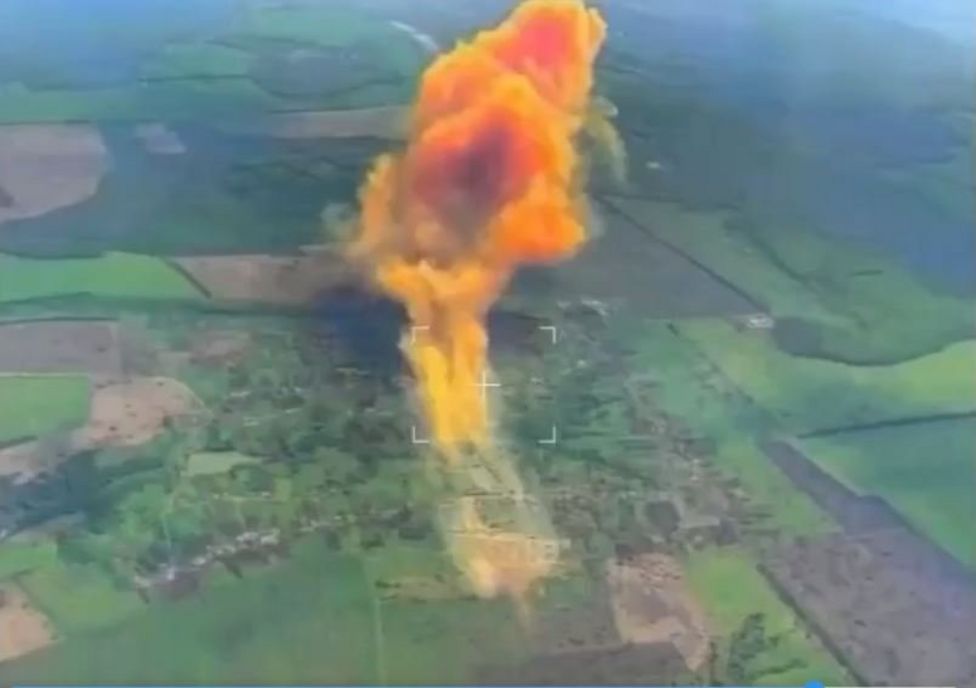
A Russian Ministry of Defence briefing on 11 May asserted that Ukrainian forces had "carried out an explosion of a tanker with fertiliser, presumably ammonium nitrate, which resulted in a cloud of orange smoke that dissipated after some time".

According to Moscow, the aim of the explosion, which occurred in the Kharkiv region, was to accuse Russia of using chemical weapons in order to "extract additional military aid from the West by the Kyiv regime".

No evidence was given in support of the claim that Ukrainian forces were responsible for the explosion.

What we know about the incident

The location in a video showing the plumes of orange smoke rising into the sky was identified using satellite imagery as Dolgenkoye, an agricultural region near the city of Kharkiv.

One Ukrainian media outlet quoted reports on Telegram that the cloud of smoke formed after "a Russian drone hit an object".

Following the explosion, Oleksiy Arestovych, an adviser to the head of the Ukrainian president's office, said he did not believe it was a Russian chemical weapon attack, although he did add the qualification that he would have to "clarify such preliminary data".

The BBC was unable to find evidence of Ukrainian officials subsequently accusing Russia of using chemical weapons in this incident.

Cloud of orange smoke after farm is hit
Image
Image source, Telegram
Image caption, The footage showed an explosion on a farm in Dolgenkoye

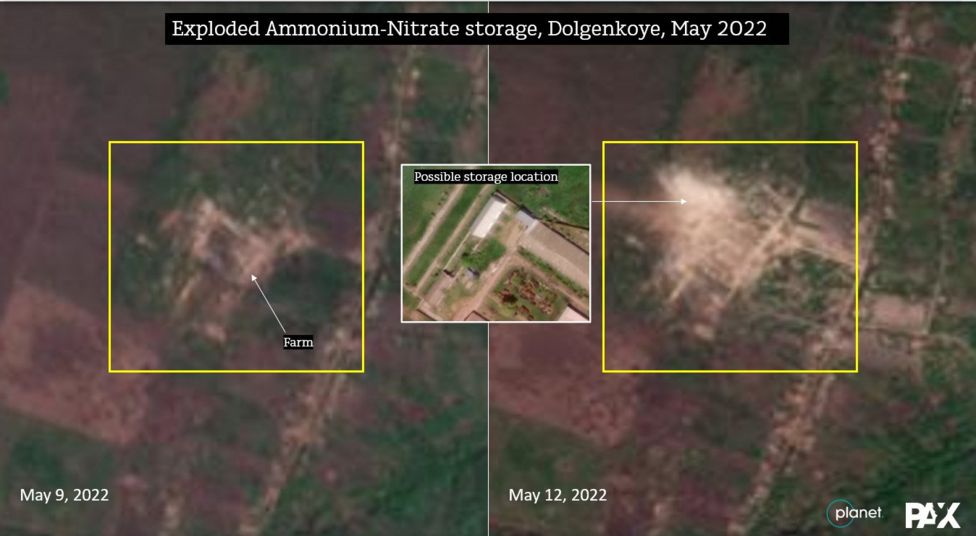
Video and satellite imagery showing the farm buildings hit are consistent with an explosion where facilities containing ammonium nitrate have been set on fire - releasing a characteristic orange-coloured cloud, says Wim Zwijnenburg, an arms researcher at Pax, a Dutch humanitarian organisation.

Mr Zwijnenburg says up to 40 similar agricultural facilities have been destroyed in Ukraine since the start of the Russian invasion in February.

In recent weeks, Dolgenkoye has been the target of shelling from Russian forces, with satellite imagery showing various fields in the area scarred by shelling.

Satellite images of a farm in Dolgenkoe
Image
Image source, Wim Zwijnenburg
Image caption, Satellite images of the area show damage to the farm after the attack

Other recent Russian 'false flag' claims

Operation Z, a pro-Russian social-media channel with almost 800,000 subscribers recently claimed doctors in Ukraine had been instructed to take the bodies of women and children to a hospital, from where they would be transported to "one of the social facilities in the city where an air raid allegedly by Russian aviation will be simulated".

The Telegram post on 12 May said: "Ukrainian special services are preparing a provocation in the Dnieper (Dnipro) region to accuse the Russian military of killing civilians."

There is no evidence for this narrative, which follows other similar claims by pro-Russian media.

In early April, the Russian ministry of defence said UK intelligence operatives were putting civilian bodies in basements in the Sumy region, who could then be portrayed in the West as victims of a "Russian massacre".

Again, there's no evidence that this happened.

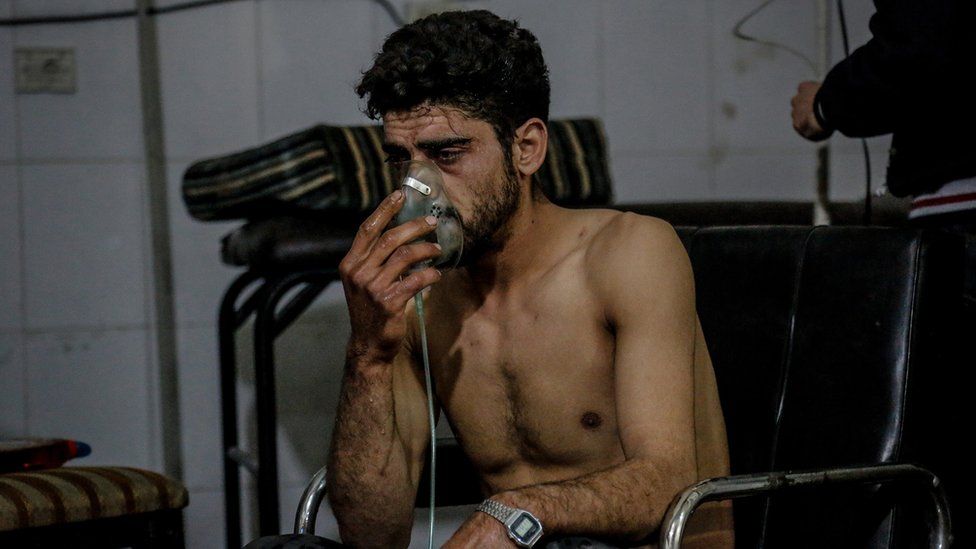
A man recovering from injuries received by chemical weapons in Syria's Eastern Ghouta
Image
Image source, Getty Images
Image caption, Moscow maintains neither it nor the Syrian government was responsible for chemical weapons attacks in 2018

Russia has a history of accusing its enemies of staging what it calls "provocations", by which it means attacks that can be blamed on Russia.

In some cases the claims are to cover for attacks committed by Russia or its proxies; in others the claims refer to future events that might not happen at all.

During the Syrian conflict, Moscow repeatedly accused the White Helmet civil defence group, the UK, the US, France and Belgium of preparing chemical attacks that they could then blame on Russia and Syria.

However, inquiries into chemical attacks during the war have concluded that the Syrian government was responsible for the attacks on Douma and Ghouta.

Prior to the invasion of Ukraine, the BBC reported on a number of false-flag events, including claims that a burned-out and bullet-ridden car was "evidence" of Ukrainian attacks on citizens.

However, closer inspection of the Russian separatists' own photos of the incident revealed that the bodies inside had surgical incisions consistent with being recently cut open for post-mortem examination, and were already dead at the time of the alleged attack.

Re: Freedom of Information

Posted: 15 May 2022, 11:28
by DaffyVina
Eurovision win brings 'incredible happiness' to Ukraine
By Sophie Williams, Hanna Chornous & Siobhan Leahy
in Lviv and Kyiv, Ukraine
Published 4 hours ago

Image
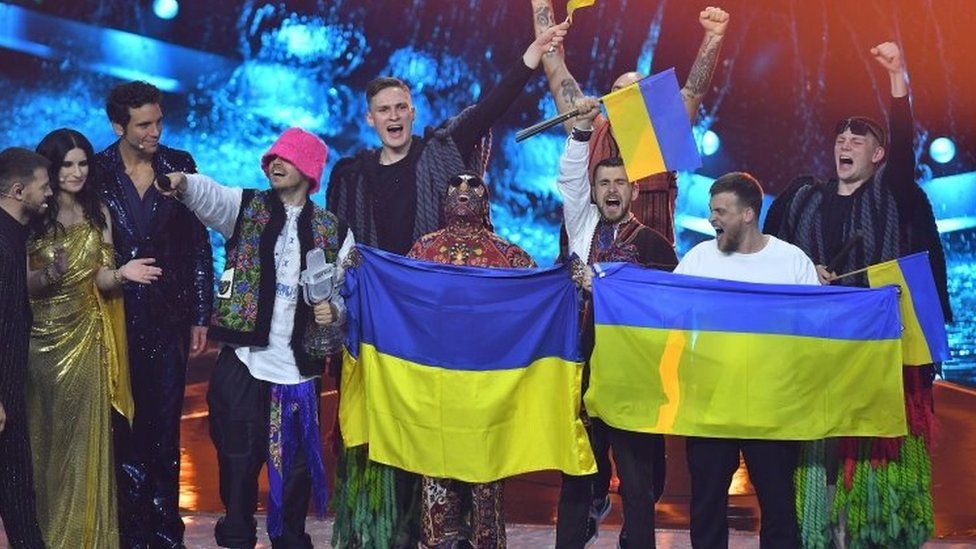
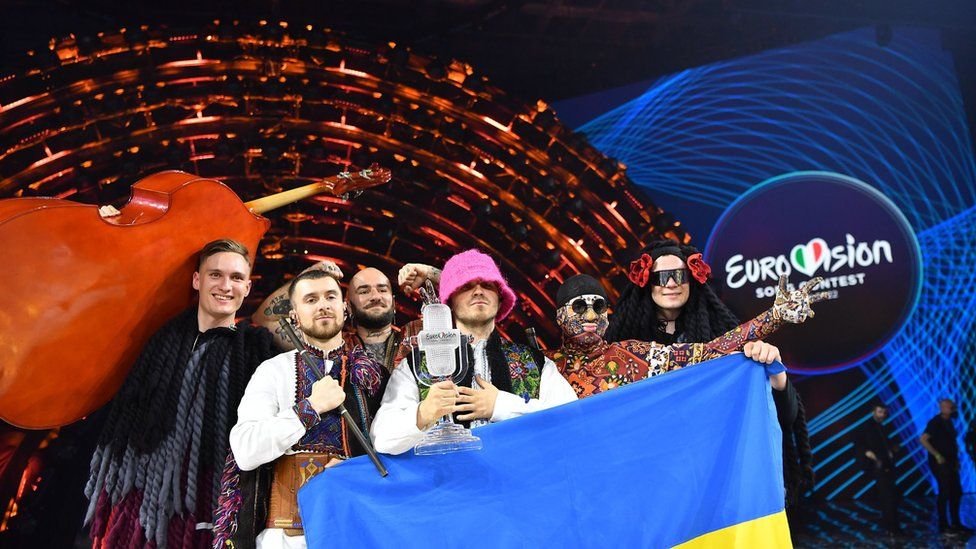
Kalush Orchestra celebrating their win in Turin
Image source, EPA
Image caption,Ukrainians are celebrating winning this year's Eurovision amid the Russian invasion

"When they said that we had won, I shouted at the whole apartment," said Ivanna Khvalyboga, who was forced to flee Ukraine following the invasion.
Speaking from Poland, she told the BBC the win meant "incredible happiness for Ukraine and Ukrainian people".

Kalush Orchestra won the competition, beating the UK and Spain to clinch the top spot.

The group had been predicted to take the title as support rose following Russia's invasion.

Ukrainian President Volodymyr Zelensky congratulated Kalush Orchestra and said Ukraine's courage "impresses the world".

In a post on Instagram, he vowed one day to host Eurovision in a "free, peaceful and rebuilt" Mariupol, referencing the port city that is mostly under Russian control.

Kalush Orchestra talked about Mariupol and the Azovstal steelworks at the end of their performance, a move praised by people online.


"I'm sure many people will search the internet for information about Mariupol and Azovstal and it's great," one person wrote on the messaging service Telegram. "We need attention, a lot of attention."

Military workers watch Eurovision in Ukraine
Image source, Reuters
Image caption, Ukrainians had been on tenterhooks throughout the ceremony

Yura Solodzhuk, the administrator of a Ukrainian Eurovision fan page, who was forced to flee his country, told the BBC he was shocked at the win but said it would "help attract the world's attention again".

"It's important to remind the world about us again and again, that Ukrainian music and culture exists," he said.

The group's song Stefania was written as a tribute to lead singer Oleh Psiuk's mother, but its emotive lyrics have been interpreted as a rallying cry and tribute to the nation.

"Stepfania is heard every day on the front line of our fighters as a call for freedom," Ann Fedirko told the BBC from Ukraine. "Every soldier remembers his mother, who prays for him at night and he has to win a free life for her."

"This song is like our blood, which is now on the lips of every Ukrainian," she added.


Video of Eurovision winners being informed and given the prize.
Media caption, Ukraine stormed into the lead following huge public support

Celebrations are mainly muted with people unable to celebrate in public places due to curfews in place across the country. Many people watched the contest from home.

In one flat in Kyiv where seven friends gathered for their annual Eurovision watch party, emotions ran high.

After a nail-biting wait for results, the friends rejoiced and hugged while waving Ukrainian flags and spraying a bottle of prosecco.

"It is something that unites us with the whole Europe," said Denys. "For us it is very important to be a part of this. Especially this year."

No parties in a bar or a club are possible in Ukraine because of a curfew that's been in place since the Russian invasion in February. So the group of friends are staying locked in together until the early hours.

Image shows celebrating
Image caption, One group of friends celebrated Ukraine's victory whilst under curfew in Kyiv

"I feel happy, there was so much tension!" Alina, who is hosting the party, said. Her message to the viewers who chose Ukraine as the winner? "You voted for peace, for freedom and future."

"In Ukraine we have war and some say it's not a time to have fun," her friend Natalia explained. "But we need to have fun, we need to live and have understanding and feeling of life."

"Now we see support of the whole world and it feels great."

Now Ukraine have won, there will need to be a discussion about where next year's Eurovision event could be hosted.

The winner usually hosts the show the following year, but depending on the situation in Ukraine, the European Broadcasting Union will have to come to a decision as to where it could be held.

But for now, Ukrainians are focused on what it feels like to be victorious and what it could symbolise for the future.

As refugee Ivanna Khvalyboga, who is currently in Poland, put it: "We have won Eurovision, we will win the war with Russia!"

Additional reporting by Hanna Chornous and Siobhan Leahy in Kyiv


From Another article just about Eurovision:
Eurovision 2022: Ukraine wins, while the UK's Sam Ryder comes second
By Mark Savage
BBC Music Correspondent

...The rap-folk band, who were given special permission to leave the war-torn country, soared to first place with 631 points.
They ended their performance in Turin with a plea: "Please help Ukraine, help Mariupol, help Azovstal right now."

...But nobody could compete with Ukraine's act, who had been favourites to win for weeks.

Video of Kalush orchestra performing
Media caption, Kalush Orchestra asked the audience to help Ukrainian forces in besieged Mariupol

Their winning song, Stefania, was originally written as a tribute to frontman Oleh Psiuk's mother, but it has been re-purposed as a rallying cry for Ukraine amidst the Russian invasion.

A unique combination of old Ukranian folk melodies and traditional flute with contemporary rap and hip-hop beats, its lyrics about "broken roads" and fields "turning grey" seemed oddly prescient given the devastation facing the country's citizens.

"After it all started with the war and the hostilities, it took on additional meaning, and many people started seeing it as their mother, Ukraine, in the meaning of the country," Psiuk said last week. "It has become really close to the hearts of so many people in Ukraine."

Receiving the coveted trophy, Psiuk declared: "Thank you for supporting Ukraine. This victory is for every Ukrainian. Slava Ukraini."

Speaking backstage, the singer said he hoped Ukraine could stage the contest in 2023.

"I'm sure that next year Ukraine will be happy to host Europe in a new, integrated and happy Ukraine."

Russia, meanwhile, was banned from this year's contest, with organisers saying the country's participation could "bring the competition into disrepute"...

Several artists expressed solidarity with Ukraine, waving flags and making brief statements on the stage. "Peace for Ukraine! We love you!" announced Iceland's Systur after their performance.

"Don't lose your hope for a better tomorrow," added Estonian singer Stefan, as he finished playing his country-tinged ballad, Hope.

The show even opened with a rendition of John Lennon's Give Peace A Chance, performed by 1,000 musicians on the streets of Turin, driving home the night's message of unity.

Elsewhere the competition was its usual mix of crazy, kitsch pop and overwrought ballads....

Who will host Eurovision 2023?
Image
Kalush Orchestra
Image source, EPA

Ukraine's win raises a question over who will host next year's Eurovision ceremony.
The winning country usually stages the show, but Ukraine is unlikely to have that capability, after its state broadcaster, UA:PBC, was targeted in the opening days of the war.

When a country is unwilling or unable to run the show, another broadcaster usually steps in... most recently in 1980, when the Netherlands took over from Israel, who declined to host the contest after winning for two years in a row.

In a statement on Saturday night, organisers the EBU said no decision had been made for 2023.

"Obviously, there are unique challenges involved in hosting next year's competition. However, as in any other year, we look forward to discussing all the requirements and responsibilities involved in hosting the competition with UA:PBC and all other stakeholders to ensure we have the most suitable setup for the 67th Eurovision Song Contest."

But Ukranian President Volodymyr Zelensky vowed he would stage the contest if at all possible: "We will do our best to one day host the participants and guests of Eurovision in Ukrainian Mariupol. Free, peaceful, rebuilt!"

Re: Freedom of Information

Posted: 15 May 2022, 11:37
by DaffyVina
8:27
Russian offensive in Donbas has lost momentum, says UK[/b]
Russia's offensive in Donbas has lost momentum and fallen significantly behind schedule, according to the UK's Ministry of Defence.

Russia refocused its campaign on the eastern region, traditionally Ukraine's industrial heartland, after the initial wider invasion.

In its daily morning update on Twitter on the situation in Ukraine, the MoD says

: "Despite small-scale initial advances, Russia has failed to achieve substantial territorial gains over the past month whilst sustaining consistently high levels of attrition."

It says Russia is likely to have lost a third of the ground combat force it committed in February and the additional loss of intelligence and critical equipment including drones, will have exacerbated delays in any Russian progress, restricted its manoeuvres and left its forces vulnerable.

The MoD also says Russian morale will be low and combat effectiveness reduced.

"Under the current conditions, Russia is unlikely to dramatically accelerate its rate of advance over the next 30 days," it concludes.

8:43
Claims Russia has lost a third of forces extraordinary - but possible
Joe Inwood
Reporting from Lviv

Whether on the road to Kyiv, in the villages of Kharkiv, or on the banks of the Siversky Donets river – the burned-out shells of Russian military vehicles have been some of the defining images of this war.

The claim that Moscow has lost a full third of its ground forces is an extraordinary one – but not beyond the realms of possibility.

The UK's Ministry of Defence also claims Russia is suffering from critical shortages of bridging equipment and surveillance drones.

The MoD says these factors - combined with increasingly low morale - mean Russian advances are unlikely to accelerate over the next 30 days.

Moscow is yet to respond - but given its previous claims about the state of the conflict, it is fair to assume its assessment would be markedly different.

10:16
Russian missiles 'fully destroy' Ukraine army facility in west
BBC Monitoring

A military facility in Ukraine's Lviv region has been "fully destroyed" by a Russian missile strike, regional governor Maksym Kozytskyy says on Telegram.

In recent weeks Russia has been focusing its offensive on the east of Ukraine but sporadic attacks have continued in western areas such as Lviv.

"Four enemy missiles hit a military infrastructure facility in Lviv Region. The facility has been fully destroyed. According to preliminary information, there were no casualties," Kozytskyy says.

He adds Ukrainian air defence systems have shot down two missiles. Earlier in the day Kozytskyy said the missiles hit the facility at 04:30 local time (01:30 GMT).

10:27
Nato must keep door open to new members, UK says

Nato must maintain its "open door" policy towards admitting new members, UK Foreign Secretary Liz Truss says.

Ministers from the defence alliance are meeting in Berlin, with Finland and Sweden expected to apply to join.

"Nato's open door policy is essential and if Finland and Sweden decide to apply to join, it is clear that they would strengthen the alliance and European security as a whole," Truss says.

The meeting has agreed Nato must continue to support Ukraine to help it to "push Russia out", she says.

"Putin must face a sustained defeat in Ukraine, Russia must be contained and such aggression must never happen again," Truss says.

"Ukraine's security must come from it being able to defend itself. Allies must support Ukraine's move to Nato-standard equipment, immediately providing artillery, training and the required expertise."

10:39
Finland, Sweden and Nato: How did we get here?

Vladimir Putin's actions have shattered a long-standing sense of stability in northern Europe, leaving Sweden and Finland feeling vulnerable.

Swedish Defence Minister Peter Hultqvist described 24 February - when Russia started its war on Ukraine - as the moment the Russian leader proved he was "unpredictable, unreliable and prepared to wage a cruel, bloody and brutal war".

After promising Sweden would never join Nato last November, Hultqvist now talks of the Nordic region's defences being strengthened if both countries sign up.

On Thursday, Finland announced its bid to join the alliance "without delay". Shortly after, Swedish Foreign Minister Ann Linde said "we need to take Finland's assessments into account".

Sweden has felt under threat in recent years, with several reported airspace violations by Russian military aircraft. In 2014, Swedes were transfixed by reports that a Russian submarine was lurking in the shallow waters of the Stockholm archipelago.

Two years later Sweden's army returned to the small but strategically important Baltic Sea island of Gotland, after abandoning it for two decades. Gotland is located about 320km (200 miles) north-west of the heavily militarised Russian enclave of Kaliningrad, where Moscow’s Baltic fleet is based.

The island is seen as strategically vital to the defence of Sweden as well as the Baltic states Estonia, Latvia and Lithuania, which are already Nato members.

11:00
Germany ready to fast track Sweden and Finland joining Nato

Germany is prepared to speed up the process of Sweden and Finland joining Nato, its foreign minister says.

The process of new members joining can typically take up to a year but, according to Reuters, Annalena Baerbock said ministers gathering for the Nato meeting in Berlin had agreed momentum should not be lost.

"Germany has prepared everything to do a quick ratification process," Baerbock tells reporters.

Referring to the possibility of there being a period when Sweden and Finland might not yet be covered by the guarantee that an attack on one Nato member is an attack on all, she says there must be no "grey zone, where their status is unclear".

Her Canadian counterpart Melanie Joly says she hopes any deal for the countries to join can be done "within weeks".

11:08
Breaking
Finland will apply for Nato membership

Finnish president Sauli Niinisto confirms his country will formally apply for membership of the Nato military alliance.

11:20
Finnish parliament to debate Nato membership bid in coming days - PM
Finland's Prime Minister Sanna Marin says she hopes the Finnish Parliament will confirm the decision to apply to join Nato in the next few days and says she hopes it will be based on a strong mandate.

Speaking alongside Finland's president in Helsinki, she says they have both been in close contact with Nato member countries and Nato itself thanks them for the support they have received so far.

"In Finland we still have the parliamentary process ahead of us but I trust that the parliament will debate this historic decision with determination and responsibility," she says.

Re: Freedom of Information

Posted: 15 May 2022, 21:25
by DaffyVina
11:57
Finland in Nato would still need relationship with Moscow - president
Finland's President Sauli Niinisto had a conversation with Vladimir Putin yesterday, during which the Russian leader said it would be a mistake for Finland to join Nato.

Speaking in Helsinki today, Niinisto says it's important to remember Nato membership would not change geography and Finland would still have a large land and sea border with Russia.

But he says he hopes and doesn't doubt that Russia is willing to continue with "daily obligations" that are in the interests of both countries - citing the example of Norway - a Nato member with a border with Russia - being able to maintain a working relationship with Moscow.

13:08
Civilians fleeing shattered Mariupol reach safety in Zaporizhzhia
Hugo Bachega
Reporting from Dnipro

And now we turn to Ukraine's devastated southern city of Mariupol.

A large convoy of cars and vans with residents escaping the city finally reached safety in the Ukrainian Zaporizhzhia, in what is believed to have been the largest single evacuation from Mariupol since the start of the war.

Petro Andriuschenko, an aide to the Mariupol mayor, said the convoy numbered between 500 and 1,000 cars, who had to wait three days for Russian troops to allow them to pass.

Officials estimate about 150,000 people remain in Mariupol, many of them unable to leave.

Olga, a 41-year-old teacher who left the city last Sunday, said the sanitary conditions were worsening as most neighbourhoods remained without water.

"There’s a strong smell of decomposing bodies as many of them remain in the streets," she said.

"Everything was destroyed, everything was burned down."

Mariupol has been devastated by weeks of relentless bombardment, and is now almost completely under Russian control.

The Azovstal steelworks is the last pocket of Ukrainian resistance in the city.

For weeks, hundreds of fighters have been holed up in underground shelters amid intense Russian attacks.

Relatives of the fighters have made desperate calls for international help to save them, while authorities say efforts are under way to evacuate dozens of seriously wounded troops. But even them acknowledge that this will be extremely difficult.

13:21
How are Ukrainian children coping?
Hugo Bachega
Reporting from Dnipro

For weeks, residents of Mariupol were subjected to a siege imposed by Russian forces as their city came under unrelenting bombardment.

Most of their time was spent in underground shelters, with no electricity or gas, and very little food and water.

Tens of thousands have now fled and, from cities across Ukraine where they found safety, they are sharing stories of surviving the war and their dramatic escapes. But how are their children coping?

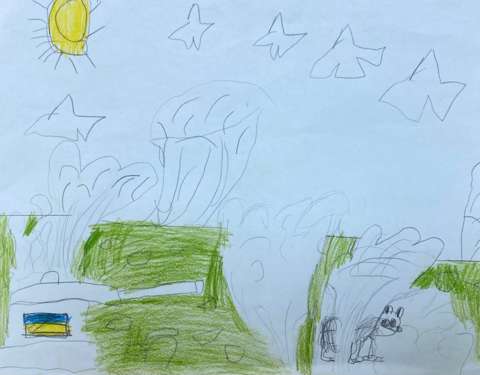
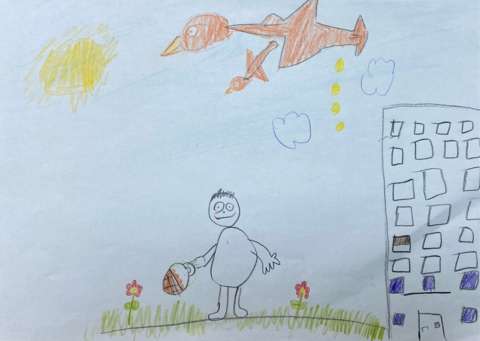
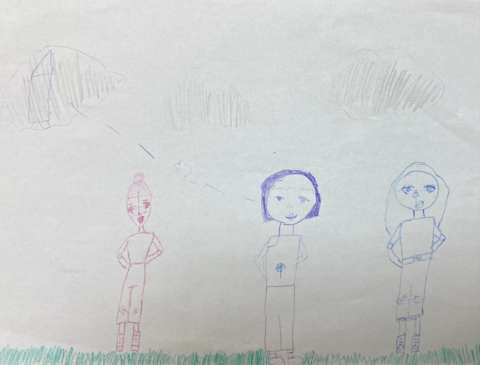
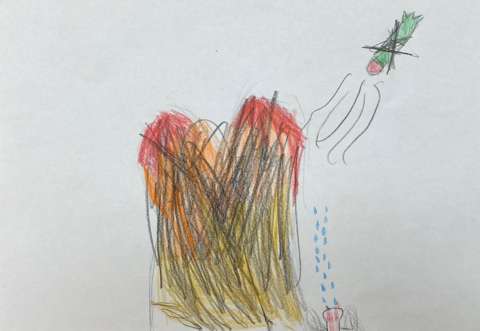
Hanna Chasovnykova, a psychologist, is helping families who have fled Mariupol here in Dnipro. In art therapy sessions, children are told to draw things they had seen in their city.

"When children go through painful experiences, they usually paint things in dark colours. Most of their drawings are only in black," she says.

Child's drawing
Copyright: BBC
"This eight-year-old girl saw how the tank shot and destroyed her grandmother’s house. Part of the exercise is to make the drawings more colourful and think about making it better. So she added grass and the sun. And to make the tank look good, she painted the flag of Ukraine," Chasovnykova says.
Image

Child's drawing
Copyright: BBC
"In this case of a nine-year-old boy, the family spent a lot of time in a basement. He was afraid of bombs and rockets. They didn’t have a lot to eat, so his main concern was about food. At the beginning, the basket was empty. He then added the sun, grass and flowers, and turned the planes into birds, which were throwing eggs from the sky.
"He also added pyrizhky [a Ukrainian bun] to the basket. He was taking them to his grandmother, who could not leave Mariupol. If you look the way he drew the eyes you see they’re big, which is a sign of fear."
Image

Child's drawing
Copyright: BBC
"This 11-year-old girl was wounded in the head and hand by shrapnel after a bomb attack. She’s now afraid of going outdoors because she thinks bombs are going to fall from the sky. She's also afraid of loud noises. Two of her friends have died in Mariupol."
Image

Child's drawing
Copyright: BBC
"The family of this seven-year-old boy couldn’t escape Mariupol for a long time. When they finally left he saw a lot of burned down houses. He then drew an X over a rocket, and water falling from the sky."
Image