Page 60 of 67

Re: Freedom of Information

Posted: 15 May 2022, 21:56
by DaffyVina
Analysis
Posted at 15:04
Sweden joining Nato would have been unthinkable - but not now
Maddy Savage
Reporting from Stockholm

Protesters in Stockholm campaigning against Sweden joining Nato
Copyright: EPA
Image caption: There have been some protests against the idea of Sweden joining Nato - but not everybody feels that way

There have been talks going on throughout the weekend.

The executive board of the ruling Social Democrat party are the ones who will make a final decision on whether the party will support a policy shift in favour of joining Nato.

All sides suggest that is likely to be what is going to happen but we're not going to know until another couple of hours from now - the party is expected to make an announcement at 18:00 local time (17:00 BST).

If the party formally says that it's happy with joining Nato then I think we could be on quite a rapid process towards that application beginning.

There's already a debate scheduled in parliament for Monday.

Most of the opposition parties are strongly in favour of joining Nato and according to Swedish media that could mean that Sweden puts its bid in formally in just the next couple of days.

This would have been unthinkable just six months ago but following Russia's invasion of Ukraine, opinion polls have really indicated a rise in support for joining Nato.

Not so much here in Sweden as in Finland - just under 50% of people asked in recent opinion polls suggesting that they would like to join Nato but that's compared to about 30% at the end of last year.

There really is a feeling among supporters of joining Nato that this would enable Sweden to feel more secure and that it would enhance the security situation across northern Europe.

16:30
BREAKING
Sweden's ruling party backs joining Nato
Sweden's ruling party, the Social Democrats, say they back the country joining Nato – this comes a few hours after its neighbour Finland said it planned to apply to join.

16:37
Sweden wants to join Nato but not have bases in the country
We've got more now on the decision of Sweden's ruling party to back the country joining Nato.

A statement says: "The Social Democrats' party board has decided that the party will work for Sweden to apply for membership in Nato."

But it does not want nuclear weapons or Nato bases in Sweden.

"The Social Democrats will thus work to ensure that Sweden, if the application is approved by Nato, expresses unilateral reservations against the deployment of nuclear weapons and permanent bases on Swedish territory," the statement continues.

Swedish leader Magdalena Andersson and other senior ministers from her party will speak in a news conference in about half an hour.

17:10
Sweden needs Nato security guarantees - Swedish PM
Sweden's Prime Minister Magdalena Andersson is currently speaking at a press conference.

She says Sweden needs the formal security guarantees that come with membership of Nato.

She is addressing reporters as Sweden has just announced it intends to apply to join the Nato alliance in the wake of Russia's invasion of Ukraine.

17:16
'We would be in very vulnerable position' - Swedish PM

Magdalena Andersson has also just told reporters that if Sweden was the only country in the Baltic region that did not join Nato "we would be in a very vulnerable position".

As we've been reporting, Sweden has confirmed its intention to formally apply to join the alliance.

The announcement being made by the ruling Social Democrats comes a few hours after Finland announced it was seeking to be part of the alliance.

17:22
Sweden will be a security provider, says PM
Magdalena Andersson says as a member of Nato Sweden will "only achieve" more security and contribute to more security.

"Sweden will be a security provider," the Swedish prime minister adds.

But she says Sweden will be vulnerable during the application process - before it gets the full backing of other countries a Nato member would have.

17:49
Turkey's concerns can be overcome - Swedish PM
Sweden's Prime Minister Magdalena Andersson says she will go to parliament tomorrow aiming to secure support for an application to join Nato.

She also says there's a good chance Turkey's reported doubts about Finland and Sweden's potential membership can be solved.

As we reported, on Saturday Turkey's Foreign Minister Mevlut Cavusoglu said it was "unacceptable and outrageous" that the prospective new members supported the outlawed Kurdish militant group PKK.

But on Sunday Nato's Deputy Secretary-General Mircea Geoana said he was confident the concerns could be addressed.

Announcing Finland's intention to join Nato earlier, the country's Prime Minister Sanna Marin said her nation's decision would also have to go through parliament but she trusted the Finnish parliament would debate "this historic decision with determination and responsibility", while President Sauli Niinisto said he was confused by reports of Turkish concerns.

17:53
Nato membership is not a move against Russia - Swedish PM

Swedish Prime Minister Magdalena Andersson says her country's decision to apply for Nato membership is "not something against Russia" but something that is best for Sweden.

She previously said the decision to join the alliance would help Sweden achieve more security and contribute to more security.

Andersson confirms her party hopes to synchronise Sweden's membership application with Finland's as much as possible.

Russian President Vladimir Putin previously described Finland's intention to join Nato as a mistake.

18:18
How popular is joining Nato in Sweden and Finland?

Sweden's decision to apply join Nato will end 200 years of military non-alignment.

In Finland, which today also confirmed it will put in a Nato bid, polls carried out by Finnish broadcaster Yle showed 76% of the population would support the country’s membership.

But in Sweden joining the alliance is a less popular stance. Recent polls suggest that about half of the population are in favour of joining the defensive military alliance.

Although this proportion is far higher than it was before Russia’s invasion of Ukraine, the country’s ruling party had previously been split on the issue.

Ukraine war: Russia's invasion not going to plan, Nato says
By Thom Poole
BBC News
Published4 hours ago

Nato's secretary general says Russia's war in Ukraine is not going to plan and that its attempt to capture the eastern Donbas region has "stalled".
Jens Stoltenberg also said Ukraine could win the conflict.

Britain's Ministry of Defence (MoD) estimates Russia has lost about a third of its ground combat force since the war began in February.
The Russian invasion has been hampered by stiff Ukrainian resistance and logistical issues.

Its initial goal appeared to be to sweep across the country and topple the Ukrainian government. Instead, Russia has withdrawn from areas around the capital Kyiv after failing to capture it and since mid-April has been focusing its efforts on two eastern provinces.

In Ukraine's second city of Kharkiv, officials say Russian forces have withdrawn from to the border and that residents were returning.

"Russia's war in Ukraine is not going as Moscow had planned," said Mr Stoltenberg.

"They failed to take Kyiv, they are pulling back from around Kharkiv, their major offensive in Donbas has stalled. Russia is not achieving its strategic objectives."

Mr Stoltenberg was speaking at a meeting of Nato foreign ministers.

On top of the military setbacks, another consequence of the invasion is that Russia will likely face an expanded Nato with Sweden and Finland set to join.

Russia's President Vladimir Putin sees Nato as a security threat to Russia and invaded Ukraine in part to stop it joining Nato.

In its assessment, the MoD's estimate of Russia's losses cover men killed or wounded and equipment destroyed or captured.

The MoD said Russia's Donbas offensive had "lost momentum and fallen significantly behind schedule".

It said Russia was constrained by "continued low morale and reduced combat effectiveness".

The British Foreign Secretary, Liz Truss, said Ukraine's allies must keep up its military support to help it "push Russia out".

On the ground. Ukrainian forces are counterattacking in the city of Izyum, regional governor Oleh Sinegubov said, something that could complicate Russian plans to capture the Donbas.

However Ukraine's military also acknowledged setbacks in its latest updates, saying Russia was advancing in several areas in the region.

There has been no let up for the remaining Ukrainian forces in Mariupol, with Russia continuing its bombardment of the steelworks where they are holed up. Video purportedly from inside showed men checking their phones and playing chess.

And in western Ukraine, the governor of the Lviv region said missiles had targeted military infrastructure.

20:12
'If you come here, it will hurt': The Swedish island of Gotland
Paul Adams
BBC Diplomatic correspondent

If Sweden joins Nato, it'll represent a return to strategic significance for its largest island, Gotland.

Lying just 200 miles from Kaliningrad, headquarters of Russia’s Baltic fleet, the island had been likened to an unsinkable aircraft carrier. An ideal spot, during the Cold War, from which to defend Sweden and project power over the Baltic.

There was a time when as many as 20,000 troops were stationed there.

But Gotland's last military units stood down in 2005 and Gotland fell into military obscurity.

Russia's annexation of Crimea in 2014, and its subsequent sponsorship of separatist fighters in the Donbas led Sweden to reconsider.

On a visit to the island in 2016, I saw preparations for the return of a garrison.

Michael Bydén, Sweden's Supreme Commander, told me it was all about sending a message to Russia.

"If you come here, it will hurt."

But it was also about making sure that Sweden - which was already experiencing regular Russian military incursions into its airspace and submarine activity close to the capital Stockholm - was not taken by surprise.

The Gotland Regiment was reactivated in 2018.

Last month, the government announced plans to spend $163m boosting the island’s defences.

Back in 2016, a decision to join Nato was still some way off, but listening at the time to Swedish airforce communications – all in English – was just one of many signs that when the time came, "interoperability" with Nato forces would not be a problem.
Re: Freedom of Information

Posted: 16 May 2022, 08:21
by DaffyVina
5:48
Welcome back
Welcome back to our coverage of the war in Ukraine. Here are the latest updates:

Ukraine

Russia's war is not going to plan, and Ukraine could win the conflict, Nato's secretary general Jens Stoltenberg said
"They failed to take Kyiv, they are pulling back from around Kharkiv, their major offensive in Donbas has stalled. Russia is not achieving its strategic objectives," Stoltenberg said
The UK military has also confirmed that Russia's offensive in the eastern Donbas region has lost momentum, estimating that Russia has lost about a third of its ground combat force since the war began in February
Senior Ukrainian presidential adviser Mykhaylo Podolyak says Ukraine can defeat Russia by the end of the year but needs heavy weapons from the West and a "real oil embargo" on Russia

Diplomacy

In a historic shift, both Sweden and Finland have confirmed they will apply for Nato membership
Sweden's ruling party, the Social Democrats, has dropped its long opposition to joining Nato, and Prime Minister Magdalena Andersson said she will go to parliament on Monday to secure support for an application
She said military non-alignment had served Sweden well in the past but was unlikely to do so in the future
Finland's bid will also have to be discussed in parliament but the country's prime minister and president have spoken in favour of it
Russia - which has cited Ukraine's intention to join Nato as one of the reasons for its invasion - has warned that further expansion of the military alliance would be a mistake
Turkey has also expressed reservations, saying both countries harbour members of the Kurdistan Workers' Party (PKK), which it says is a terrorist group

This is Tessa Wong in Singapore and Andrew Clarance in Delhi, stay with us as we continue to bring you the latest developments.

Re: Freedom of Information

Posted: 16 May 2022, 08:45
by DaffyVina
Ukraine: The children's camp that became an execution ground
By Sarah Rainsford
BBC News, Bucha
Published7 hours ago

the basement in Bucha
Image

Since Russian forces were pushed back from Kyiv at the end of March, the bodies of more than 1,000 civilians have been discovered in the Bucha region - many hastily buried in shallow graves. The BBC's Sarah Rainsford has been investigating what happened at a children's summer camp - now being treated as a crime scene.

*This report contains material some readers will find disturbing*

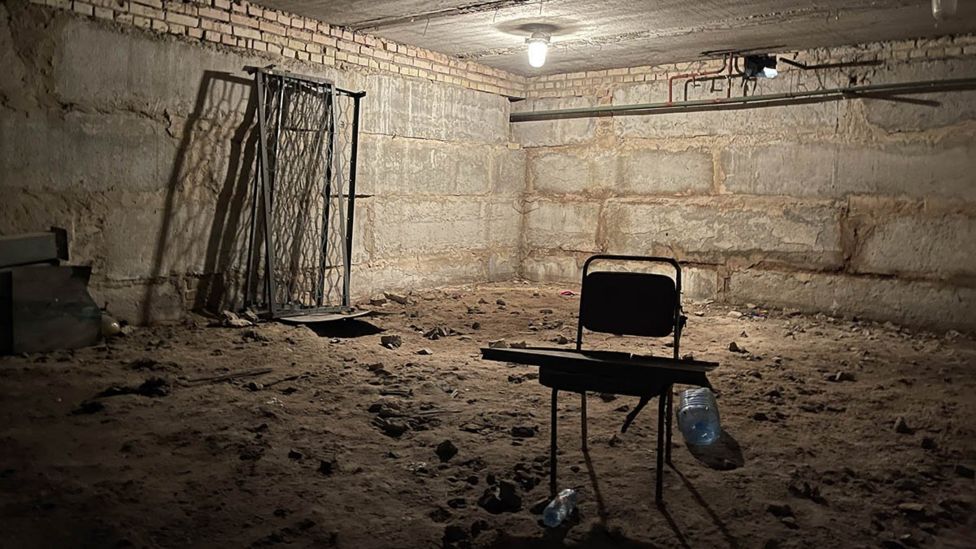
It is easy to miss the killing spot at first in the gloom. But in a cold, damp basement on the edge of the woods that made Bucha a popular get-away spot before the war, five Ukrainian men were forced to their knees and shot in the head.

To the right of the entrance, there are stones coated in blood that has turned dark red. Lying among that is a blue woollen hat with an exit hole in one side and its rim soaked in blood. In the wall, I counted at least a dozen bullet holes.


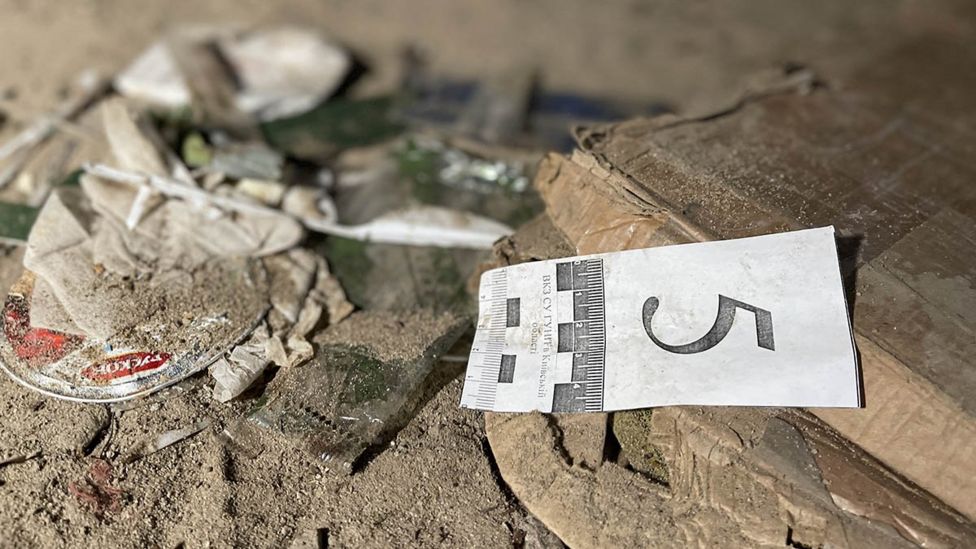
Forensics team marker in Bucha basement
Image caption, A marker left by a forensics team in the basement
Image

A couple of steps away are the remains of a Russian military ration pack - an open can of rice porridge with beef and an empty packet of crackers. A name daubed in graffiti on a wall is a reminder that the scene is a children's camp. But when Russian troops moved into Bucha, just outside the capital, in early March, Camp Radiant became an execution ground.

The story of the summer camp killings is chilling but so is this detail: more than 1,000 civilians were killed in the Bucha region during a month under Russian occupation, but most did not die from shrapnel or shelling. More than 650 were shot dead by Russian soldiers.

Now Ukraine is searching for their killers.

* * * * *

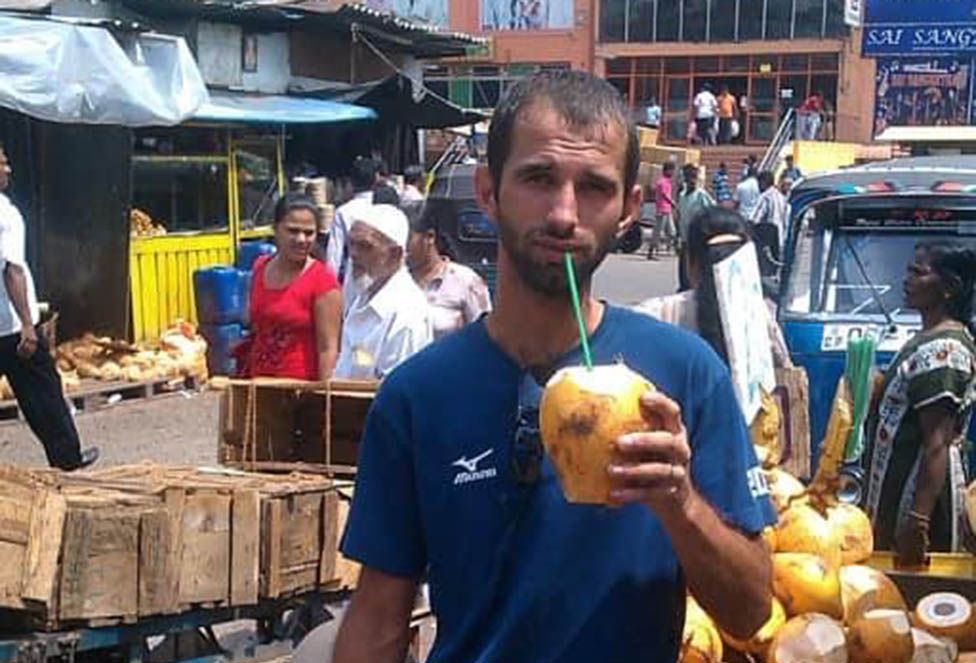
Volodymyr Boichenko lived in Hostemel, just up the road from Bucha and near the airfield where the first Russian forces landed to try to overthrow Ukraine's government. When his sister Aliona Mykytiuk decided to flee before the fighting reached her, she pleaded with Volodymyr to join her. He was a civilian, not a soldier, but he wanted to stay and help. So he spent the days searching Hostemel for food and water to bring to neighbours, including children, who were trapped in their cellars by the constant shelling and Russian airstrikes.

A chatty 34-year-old, who had travelled the world in the merchant navy, Volodymyr phoned his family from Hostemel most days to reassure them he was safe. Aliona would wait nervously for his brief calls: she knew he had to move to higher ground to get a connection and if the shelling was heavy it was impossible to leave the bomb shelter. As supplies ran low, she urged her brother to try to escape but by then the roads were blocked.


Volodymyr drinking from a coconut
IMAGE SOURCE,BOICHENKO FAMILY
Image caption, Volodymyr Boichenko had travelled the world
Image

The last time Aliona heard from him was on 8 March. Volodymyr wasn't the demonstrative type, but that day he told his sister not to worry about him. "He said 'I really love you,' and that was so painful to hear," Aliona sobs, rubbing her eyes hard but unable to stop the tears. "There was fear in his voice."

Four days later, Volodymyr was spotted by neighbours close to Promenystyi, as it's known here, or Camp Radiant. Then he disappeared.

In March, the fighting around Kyiv was intense and the small town of Bucha was at the epicentre. The withdrawal of Russian troops in early April revealed scenes that shocked the world: the bodies of residents slumped in the streets where they'd been shot.

Moscow tells anyone who will listen that the killings were staged, an idea that is as twisted as it is patently false. Determined to hold those responsible to account, Ukrainian investigators are busy collecting the hard evidence on territory now back under their control.

"We don't know what Putin's plans are, so we are working as quickly as possible in case he drops a bomb and destroys all the proof," says Kyiv regional police chief, Andrii Niebytov.

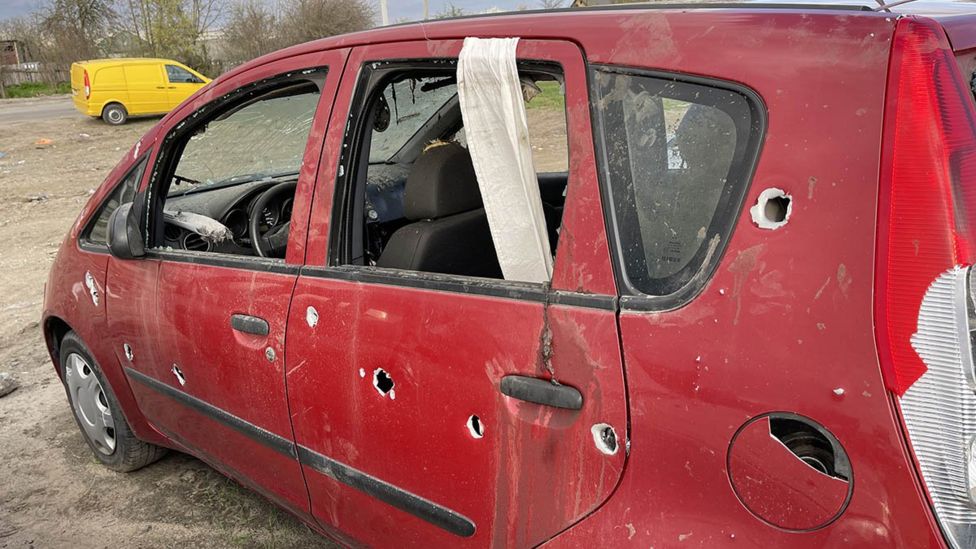
That evidence includes a field full of civilian cars pierced with multiple bullet holes, now piled up on the edge of Bucha. They are vehicles that were shot at when families tried to flee. One still has a length of white cloth at the window, hung to show the soldiers that its occupants were no threat. Step too close, and you catch the sickly smell of death.


Car with white ribbon and bullet holes
Image caption, A white flag did not prevent this car from being attacked
Image

When the bodies beneath Camp Radiant were discovered on 4 April, Volodymyr Boichenko was among them. Aliona had spent weeks frantically calling hospitals and morgues. That day she was sent a photograph to identify. She knew it was her brother before it had even downloaded.

"I hate them with every cell of my being," Aliona cries, about Volodymyr's killers. "I know that's wrong to say about people, but they are not human. There was not one patch on those men's bodies that was not beaten."


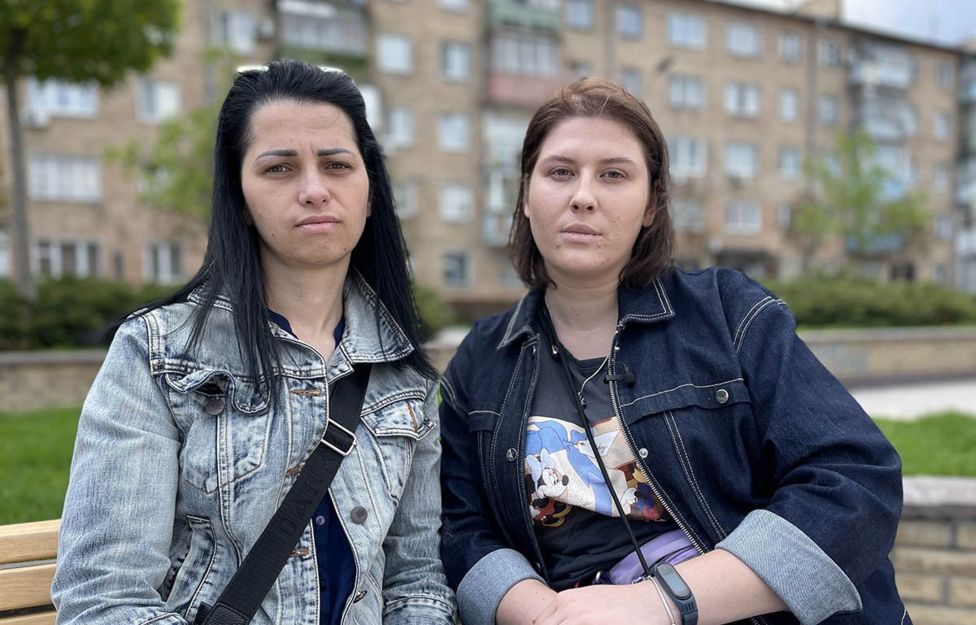
Ilona and Alona, Volodymyr's sister
Image caption, Volodymyr's sister Aliona, with her cousin Ilona
Image

The five men had been found crouching on their knees, heads down and hands bound behind their backs.

"We know they had been tortured," the police chief told the BBC. "The Russian army has crossed the line of how war is conducted. They were not fighting the military in Ukraine, they were kidnapping and torturing the civilian population."


Neither the Prosecutor's Office nor the SBU security service will disclose details of ongoing investigations, but some Russian military were so careless at covering their tracks that there are likely to be considerable clues to work with. Ukrainian territorial defence units have even discovered lists of soldiers at some abandoned positions. One appears to be part of a rota for litter duty, another includes passport details and mobile phone numbers.


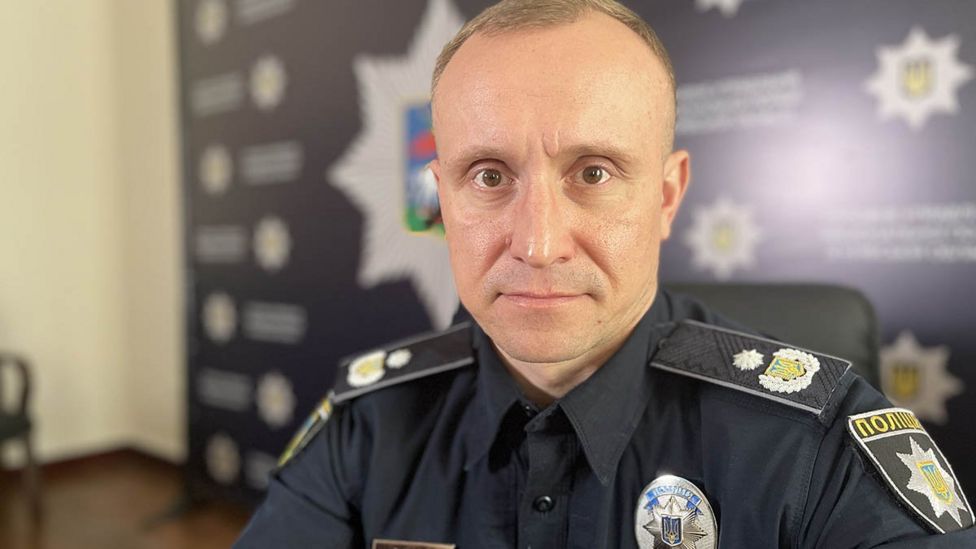
Kyiv regional police chief, Andrii Niebytov
Image caption, Kyiv regional police chief, Andrii Niebytov, is working fast to gather evidence
Image

With such a vast volume of work - more than 11,000 potential war crimes cases registered so far - Ukraine's security services have called on more digitally savvy civilians for help.

"I feel some call of duty," said Dmytro Replianchuk, a journalist at slidstvo.info who worked to expose corruption within Ukraine's law enforcement bodies before the war. Now he's joined forces with prosecutors, scouring the internet for extra data to help catch suspected war criminals.

"I understand it will be so hard and a lot of cases won't be solved. But in these weeks, it's important to find as much information as possible," Dmytro explained.

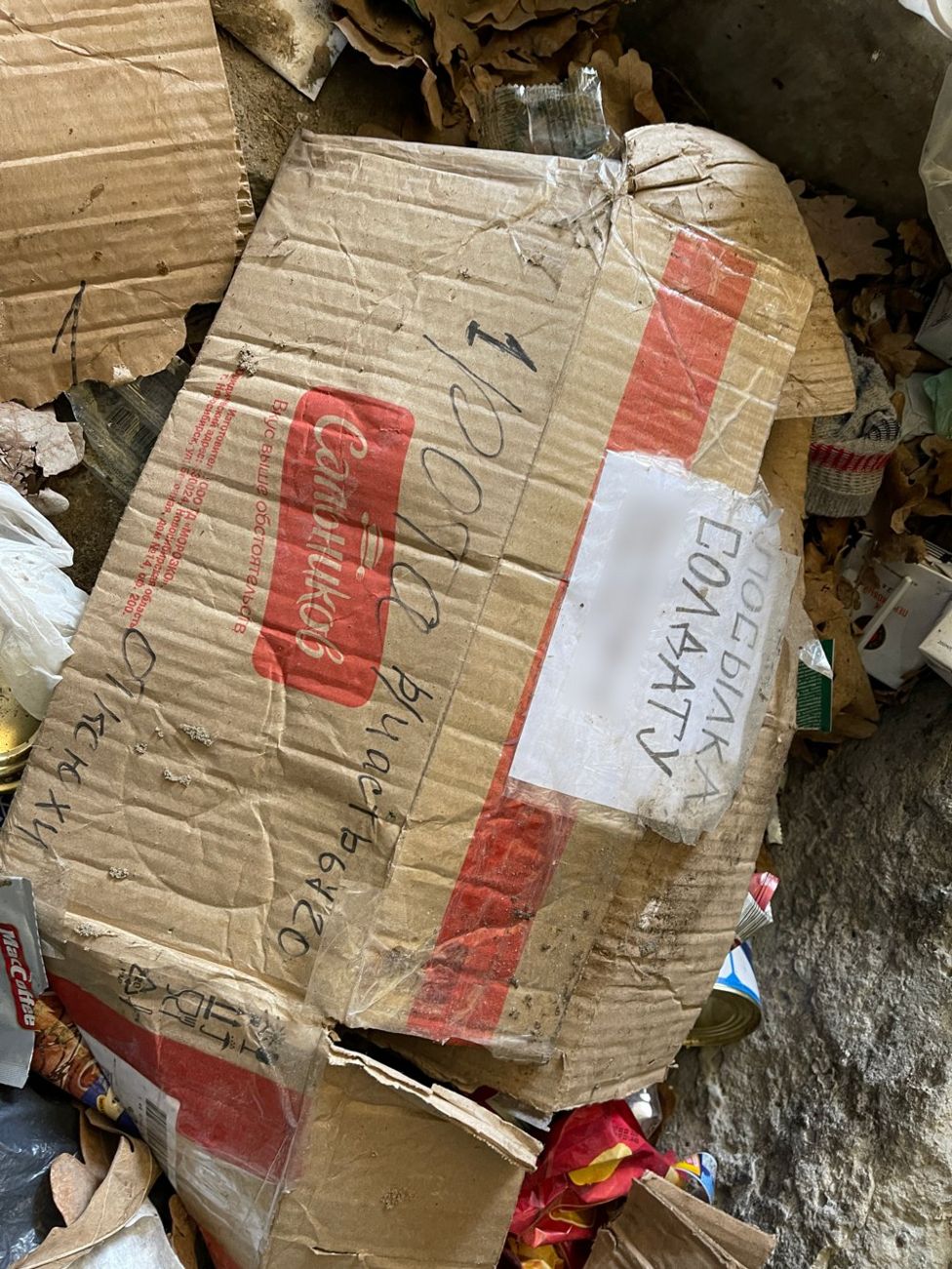
We found one potential clue among the litter at Camp Radiant - the wrapping from a parcel sent by a woman named Ksyukha to a Russian soldier whose own name and military unit are clearly marked. Unit 6720 is based in Rubtsovsk, in the Altai region of Siberia. It has been linked to Bucha before when soldiers from the town were caught on CCTV sending giant packages to relatives full of goods that they had looted from Ukrainian homes.


A parcel addressed to a Russian soldier - the address has been blurred
Image caption, A parcel addressed to a Russian soldier - the name has been blurred
Image

We can't be sure yet whether soldiers from Rubtsovsk were based at the children's camp, or were there when the men were killed. The police first need to establish a more precise time of death.

"We are working on it, but it's not a quick thing," Mr Niebytov explains. "But that camp was a headquarters so there would have been a commander. The soldiers could not have executed anyone without the commander's knowledge. So we will first find the organisers and then look for the implementers."

Across the road from Camp Radiant, behind a church spattered with shrapnel damage, a corner of Bucha is slowly showing renewed signs of life. Young boys run around the yard, while a man fixes sheets of wood to windows shattered when the town was being shelled, constantly. And a little shop has just reopened to serve others now trickling back to begin their own repairs.


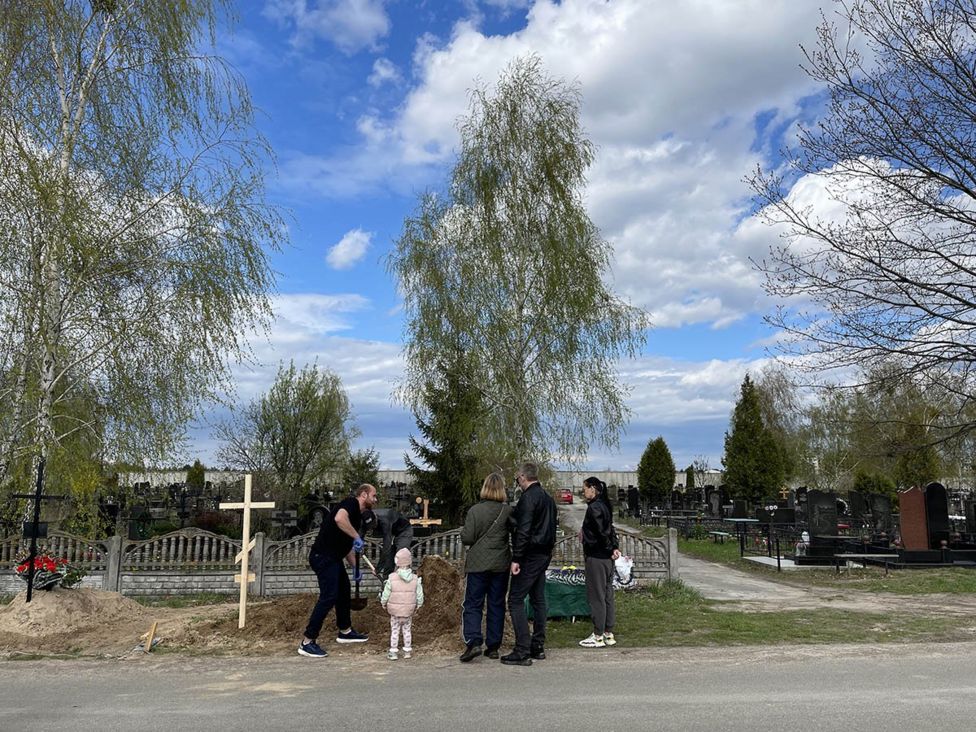
family in Bucha cemetery - a fresh grave is being dug
Image caption, Fresh graves are still being dug in Bucha
Image

As neighbours cross paths, they discuss the days when Russian tanks rolled into their town, the soldiers who would shoot wildly and those who roamed the streets drunk, breaking into homes and stealing from them. And they remember the local man who escaped to their block of flats from the summer camp opposite, and who they had sheltered despite the risk.

Viktor Sytnytskyi didn't know Camp Radiant before, but all the details he gives match up. He's now in western Ukraine and told me his story over the phone, calling from his car so he wouldn't upset his mother.

It was early March when Viktor was grabbed by Russian soldiers on the street. They tied his hands and pulled his hat down over his eyes, then dragged him to a cellar that he's sure was on the grounds of the children's camp.


Mosaic of children dancing around a camp fire
Image caption, Camp Radiant is decorated with mosaics of happy children playing - now it's a crime scene
Image

There, the Russians poured water over his legs so he would freeze, and they held a gun to his head.

"They kept saying, 'Where's the fascists? Where's the troops? Where's Zelensky? One of them mentioned Putin so I said something rude and he hit me," Viktor recalls.

He remembers being angry at his captors as well as terrified. He had worked in Moscow in the past with men from Siberia and was horrified that Russians could now treat him with such brutality. Even more so, when one of the soldiers revealed that he, too, was from Siberia.

Viktor told him he was sad things had come to this.

"The sad thing is that our grandfathers fought together against the Nazis and now you're the fascists," was the Russian's angry reply.

"He told me: 'You have until the morning to remember what you've seen, and if not, you'll be shot.'"

That night, Viktor got lucky. There was heavy shelling and when he realised his captors were no longer guarding him, he ran for his life.

"I calculated that I had more chance of surviving under shelling than if I stayed in that cellar. They'd already put the gun to my head. What would it cost them to pull the trigger?"

* * * * *

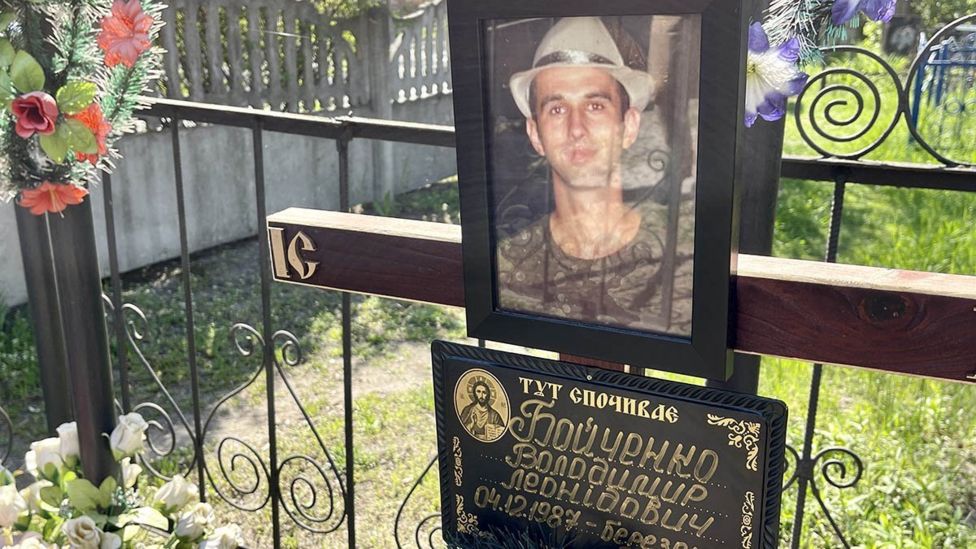
From a common grave beneath the children's camp, Volodymyr Boichenko has now been given a proper burial beneath the cherry blossom in the old cemetery of Bucha.

After his funeral, Aliona says she finally saw her brother's face in her dreams again, as if he were comforting her.


Vladimir Boychenko grave
Image

But she still has many questions. The cross on Volodymyr's grave is marked only with his birthday, not the date of his death, because the family have no idea when he was shot.

They may never know, unless the Russian commander who took over Camp Radiant can be found.

Like everyone in Bucha, though, they do know that civilians are not only caught up in this war. They are being targeted - by Russian soldiers who either don't know the rules of war, or don't care.


Photographs by Sarah Rainsford unless otherwise marked
Additional reporting: Daria Sipigina, Mariana Matveichuk and Tony Brown

Re: Freedom of Information

Posted: 16 May 2022, 19:18
by DaffyVina
6:02
Large-scale Nato military exercises due today
In other Nato news, some of the biggest ever drills in the history of the Baltics by the military alliance are due to begin later today. They're codenamed Hedgehog.

The exercises will take place in Estonia over the next two weeks and involve 15,000 troops from ten countries, including the UK, US and current non-members Finland and Sweden.

Despite being planned well before Russia launched its invasion of Ukraine, the drills are now taking place at a moment of significantly raised tension between Nato and Moscow.

In the context of the Russian invasion, the exercises are highly symbolic for the Baltic states, as they are intended to test their capacity to respond to a similar incursion by enemy forces.

6:09
An unexpected move
Paul Adams
BBC Diplomatic correspondent

Less than three months into his invasion of Ukraine, Vladimir Putin is about to be rewarded with something he clearly did not plan for.

Finland and Sweden will soon be members of the very alliance he sought to contain.

Public opinion in Sweden and Finland, lukewarm about joining before the war, has been transformed by recent events.

In Sweden, the ruling Social Democrats dropped their long-standing opposition over the weekend.

The prime minister Magdalena Andersson is due to chair a special cabinet meeting today, with parliament also expected to have its say.

A similar process is going on in Finland. Formal applications are likely to follow this week, with the two countries coordinating closely. All thirty members of the alliance must then agree.

Despite reservations expressed by Turkey, the US Secretary of State Anthony Blinken says he’s confident Nato will soon welcome its newest members.

6:36
Wives of Azovstal defenders say food and water running out

Service members of Mariupol's unit of the Ukrainian Sea Guard play chess inside a bunker of the Azovstal Iron and Steel Works
Copyright: Press service of the State Border Guard Service of Ukraine/Reuters
Image caption: Servicemen trapped in the steelworks play chess

Ukrainian servicemen trapped in the Azovstal steelworks in Mariupol have very little food and drinking water left, the Ukrainian news agency Unian reports, citing the wives of the defenders.

They were speaking at a news conference, a video of which is available on YouTube.

"I spoke with my husband yesterday. He said that the bombing continues unabated, and that they almost never go to the surface," says Yuliya, the wife of serviceman Arseniy Fedosyuk.

"And when they do go outside, they try to find water and food.

"They are quite pessimistic. They are preparing for the final battle because they do not believe in a diplomatic solution to this issue.

"Most of the time they stay in the bunker because there is constant bombardment. These are three-tonne bombs, incessant air strikes, naval and ground artillery, as well as tanks. They may stay underground for many as three days in a row," Yuliya said.

According to the soldiers' wives, there is very little water at Azovstal and their husbands have to drink service water previously used for the plant's operation.

"We had a call a few hours ago. I was struck by the news that they [Russians] are dropping phosphorous bombs on Azovstal," says Kateryna, the wife of Azov regiment commander Denys Prokopenko.

6:47
Russia giving up on encircling Ukrainian troops - think tank
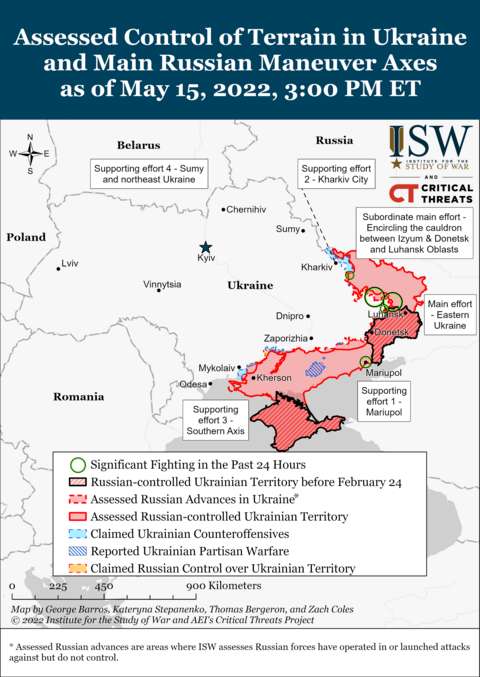
Russian troops have likely given up on a "large-scale encirclement" of Ukrainian troops from Donetsk to Izyum city, also known as the gateway to the eastern Donbas region, according to military analysts.

Russia is likely to prioritise completely seizing the Luhansk administrative region, says the latest assessment by US-based think tank the Institute for the Study of War (ISW).

Russian forces are likely to focus on capturing the city of Severodonetsk, going forward. It's important because controlling it would enable Russia to drive west and link up with its forces pushing south-east of Izyum.

The ISW also says Russia has likely run out of combat-ready reserve forces, forcing the military command to gather soldiers from different units including private military and proxy militias.

The Ukrainian general staff has reported that around 2,500 reservists are training in Belgorod, Voronezh and Rostov regions. This number is unlikely to supplement Russian units that have reportedly lost 20% staffing in some areas, the ISW notes.

Meanwhile in southern Ukraine, Russian troops are digging in for the long haul, looking to establish permanent control in some areas in Mykolaiv and Kherson.

Russia continues to launch military, air and naval strikes on the Azovstal steelworks complex in the southern city of Mariupol, but defenders in the battered port city have maintained their positions, says the ISW.

Image

7:07
A long way to go despite Russian losses
James Waterhouse
Reporting from Kyiv

The UK's Ministry of Defence estimates that Russia has lost about a third of its combat troops. That includes killed soldiers, injured soldiers, as well as damaged equipment.

Nato thinks Ukraine could eventually put itself in a position to fully push the Russians back and win this war. But President Zelensky, when asked about the issue of the besieged southern city of Mariupol, conceded that he didn’t have the military means to push the Russians out and to free that deadlock, as things stand.

A month ago the Pentagon made a similar conclusion, saying the Russians had lost about 25% of its invading forces. I think this has been the case for some time. These are the very reasons Russia has looked to shift things eastwards.

Today the Ukrainians are saying the Russians are trying to launch offensives all along the front line stretching from the east along and across this land corridor to the south. But they are sustaining heavy losses as well as continued morale issues.

There’s heavy fighting around the city of Izyum in the northeast, which the Russians now occupy but the Ukrainians are keen to disrupt things so to not have friendly troops trapped in the Donbas region, where we’re continuing to see heavy fighting.

7:20
Belarus to send forces to Ukraine border, UK MOD says
Belarus has announced the deployment of special operations forces along the Ukrainian border, the UK Ministry of Defence says in its latest intelligence update.

It has also deployed air defence, artillery and missile units to training ranges in the west of the country, it says.

"The presence of Belarusian forces near the border will likely fix Ukrainian troops, so they cannot deploy in support of operations in the Donbas," but adds, "to date Belarusian forces have not been directly involved in the conflict".

7:35
Ukraine preparing for Russian push in Donbas, Zelensky says

Ukraine is preparing for a new Russian push in the eastern Donbas region, President Volodymyr Zelensky says.

Since failing to take Kyiv at the beginning of the invasion in late February, control of Donbas has become one of Moscow's main objectives.

"We are preparing for new attempts by Russia to attack in Donbas, to somehow intensify its movement in the south of Ukraine," President Zelensky said in his nightly address.

"The occupiers still do not want to admit that they are in a dead-end and their so-called 'special operation' has already gone bankrupt," he added.

He once again called on the West to impose an oil embargo on Russia.

"We are also working to strengthen sanctions on Russia. Partners need to make decisions that limit Russia's ties to the world every week," he said.

"The occupiers must feel the rising cost of war for them, feel it constantly."

Re: Freedom of Information

Posted: 16 May 2022, 19:53
by DaffyVina
7:58
Nato expansion would boost Baltic security - Estonian FM
Sweden and Finland joining Nato would increase the security of the Baltic region, Estonian Foreign Minister Eva-Maria Liimets has said.

"When we see that in our neighbourhood also other democratic countries belong to Nato, it would mean that we could have broader joint exercises and also... more defence co-operation," she is quoted as saying by Reuters news agency.

"It would mean that we would have more robust presence of land forces, but also air and maritime defence," she added.

Liimets was in Berlin for a meeting with Nato counterparts.

8:12
BREAKING
Ukrainian troops defending Kharkiv reach Russian border - governor

Ukrainian troops defending the northern city of Kharkiv have reached the state border with Russia, the regional governor said on Monday.

Governor Oleh Sinegubov made the claims on the Telegram messaging service.

It is not yet possible to verify the claims and it's not immediately clear how many troops had reached the Russian border and where.

The Ukrainian defence ministry has published a video purportedly showing a number of soldiers from a territorial defence brigade at an unspecified location on the frontier.

"We have arrived, we are here," one of the soldiers says.

Ukraine has been driving Russian forces away from Kharkiv, the second-largest Ukrainian city.

8:29
Global situation changed radically by Nato expansion - Russia
We have more reaction from Moscow, which has previously said that Nato's expansion would be a mistake.

Russian Deputy Foreign Minister Sergei Ryabkov has said Finland and Sweden choosing to join Nato would have far-reaching consequences, Russian news agencies report.

He also said he saw the global situation changing radically as a result of the move.

Ryabkov said Finland and Sweden should have no illusions that Russia will simply put up with their decision, Interfax reports.

8:44
Baltic nations take little comfort from Russia's mauling in Ukraine
Frank Gardner
BBC News, Security Correspondent

Russia's invasion of Ukraine has convinced governments in the region that they need to seriously beef up their defences if they are to deter President Putin from further military aggression.

Latvia's defence minister told a Baltic security conference yesterday: "Nobody should trust Putin. We've been telling this to our partners for years".

Estonia's president accused Russia of having what he called "a mutated gene of aggression".

So the expected imminent addition of Finland and Sweden to Nato is being celebrated by its members in this region. In practical terms though, the alliance still has some worrying gaps in its defences.

Estonia lacks a credible air defence system, while western forces are heavily outnumbered by the Russian army on its side of the border.

Baltic defence chiefs take little comfort from the mauling the Russians are getting in Ukraine.

Estonia's permanent representative to Nato reminded the conference that despite Russia’s setbacks there, its forces still seized territory the size of the whole of Estonia on just day one.

9:08
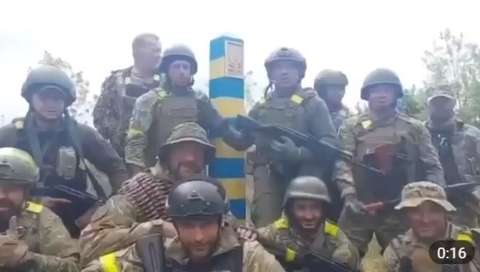
Troops defending Kharkiv reportedly reach Russian border

Image
Ukrainian troops at border
Copyright: Telegram

More now on reports that Ukrainian troops counter-attacking near the city of Kharkiv have reached the Russian border.

The Ukrainian defence ministry has published a video purportedly showing a number of soldiers from a territorial defence brigade at an unspecified location on the frontier.

The governor of the Kharkiv region, Oleh Sinegubov, said troops had restored a sign marking the border.

"We are proud of the soldiers... who restored the border sign on the state border!" he wrote on Telegram.

"We thank everyone who, risking their lives, liberates Ukraine from Russian invaders," he added.

Russia has committed newly mobilised units from occupied Donetsk and Luhansk to Kharkiv, "further evidence of the inadequacy of Russia’s available reserves", the Institute for the Study of War think tank reports.

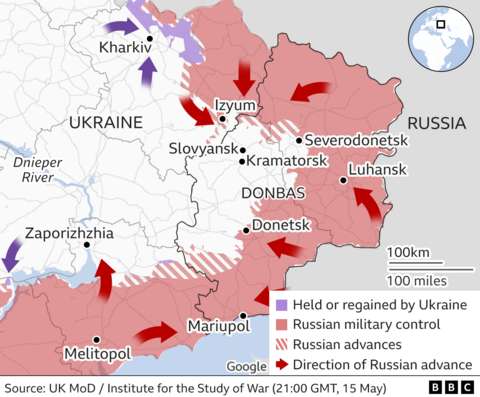
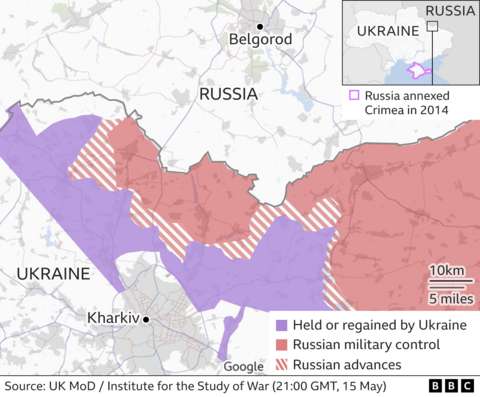
Ukrainian forces have been retaking territory in north-eastern areas in recent days, pushing the Russians out of artillery range of Kharkiv – which had endured weeks of bombardment. Russia has been continuing its offensive in the Donbas region further south.

Map showing areas of Russian military control in Ukraine
Image

Re: Freedom of Information

Posted: 16 May 2022, 20:01
by DaffyVina
10:04
Shelling intensity significantly reduced - Kharkiv region governor
Sophie Williams
Reporting from Lviv

The intensity of the shelling on the city of Kharkiv has "significantly reduced", the governor of Kharkiv regional administration said on Monday.

Oleh Sinegubov said on Telegram that forces in the region are continuing to hold their ground and carry out successful counter-offensive actions.

It comes after he announced that Ukrainian troops had reached the border with Russia. That claim has not yet been verified.

He said that Russian forces are now focusing on maintaining their positions and preparing an offensive in the area of Izyum.

10:19
A symbolic moment
Danny Aeberhard
Europe analyst, BBC World Service

Ukraine says that troops that have been counter-attacking near the north-eastern city of Kharkiv have reached the Russian border.
Flashing "V" signs for victory, and gathered round a wobbly blue and yellow border post, the soldiers addressed President Zelensky.
"We are here! We are at the border!" they say.

It's a symbolic moment, and a morale boost. But despite successes of this counter-offensive, the city of Kharkiv itself is not out of danger.
Russian shelling, though reduced, does continue - several people were injured overnight in the latest attacks.

And Ukraine is not yet in a position to threaten Russian supply lines that lie further east. Meanwhile fierce battles continue in Luhansk and other parts of Donbas.

10:33
3,000 Mariupol residents in Russian 'filtration camp', Ukraine says

At least 3,000 Mariupol residents are being held in a Russian "filtration camp" - a centre for housing civilians before they are evacuated - in the Donetsk Region. That's according to Petro Andryushchenko, an adviser to Mariupol's mayor.

Russia has set up its so-called filtration camps in numerous locations outside Ukraine but many Ukrainians have given chilling accounts of life in these centres, one describing them "like a true concentration camp".

According to him, a former correctional institution in the town of Olenivka has been turned into a filtration camp.

"[They are being held] only because of their active pro-Ukrainian position. Is it not repression and political persecution?", Interfax-Ukraine news agency quoted Andryushchenko as saying.

He also said the Russian "repressive machine" had stepped up activity across Mariupol and its outskirts, with the Russians "actively looking for" Ukrainian war veterans.

11:07
Russia's failure in Kharkiv 'is a defeat for the country'

More now on our top story, that Ukrainian troops have reportedly reached the border with Russia after counter-attacking near the city of Kharkiv - Ukraine's second largest city and home to 1.4 million people.

Russia's inability to take over Kharkiv should be regarded as a defeat for the country, according to General Sir Richard Barrons, former commander of UK Joint Forces Command.

"It was just way too big an objective for the Russian military," Barrons told Radio 4's Today Programme, adding that Russia "doesn’t have the numbers, the will or the skill to take large cities".

"When [the Russians] got stuck round outskirts, it became an easier target for a very aggressive and successful Ukrainian counter-attack, and trying to sit around Kharkiv became much less important than the fight under way in the Donbas," he said.

Barrons said Russia's failure around Kharkiv doesn't amount to a failure of the Russian invasion on its own terms, adding that its focus is now advancing in the east of the country.

12:10
Eurovision winner heads home to help Ukrainian refugees

The frontman of Ukraine's Eurovision winners Kalush Orchestra has returned home to help people fleeing his country due to the war.

Oleg Psiuk, notable for his trademark pink bucket hat, runs a volunteer organisation that helps refugees with food, accommodation, and medication.

Psiuk said he hoped next year's Eurovision song contest would be held "in a newly rebuilt and happy Ukraine".

Winning nations are automatically given the chance to host the annual event. Ukraine's president Volodymyr Zelensky echoed the artist's sentiments, saying: "We will do our best so that Ukraine's Mariupol, a liberated, peaceful city that has been rebuilt, will host guests and participants of Eurovision one day."

Following his win on Saturday night, Psiuk made a plea from the stage. “Please help Ukraine, Mariupol. Help Azovstal right now,” he shouted, referencing some of the worst-hit areas since Russia invaded.

Re: Freedom of Information

Posted: 16 May 2022, 20:22
by DaffyVina
12:30
Russian attack stopped in Sumy region, Ukraine says
Ukrainian border guards repelled an attack by a Russian sabotage and reconnaissance group in the north-eastern region of Sumy this morning, the regional governor Dmytro Zhyvytsky has said.

The Russian group entered Ukrainian territory under the cover of mortar shells, grenades and machine gun fire but retreated after the border guards fought back, Zhyvytsky wrote on Telegram.

Russia's military crossed into the Sumy region shortly after its invasion on Ukraine began on 24 February, however, Ukrainian forces regained control of the region on 8 April and have been bracing for further attacks.

The BBC has not been able to independently verify these claims.

12:51
Eurovision commentator celebrates Ukraine's win from bunker
Video content
Video caption: Timur Miroshnychenko celebrates the Eurovision win from a Kyiv bunker

Ukraine's Eurovision victory continues to bring some joy to the war-torn nation, in particular Timur Miroshnychenko, a commentator whose reaction to the moment his country won the contest was caught on camera.

Covering the event from a bomb shelter in Kyiv, he could be seen celebrating when Kalush Orchestra beat the UK's Sam Ryder to take the title.

Speaking to BBC Breakfast earlier, Miroshnychenko said Eurovision showed his country that the "whole of Europe stands with us" in the face of Russia's war.

"You can't even imagine how important that is for us," he said, adding he was "overwhelmed" with emotion when the result was announced.

Asked if he hopes Ukraine will be able to host the contest next year, the presenter said "of course".

13:17
Nato expansion is a problem - Putin
Russian President Vladimir Putin has said Russia has no issue with Finland and Sweden, but that the expansion of military infrastructure on their territory would demand a reaction from Moscow.

Speaking about Nato expansion at a summit of the Russian-led Collective Security Treaty Organisation (CSTO) in the Russian capital, he says it is a problem for Russia and is in the interest of the USA.

He also says Russia needs to pay additional attention to what he says are Nato's plans to increase its global influence.

13:32
Russia alleges creation of biological weapons near border
We have more on what President Putin has been saying in his latest remarks.

During Russia's invasion of Ukraine, Moscow had obtained "documentary evidence of components of biological weapons being essentially created" near Russia's borders, he told the summit of the Russia-led security bloc CSTO.
He added "possible methods and mechanisms of destabilising the epidemiological situation in post-Soviet space were being worked on".

The BBC is unable to independently verify those claims.

Putin added the CSTO was planning a "series of joint exercises in Kazakhstan, Kyrgyzstan and Tajikistan in the autumn".

13:48
Lukashenko urges unity of Russian military alliance
Belarusian President Alexander Lukashenko has urged other members of a Russian-dominated military alliance to stand united.

He also accused the West of hoping to prolong the conflict in Ukraine in an effort to weaken Russia.

Lukashenko, speaking at a summit of the leaders of the Collective Security Treaty Organisation (CSTO) in Moscow, said "hellish sanctions" against his country and Russia could have been avoided if the group had spoken with a united voice.

"Without a united front, the collective West will build up pressure on the post-Soviet space," Lukashenko said in televised opening remarks, addressing Russian President Vladimir Putin and the leaders of Armenia, Kazakhstan, Kyrgyzstan and Tajikistan.

14:09
BREAKING
Sweden will apply for Nato membership: PM
Swedish PM Magdalena Andersson is giving a press conference in Stockholm.
She begins by confirming that Sweden will apply for Nato membership, upending a long history of military neutrality.
The PM adds that she is confident that there is support for this among the Swedish people.

14:20
We will be vulnerable as Nato application processed: Swedish PM
More now from Swedish PM Magdalena Andersson in Stockholm, she says that Sweden will be in a vulnerable position while its Nato application is being processed.
She adds that people can have a different opinion about joining Nato and still care about Sweden.
Last week, the UK signed security pacts with both Sweden and Finland, agreeing to come to their aid should either nation come under attack.

14:31
Date for Nato application not yet decided: Swedish PM
Swedish PM Magdalena Andersson is still speaking on the country's application to join Nato.

A date for the formal application is still unclear because Sweden will send in its application together with Finland, she says.

She adds that she does not see any direct military threat against Sweden yet.

Ulf Kristersson, leader of the opposition Moderate party, is also speaking at the press conference.

He also backs the decision to apply for Nato membership.

"This is a historic decision", he says.

It's not about party politics but about taking joint responsibility for the country's security, he adds.

14:49
'We are leaving one era and beginning another'
"We are leaving one era and beginning another," Swedish PM Magdalena Andersson tells a press conference after announcing the country will be applying for join Nato.

Sweden and Finland have both expressed a desire to file their Nato applications together.

"We expect it shouldn't take more than a year" for the alliance's 30 members to unanimously ratify Sweden's membership application, Andersson adds.

14:54
Sweden's opposing parties unite over Nato application
Maddy Savage
Reporting from Stockholm

It’s rare to see Sweden’s two largest parties holding a joint news conference, and in such agreement, especially just months before a general election.

But Prime Minister Magdalena Andersson and Ulf Kristersson, leader of the largest opposition party, the centre-right Moderates, clearly wanted to send out a message that Sweden is united when it comes to its Nato application.

Andersson suggested it was the end of an era for her country and said she was confident that the Swedish public supported her decision.

Kristersson argued it wasn’t a time for party politics, but couldn’t contain his excitement that a policy his party has been pushing for for two decades is finally coming into fruition.

Their news conference followed a three-hour special debate in the Swedish parliament earlier on Monday.

There wasn’t a vote, but this was an important chance for opposition parties to express their views before the government’s final decision on Nato membership.

Although most offered strong support for the decision, the Left Party and the Greens remain opposed to the application.

15:09
We do not want nuclear weapons on our territory: Swedish PM
Swedish PM Magdalena Andersson says Europe and Sweden "are living now in a new and dangerous reality".

Andersson has just announced that Sweden will be applying to join Nato, during a press conference.

However, she says Sweden does not want permanent Nato military bases or nuclear weapons on its territory if its membership is approved.

15:14
Sweden and Nato: A change in stance
Joining Nato would mean a monumental shift in stance for Sweden, as the country has been militarily neutral for 200 years.

In some ways, not much would change. Sweden and Finland became official partners of Nato in 1994 and have since become major contributors to the alliance.

They have taken part in several Nato missions since the end of the Cold War.

But a major change would be the application of Nato's "Article 5", which views an attack on one member state as an attack on all.

For the first time Sweden, and Finland - which confirmed on Sunday it would formally apply for membership - would have security guarantees from nuclear states.

15:25
Norway: We will protect Sweden and Finland 'by all means necessary'

Norwegian PM Jonas Gahr Stoere pictured outside 10 Downing Street, London
Getty ImagesCopyright: Getty Images
Image caption: Norwegian PM Jonas Gahr Stoere issued a statement alongside Denmark and Iceland

Reactions are continuing to pour in after Sweden confirmed it would follow in Finland's footsteps and apply for membership to Nato.

Norway, Denmark and Iceland issued a joint pledge to their "Nordic neighbours", offering them support should they come under attack before their respective applications have been processed.

Jonas Gahr Stoere, Norway's prime minister, said in a statement:
Together with Denmark and Iceland, Norway stands ready to assist its Nordic neighbours by all means necessary should they be the victim of aggression on their territory before obtaining Nato membership."
15:35
Russia shrinking its ambitions but continues to mount assaults
James Waterhouse
Reporting from Kyiv

A resident walking near destroyed property in the area of Kharkiv
Copyright: EPA
Image caption: Kharkiv has seen continued attacks since Russia's invasion

We are seeing Russia's goals continue to shrink and move. On 24 February, Putin wanted to take all of this country, to topple President Zelensky and his government but in the 82 days since, this war shifted eastwards.

We are seeing videos this morning, seemingly posted by Ukrainian forces on the Russian border in the north-eastern Kharkiv region, shouting: "Here we are, Mr President."

That suggests that Russians there have been forced out of artillery range from Ukraine's second largest city, Kharkiv, a city that has come under almost continued attack throughout this invasion.

The Russians have moved south to the Donbas region in the east, which Vladimir Putin has said is now his priority.

Military experts say they have even abandoned their goal of trying to encircle defending Ukrainian troops in the area.

The Russians keep shrinking their ambitions but they are still mounting a number of assaults along the front line in this sizeable land corridor that they now occupy.

15:44
We still have severe fighting - Kharkiv governor
Sophie Williams and Olga Pona
Reporting from Lviv

Oleh Synyehubov, governor of Kharkiv regional administration has confirmed to the BBC that Ukrainian troops have pushed Russian forces to the border in one area.

"We are fighting 24/7 so it's hard to say whether it's a permanent result for our troops," he said.

"We experience Russian conquering from different sides, one kilometre to the right or left, we still have severe fighting."

Synyehubov said he could not confirm how many Ukrainian fighters have reached the border but confirmed a video that had been circulating on telegram of soldiers celebrating and said that there were many more troops that were not pictured.

He said that the hotspot of the fighting is in the Izyum direction, a city that is currently occupied by the Russians.

"Izyum is totally blocked, there is no any possibility to held the evacuation process and provide humanitarian aid for civilians," he said.

Synyehubov claimed that Russians are losing huge number of personnel, armoured vehicles and aircraft.

Image

15:52
Zelensky thanks soldiers for driving Russians back from Kharkiv
President Zelesky has sent a message of thanks to Ukrainian soldiers who have driven Russian troops out of Kharkiv, Ukraine's second largest city.

Ukrainian forces have been retaking territory in north-eastern areas in recent days, pushing the Russians out of artillery range of the city, which had endured weeks of bombardment.

Earlier today a group of those soldiers were pictured alongside a restored border sign - in the colours of the Ukrainian flag - having reportedly reached the frontier with Russia.

"The 227th battalion of the 127th territorial defence brigade of Ukraine! Thank you very much!" said Zelensky, in a video posted on Instagram.

"From all Ukrainians, from everyone, from myself and from my family. My gratitude has no borders," he continued.

"I wish you all health, and take care of yourself,"

He concluded, in traditional style: "Glory to Ukraine!"

15:59
Agreement over evacuation of Azovstal wounded soldiers, Russia claims
Russia's Ministry of Defence is claiming to have reached an agreement with Ukraine for wounded soldiers to be evacuated from the besieged Azovstal steelworks in Mariupol.

State-owned Russian news agency RIA Novosti is reporting that, under the terms of the agreement, soldiers who are currently trapped in the steel plant will be taken to a hospital in Russian-controlled territory.

No one on the Ukrainian side has so far confirmed the reports.

Earlier we told you how food and water are becoming increasingly scarce at the site, where hundreds of Ukrainian servicemen are sheltering in bunkers underground, defending the only remaining Ukrainian stronghold in the port city, which is now under Russian control.

16:48
Ukraine pushed back troops to within 3-4km of Russian border - US official
As we've been reporting, Ukrainian officials say troops defending the northern city of Kharkiv, have pushed Russian troops back and even reached as far as the border with Russia.

Now, a senior US defence official has given an assessment of the situation, saying Ukrainian forces have pushed back Russian troops to within three to four kilometress (1.9-2.5 miles) of the Russian border, Reuters reported.

Earlier today, a group of those soldiers were pictured alongside a restored border sign in the colours of the Ukrainian flag - having reportedly reached the frontier with Russia.

The BBC has not been able to independently verify these claims.

17:03
The Baltic Sea is about to become a Nato lake, facing Russia
Paul Adams
BBC Diplomatic Correspondent

Clearly Russia isn’t happy about Finland and Sweden joining Nato.

But Putin said this dramatic step represents “no direct threat” to Russia, and his latest comments contained some important nuance.

Only the expansion of Nato military infrastructure, he said, would provoke a response.

In some ways, the fact that two highly capable military powers have joined the Western alliance changes little on the ground.

But a quick glance at the map shows that Russia’s Kola Peninsula, bristling with naval bases and missile silos, lies just 100 miles (160km) from the border with Finland.

And the home of Russia’s Baltic Fleet, Kaliningrad, which is already sandwiched between Nato members Poland and Lithuania, will soon have another Nato neighbour, Sweden, watching it from across the sea.

The Baltic Sea is about to become a Nato lake.

Putin realises – belatedly perhaps – that there’s nothing he can do to stop the two Nordic countries from joining Nato.

But he’s warning the alliance not to go further, by placing missiles or creating permanent bases in either country.

Such moves are unlikely. Sweden and Finland are already well-established Nato partners, with armed forces that are already highly “interoperable” with their Nato counterparts.

17:21
Life in Kharkiv is returning to normal, but slowly
Olga Malchevska
Reporting from Kharkiv

As we've been reporting, Ukrainian officials say their forces have managed to push Russian troops back in the area around the city of Kharkiv.

For the last few weeks, the Ukrainian army has retaken around a dozen villages in and around Kharkiv, Ukraine's second largest city, making it harder for Russia to attack.

Despite that, we can still hear the sound of blasts from time to time. And the air raid sirens are still being used quite often.

According to local administrations, four more people were wounded today due to Russian shelling in the city. Another two were injured in surrounding villages.

As far as the atmosphere in the city goes, it's still tense. It's very different to pre-war life and while Kharkiv is getting back to normal, it's happening slowly.

17:56
Ukraine is winning and will survive - UK's top military officer
Jonathan Beale
BBC defence correspondent

Britain’s most senior military officer says Ukraine is winning the war and had already "guaranteed" its survival.

Admiral Sir Tony Radakin also described Sweden and Finland’s applications to join Nato as "further victories for Ukraine" in its war with Russia.

Radakin, Chief of the Defence Staff, said: "It's clear Ukraine is winning and Putin is losing."

"Ukraine is winning because Ukraine is in an existential fight for the survival… and it is going to survive." Radakin said its future as an independent country was now guaranteed.

He added that victory for Ukraine went much further than what was happening on the battlefield. He said Ukraine was on "the front line of the defence of global rules and global values".

He also said that UK Prime Minister Boris Johnson's direction to him was that Putin must fail.

Re: Freedom of Information

Posted: 16 May 2022, 20:27
by DaffyVina
18:14
Ten civilians killed by Russian shelling in Severodonetsk, Ukraine says
At least 10 civilians have been killed by Russian shelling in the city of Severodonetsk in eastern Ukraine today, the governor of Luhansk region, Serhiy Haidai, has said.

Haidai said that heavy shelling had caused fires in residential areas in the region, damaging houses and hospitals and hitting a scientific production plant.

Russia has shifted most of the focus of its war to eastern Ukraine, after pulling back its forces from near the capital Kyiv.

The BBC has not been able to independently verify these claims.

18:58
Turkey says it will veto Finland and Sweden's Nato membership
Turkish President Tayyip Erdogan has said Swedish and Finnish delegations should not bother to come to Turkey.

The incumbent members of Nato said earlier on Monday that they would send diplomats to Turkey to try to overcome the country's objections to their plan to join the military alliance.

But President Erdogan has stated Turkey will not approve their bids to join Nato.

He has labelled Sweden a "hatchery" for terrorist organisations, claiming there are terrorists within parliament.

Turkey accuses Sweden and Finland of sheltering people it says are linked to groups it deems terrorists, namely the Kurdistan Workers Party (PKK) militant group and followers of Fethullah Gulen, whom Ankara accuses of orchestrating the 2016 coup attempt against President Erdogan and his government.

19:09
Global brands pull out of Russia at major cost to them
Theo Leggett
BBC International Business Correspondent

As we've been reporting, two major international brands have announced they are pulling out of Russia.

The carmaker Renault is selling its Moscow factory and its stake in the manufacturer of Lada cars, in a deal that amounts to nationalisation of its Russian business.

Meanwhile, fast-food giant McDonalds says it is preparing to sell its Russian restaurants to a local buyer. Both companies are expected to write off investments worth billions of dollars.

Renault had initially resisted calls to leave Russia. But after the company was directly criticised by Ukraine's President Volodymir Zelensky, along with other French firms, for allegedly "sponsoring the Russian war machine", it suspended its Russian operations.

Now, it is pulling out altogether, abandoning assets including its Moscow factory and its 68% stake in Avtovaz, the maker of Lada cars.

Meanwhile, McDonalds says it is looking to sell its entire chain of restaurants in Russia - which have been closed since early March.

It says continued ownership of the business is no longer tenable, or consistent with its values. It is removing its branding from its outlets there, a process it describes as "de-arching".

Re: Freedom of Information

Posted: 16 May 2022, 20:43
by DaffyVina
Pinned down by Russian fire in key frontline village
By Quentin Sommerville
Near Izyum, eastern Ukraine
Published7 hours ago
https://www.bbc.co.uk/news/world-europe-61460790

Media caption, Watch: Quentin Sommerville under fire with Ukrainian troops

Serhiy drove like a maniac. Before the war, the laconic Ukrainian was a lawyer. Now he sat in the front of a Mitsubishi pick-up, barrelling along a dirt road at 65mph (100km/h).

Three of us were crammed in the back and the seat belts didn't work. But that was the least of anyone's worries - up ahead lay our destination, and it was being shelled by Russian artillery.

The car swerved to avoid a spent Russian shell stuck in the earth. "Cluster bomb," said Serhiy. It felt as though it could be a marker - a warning to travel no further.

"Do you want to see the village first, or our bunker?" he asked as the green pickup lurched to a halt. "Bunker," cameraman Darren Conway and I said in unison.


Soldier in the bunker
IMAGE SOURCE,DARREN CONWAY
Image caption, A volunteer fighter, part of Ukraine's Territorial Defence takes a break in the bunker

Vladimir Putin has turned day into night along Ukraine's eastern front, forcing people underground. This village lay at the edge of Izyum, where Russian forces are concentrated. The artillery barrage was ending as we descended into the cool darkness of the shelter.

After its failure to take the whole country, Russia is focused instead on taking Ukraine in pieces. The men in the bunker - and there are many of them - are here to ensure that doesn't happen. Izyum is in Russian hands, it's called the gateway to Donbas. During Russia's Victory Day celebrations last week, they crossed live on television from Moscow to occupiers in the city.

Bare bulbs lit the dark space in the bunker - the new home to the group of volunteer fighters who are part of Ukraine's Territorial Defence.

It could have been a scene from earlier wars, except it was pimped by technology. A widescreen TV showed live feeds from powerful spy cameras trained on Russian positions. "A gift from our friends," one commander told me, indicating they had come from western governments.

The men sat around scrolling through Instagram and Facebook, messaging wives and lovers. If frontline troops have their way, Elon Musk will be made a hero of Ukraine. His Starlink satellite network provides free internet to men across the battle space.


Troops under fire
IMAGE SOURCE,DARREN CONWAY
Image caption, Troops are under an almost constant barrage of constant fire from nearby Russian positions

The shelling restarted outside, loud enough to make the cobwebs on the ceiling dance. "The Russians have finished their cigarette break," another fighter said, rising from his army cot.

It was time for us to move. We were to accompany a foot patrol, some of it across open ground, to the first line of defence. Outside a dove called out, and everything was still. Then somewhere I could hear automatic gunfire.

"Don't bunch up," we were instructed, as we walked in single file through the ruined village. Of course, it would make us more of a target, but it is hard to resist the urge when under fire.


Image
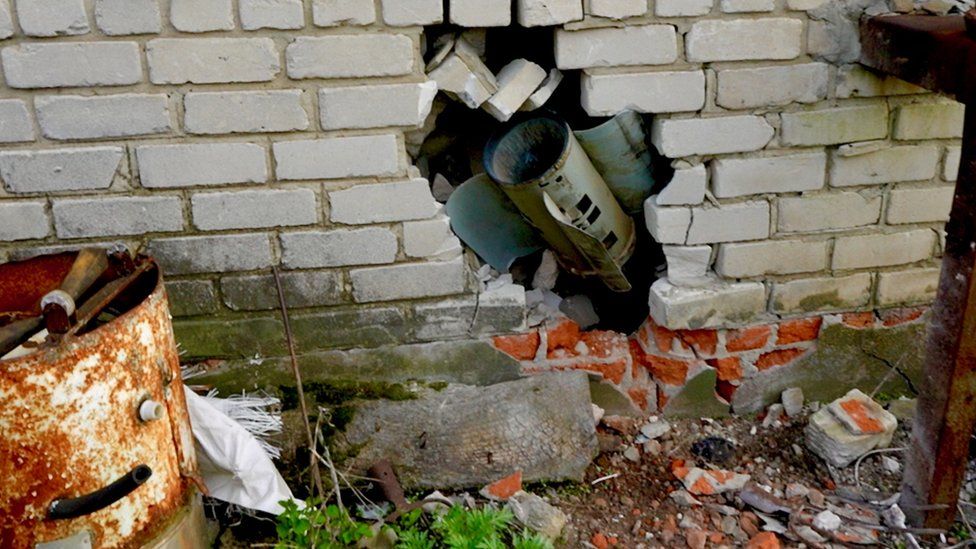
Rocket embedded in a wall
IMAGE SOURCE,DARREN CONWAY
Image caption, A Russian shell embedded in the wall of a home

Incoming shelling restarted in earnest - one shell squealed overhead and hit not far away. A Russian tank was operating nearby, and then the mortar fire started, too. The men leading us moved steadily through back yards and gardens, avoiding roads and trying to stay out of sight of spotter drones.

I ducked as another shell whistled overhead and exploded 300m away. "If you can hear them, it isn't for you," said Yuri who was accompanying us. It is the ones you don't hear that kill you. It's the third time in this war that someone has cracked that grim joke.

The men pressed on and we reached our destination. It was much further than we'd been led to believe. Inside, the unit was having lunch, apparently unbothered by the constant explosions.

"God save the Queen," said Yuri pointing out a British-supplied anti-tank weapon. "Thank you, Mr Johnson, we need more," he said with a laugh. It struck me that what these men needed was armoured vehicles - I didn't see any during the whole day at the front.

We waited out the latest barrage. Surely it was time for the Russians to take another cigarette break?

Then we were on the move again, fresh craters along our route and the smell of cordite and smoke in the air. The ground was littered with enemy munitions.

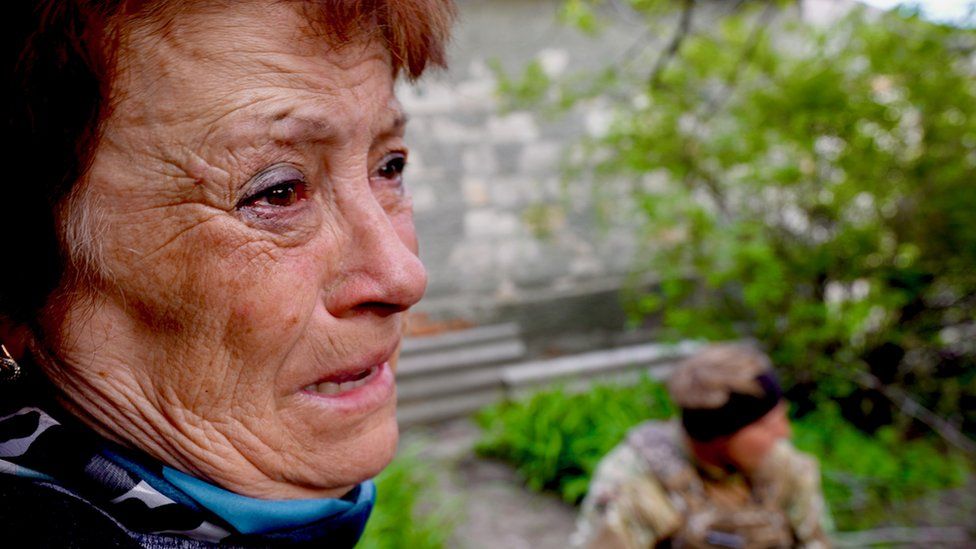
We passed byres and stables, wary looking cows and nervy sheep still in their pens. When the villagers had fled, they had no time to save their livestock, the only sign of life. But then, improbably, a woman with red hair and green eye make-up came out of her house, as if to see what all the commotion was about. Natasha began to cry. She told us she couldn't leave her village because her husband was buried here. It would be a betrayal, she said.


Image
Natasha is one of the only residents left in the village
IMAGE SOURCE,DARREN CONWAY
Image caption, The villagers have left but Natasha doesn't want to leave her home

The shelling reached a new crescendo, the patrol was pinned down, and even Natasha ducked. "Would you boys like some borscht?" she asked. Instead, we took cover in her garden underground larder, where jars of preserved vegetables were turning bad on the wooden shelves.

Finally, the sound of outgoing artillery. Ukrainian shells headed over Natasha's house seeking Russian targets. We took that as our signal to leave, but Natasha refused to come. Her husband's portrait was still hanging on her sitting room wall, she said. The defence unit said they would send someone back for her.


Map showing Izyum and north-west Donbas

Back in the operations den, the men were crowded around the surveillance screen. Twenty Russian infantry, with mortars, had been trying to attack the village while we were with the patrol. The Ukrainian guns didn't find them, so today like many other days, stalemate reigned. But the defenders' lines were unbreached and the men around us had again done their duty. The gateway to Donbas remained closed.

Defeat in the west of the country has sharpened Russia's focus to Izyum, where it has its command headquarters, and Donbas to the south, were a long war has been fought against separatists seeking to break away Donetsk and Luhansk. But even concentrated there, Russia struggles to advance.

But our day wasn't over. The Russians were still firing and we needed to get back across those exposed roads and out of range of their guns. It was dusk when Serhiy arrived in his green pickup. Perhaps he was in a good mood, or maybe it was more frontline humour, but he was humming God Save the Queen.

Before we had set off on the day's journey, I'd met a veteran American journalist who had been to the same front, 'You'll pray on your way in, and you'll pray on your way out," she said. As I ran through the Lord's Prayer in my head, we accelerated across the fields and hit something hard in the road. Thankfully for the second time in its short life, a Russian shell that had landed in the dirt didn't explode.


Follow Quentin on Twitter @sommervilletv

Re: Freedom of Information

Posted: 16 May 2022, 23:42
by DaffyVina
21:10
Putin making military decisions in Donbas - Western military source
Jonathan Beale
BBC defence correspondent

Russia's President Putin and his military chief, General Valery Gerasimov, are believed to be directly intervening in Russia’s military offensive in Ukraine and taking decisions normally made by more junior officers - according to a Western military source.

Speaking on the condition of anonymity, the source said: “We think Putin and Gerasimov are involved in tactical decision-making at a level we would normally expect to be taken by a colonel or brigadier.”

The military source said the two were the ones making decisions about troop movements in the Donbas – the area of eastern Ukraine which is now the focus of Russia’s military offensive.

There have already been suggestions that President Putin has become more involved in the day-to-day running of the military campaign, ever since Russia suffered setbacks in the north of the country and around the capital Kyiv.

There’s also been recent speculation that Russia’s military chief, General Gerasimov, may have been sidelined – along with unsubstantiated rumours that he was injured while visiting the Donbas a few weeks ago.

But the Western military official made clear that Russia’s chief of the general staff was still giving orders. “Gerasimov is up and running,” he said.

21:21
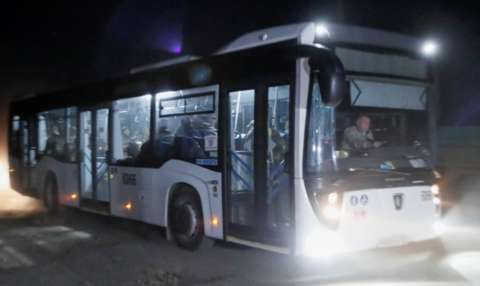
Ukrainian fighters being evacuated from Azovstal - reports
Reuters news agency said this picture shows one of the buses carrying fighters from the steel works - the BBC cannot independently verify this
Copyright: Reuters
Image

We've news of what appears to be a development at the Azovstal steelworks in Mariupol.

About a dozen buses carrying Ukrainian fighters who were holed up beneath the besieged plant have been seen leaving the site, Reuters news agency is reporting.

This has not been confirmed by Ukrainian authorities and the BBC cannot verify it independently.

A senior commander of Ukrainian forces at the besieged plant said earlier in a post on social media that fighters there were carrying out a decision by the Ukrainian military high command to save the lives of service personnel, but he gave no details of what the decision was.

Earlier we reported that Russia's Ministry of Defence said it had reached an agreement with Ukraine for wounded soldiers to be evacuated from the besieged Azovstal steelworks.

21:54
Don't come back to Kyiv, mayor urges capital's residents

Kyiv's mayor Vitali Klitschko is still advising residents who have fled to a safer location to stay there, rather than return to Ukraine's capital at present.

"We can't 100% guarantee safety to everyone," the mayor told BBC World.

Russian forces have moved away from Kyiv and refocused their attack on the east of the country, after being pushed back from areas around the capital earlier on in the invasion.

Klitschko said the city was "slowly returning to life" with cafes and bars reopening, but warned Kyiv remained "a target for Russian aggressors" - with air raid warnings still sounding and night-time curfews in place.

He calculated at least one million of Kyiv's pre-war population had not yet come back to the city, and said Kyiv was "still empty", with the country ravaged by war, damaged infrastructure and rising unemployment.

22:24 16 May
BREAKING
Azovstal evacuation operation under way - Ukraine
Ukraine's defence ministry has confirmed that an operation to evacuate fighters from the besieged Azovstal steelworks is under way.

Deputy Defence Minister Hanna Malyar said that 53 heavily injured fighters were taken to the town of Novoazovsk, held by Russian-backed rebels. Another 211 were evacuated using a humanitarian corridor to another rebel-held location, Olenivka,

As we reported earlier, Reuters news agency says about a dozen buses carrying Ukrainian fighters who were holed up beneath the besieged plant have been seen leaving the site.

22:43 16 May
Mariupol fighters to be exchanged for captive Russians - Ukraine
Ukrainian Deputy Defence Minister Hanna Malyar says the 264 wounded Ukrainian fighters rescued from the Azovstal steel plant in Mariupol would be exchanged for captured Russian soldiers.

23:01 16 May
Zelensky: 'We need our heroes alive'

"Thanks to the actions of the Ukrainian military - the Armed Forces of Ukraine, intelligence, the negotiating team, the International Committee of the Red Cross and the United Nations, we hope that we will be able to save the lives of our guys," says Zelensky.

"Among them are the seriously wounded. They are being provided with medical aid."

"I want to emphasise: Ukraine needs Ukrainian heroes alive," he continues.

"This is our principle. I think that every adequate person will understand these words."

Zelensky added that the work "to bring the boys home" continues in Mariupol while other fighting continues to rage in the country's east.

Ukraine's troops "are repelling constant attacks in those areas where Russia is still trying to advance", he said, pointing to the city of Severodonetsk as one of Russia's main targets.

23:15 16 May
Military chiefs say Mariupol defenders are 'heroes of our time'

The Ukrainian military's general staff has said that fighters evacuated from the Azovstal steel plant in Mariupol are "heroes of our time".

In a message posted to Facebook, army chiefs said the determination of the Ukrainian troops had forced Russia to keep around 20,000 troops entrenched around the city and "hindered the implementation of the plan for the rapid capture of Zaporizhzhia".

"Forging the enemy's core forces around Mariupol has given us the opportunity to prepare and create the defensive frontiers on which our troops are still present today and give a decent counterpoint to the aggressor," the post said.

"We got the critically needed time to build reserves, regroup forces, and get help from partners," military chiefs went on.

The post added that some fighters remain trapped at the plant and said measures to "rescue defenders who remain in the territory of Azovstal are ongoing".

23:36 16 May
Azovstal - symbol of Ukrainian resistance
Destroyed facilities of Azovstal Iron and Steel Works in Mariupol
Copyright: Reuters
Azovstal steelworks has become a symbol of Ukrainian resistance against Russia's invasion.

Hundreds of fighters have been holed up in the tunnels beneath the massive industrial plant, defending the last Ukrainian stronghold in the besieged city of Mariupol.

The strategically located port city came under massive bombardment from Russian forces early in the invasion.

Taking the city would allow them to complete a land bridge between Crimea and the Donbas region, as well as giving Russia full control of more than 80% of Ukraine's Black Sea coastline.

Ukraine says the Russian bombardment and siege of the city killed tens of thousands of people, with reports of bodies lying in the streets. Moscow denies having targeted civilians.

Pummelled with artillery, rockets and missiles, 90% of the city has been damaged or destroyed, Ukrainian officials say.

Only Azovstal held out.

Its defenders had said they were "buying time" for the rest of Ukraine to battle Russian forces and secure Western arms needed to withstand Russia's assault.

Until 10 days ago, there were also hundreds of civilians sheltering at the steel plant, with food, water and medicine in short supply.

It took about a week to evacuate the women, children and the elderly who had been trapped there for more than a month, in an operation coordinated by the UN and the Red Cross, which concluded on 7 May.

Since then, it's believed only the fighters remain - many having vowed to die fighting rather than surrender.