19:17 17 May
Zelensky tells Cannes Film Festival 'hatred will disappear'
Volodymyr Zelensky addresses the audience at the Cannes Film Festival on a large screen
Copyright: Reuters
He's addressed parliaments and legislatures around the world - and now former actor and comedian, and current Ukrainian president, Volodymyr Zelensky has taken his message to the Cannes Film Festival.
In a video he told the audience:
"In the end, hatred will disappear and dictators will die."
He made reference to the power of cinema during World War 2, including the Charlie Chaplin film The Great Dictator which mocked Adolf Hitler.
"We need a new Chaplin to prove today that cinema is not mute," he said.
His speech received a standing ovation from the audience at the famous festival.
20:18 17 May
More EU support needed for Ukrainian refugees - Polish president
Europe is neglecting Poland and Hungary when it comes to support for the number of Ukrainian refugees the countries are taking in, Polish President Andrzej Duda has said.
Following a meeting with his Hungarian counterpart earlier today, Duda claimed neither country had received enough backing to implement the programmes needed to sufficiently help the millions of people forced out of their homes.
He said he had "no doubt" this attitude "undermines European unity", but promised to continue to do "everything to make guests from Ukraine feel as good as possible in Poland".
The latest UN data shows that 6.2 million people have left Ukraine since Russia invaded:
Poland has taken in 3,376,992 refugees
Romania 919,574
Russia 850,534
Hungary 610,076
Moldova 464,294
Slovakia 424,027
Belarus 27,308
20:48 17 May
Seven civilians killed in Donetsk by Russian attacks - regional governor
At least seven civilians were killed and six wounded in Ukraine's Donetsk region by Russian attacks on Tuesday, regional governor Pavlo Kyrylenko has said.
In a post on the Telegram social media platform, he said two people had died in Bakhmutske, two in Bakhmut, one in Avdiivka, one in Drobysheve and one in Soledar.
He added that the number of casualties in Mariupol and Volnovakha remains unknown.
The BBC has been unable to independently verify these claims.
Donetsk is part of the eastern Donbas region where Russia is focusing its forces. Much of the Donbas was already controlled by Russian-backed separatists prior to the invasion of Ukraine.
22:24 17 May
US launches programme to gather evidence of war crimes
The US State Department has announced a new programme to capture and analyse evidence of Russian-perpetrated war crimes and other atrocities in Ukraine.
The Conflict Observatory aims to document, verify and disseminate open-source evidence of the actions of Russian forces during the invasion of Ukraine.
Under the programme, the US State Department will gather satellite imagery and information shared via social media as part of a broader effort to hold Russia accountable for any war crimes.
An online platform will publicly share the gathered information to help refute any attempt at disinformation by the Russian government, the State Department said.
* * * * *
18 May 2022
6:00
Welcome back
It's just after 08:00 in Ukraine, and we're resuming our live coverage. Here's a quick recap of our main story:
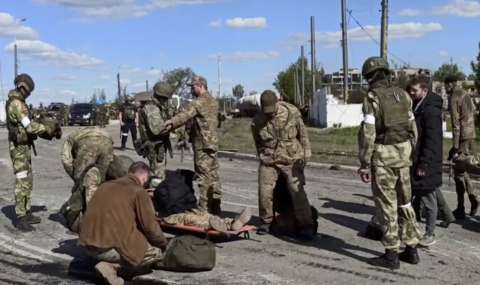
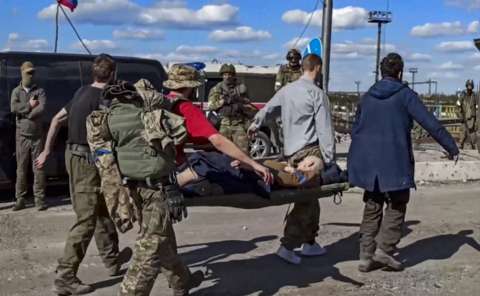
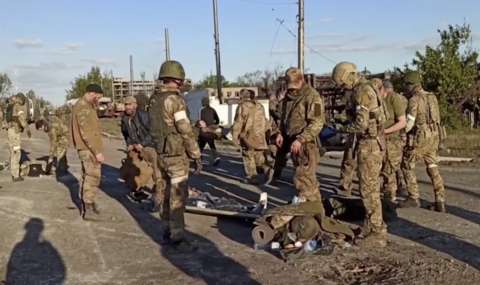
Ukraine said it is doing "everything possible and impossible" to save the remaining fighters trapped in Mariupol's Azovstal steelworks - their fate remains unclear as the city appears on the verge of falling
Hundreds of fighters were evacuated from the site over the last few days but several more are still trapped there - Ukraine's Deputy Defence Minister Hanna Maliar said Kyiv knew how many soldiers were still at the plant but refused to disclose the number
The Ukraine military asked the fighters who made the last stand in Azovstal to surrender on Tuesday, bringing an end to the gruelling, three-month-old siege of the south-eastern port city
Ukraine has said its forces will be exchanged for Russian prisoners-of-war, but Moscow has not confirmed this. A senior Russian MP has accused the Ukrainian soldiers of being Nazis and war criminals and Russia's Supreme Court is due to hear a prosecutors' request to designate the group many of the fighters belong to - the Azov Regiment - a terrorist organisation.
Talks between the two countries to end the war have been put on hold. Russia says Ukraine has "practically withdrawn" from the negotiations, while Kyiv blames Moscow for failing to compromise
Russia continues missile strikes across country, says Ukraine military
Ukraine's military says that Russian forces continue to launch missile strikes at military targets and civilians throughout Ukraine.
In Mariupol - which appears to be on the verge of falling after battling a months-long siege - Russian solders are blocking units in the Azovstal steel mill, according to an update by Ukraine's General Staff of the Armed Forces.
They add that Russian forces are also attacking in Donestsk, and continue to shell border areas of Chernihiv and Sumy.
6:28
Russian losses have led to 'disunited command' - UK MoD
Russia is likely to have been using thousands of Chechen fighters in the Mariupol and Luhansk areas, underlining its "significant resourcing problems in Ukraine", according to the UK Ministry of Defence.
The MoD says: "Despite Russian forces having encircled Mariupol for over ten weeks, staunch Ukrainian resistance delayed Russia’s ability to gain full control over the city. This frustrated its early attempts to capture a key city and inflicted costly personnel losses amongst Russian forces."
This left Russia needing to make "significant use of auxiliary personnel", the MoD says in its daily defence intelligence update.
"These forces likely consist of both individual volunteers and National Guard units, which are routinely dedicated to securing the rule of Chechen Republic Head, Ramazan Kadyrov."
It says Kadyrov likely maintains close personal oversight of the deployment, with his cousin probably acting as the Chechen field commander in Mariupol.
The MoD says using such "disparate personnel" could be contributing to a disunited command, hampering Russian operations.
6:56
Russian gymnast banned for wearing pro-war symbol
A Russian gymnast has been banned for a year for wearing a symbol associated with support for the invasion of Ukraine while on the medal podium.
Ivan Kuliak displayed a letter "Z" on his singlet while receiving bronze for an event in Qatar in March. At the ceremony he stood beside the gold medal winner, a Ukrainian.
The Z is painted onto Russian tanks and vehicles in Ukraine and worn by pro-war Russians, including politicians.
The Gymnastics Ethics Foundation found that the 20-year-old had violated the rules of the sport's governing body.
Kuliak must also return his medal and prize money but can appeal the decision.
7:12
Russian missile shot down over Dnipro, governor says
Hugo Bachega
Reporting from Dnipro
A damaged building in Dnipro
Copyright: Valentyn Reznichenko/Facebook
Two loud explosions were heard at about 06:00 here in Dnipro, a city in central Ukraine that has been largely spared of Russian attacks recently.
Valentyn Reznichenko, the region’s governor, says one missile was shot down by the Ukrainian air defence. The debris fell on a private garden, he says, damaging two houses and wounding a woman.
Another missile hit transport infrastructure, he says, without giving details.
One of the country’s largest cities with a population of about one million, Dnipro has become a hub for thousands of people fleeing the conflict in southern and eastern Ukraine, including those escaping the besieged city of Mariupol.
The war hasn’t brought to Dnipro the same level of suffering and destruction inflicted by Russia on other Ukrainian cities. But the constant air raid sirens, sandbags and barricades in the streets are a reminder of the conflict - as are the sporadic attacks. Earlier this month a Russian missile hit an area in the centre of the city.
7:22
Russia firing missiles because of lack of success on ground - Zelensky
Russia is firing long-range missiles on Ukrainian civilian and military infrastructure because its army cannot demonstrate any significant achievements on the ground, Ukrainian President Volodymyr Zelensky has claimed.
In a video address released late last night, Zelensky said there had been missile shelling in the Lviv, Sumy and Chernihiv regions, air strikes in the Luhansk region and "sabotage activity" in border areas.
"All this is not just creating tension for our state, not just testing our strength," Zelensky says.
"This is a kind of attempt of the Russian army to compensate for a series of failures in the east and south of our country.
"They cannot demonstrate success with general military action in the areas where they are trying to advance. So they are trying to show success through their missiles and other activities. To no avail as well."
7:46
What will happen to the evacuated fighters?
Ukraine says all those being evacuated from the Mariupol steelworks will be swapped for Russian prisoners of war, but the parliament in Moscow is sending out a different signal, with the speaker saying "Nazi criminals" should not be exchanged.
A Ukrainian MP, Oleksiy Goncharenko, told the BBC that he hoped the Russians would honour the deal:
For us, the main (thing) is to save the lives of these heroes, because they are real heroes of the whole free world. We worry very much, because we know that Russians don't care about their soldiers. We are ready to exchange, but they don't even take (the) bodies of their soldiers and officers from the field. So I hope we will have (the) exchange, and I hope to see our heroes back at home, and see them alive.
Oleksiy Goncharenko
Ukrainian MP
7:55
Finland and Sweden submit Nato applications
Finland's Ambassador to NATO Klaus Korhonen, NATO Secretary-General Jens Stoltenberg and Sweden's Ambassador to NATO Axel Wernhoff attend a ceremony to mark Sweden's and Finland's application for membership in Brussels, Belgium, 18 May 2022.
Copyright: EPA
Image caption: The ambassadors to Nato from Sweden and Finland handed in their applications to the alliance's secretary general (centre) this morning
Sweden and Finland have formally submitted their applications to join Nato this morning.
The alliance's secretary general Jens Stoltenberg says it is "a historic moment, which we must seize", adding that the Nordic countries' membership would increase shared security.
The two nations' leaders announced their intention to apply for membership of the defence alliance on Sunday, in the wake of Russia's invasion of Ukraine. The Swedish parliament voted in favour on Monday, with Finland's doing the same yesterday.
Finland shares a lengthy land and sea border with Russia. Both it and neighbouring Sweden remained neutral throughout the Cold War so their applications to join Nato mark a significant change in stance.
The process could be fast-tracked to only take a few weeks but would require the support of all 30 members, ratification of which could take up to a year. The Turkish government has voiced opposition.
Finnish President Sauli Niinisto and Sweden's Prime Minister Magdalena Andersson are due to meet US President Joe Biden at the White House tomorrow to discuss topics including the Nato applications, European security and support for Ukraine.
8:12
Mariupol rescue only ends when all in Ukrainian territory - minister
The Azovstal steelworks rescue operation will only be finished when all Mariupol defenders have been evacuated to territories under Ukrainian control, Ukraine's deputy defence minister Hanna Maliar tells the BBC.
"There are still many people left at Azovstal and we continue negotiations in order to get them out of there," Maliar says.
She says it is a sensitive operation and any command can potentially be dangerous for people's lives.
Calls from politicians in Moscow to put some of those taken from the steelworks on trial for war crimes "were most likely made for domestic propaganda in Russia", Maliar says.
"Negotiations are still ongoing and we very much hope for a positive result."
8:27
Relatives are worried about evacuated fighters
Hugo Bachega
Reporting from Dnipro
What will happen to the hundreds of Ukrainian soldiers who have surrendered from the besieged steelworks in Mariupol and are now in Russian hands is still unclear. And that’s why their relatives are concerned.
No details of the deal negotiated between Ukraine and Russia, which put an end to the bloodiest fight in this war, have been made public. For weeks, hundreds of fighters holed up in the Azovstal’s underground tunnels and shelters put up incredible resistance, and were seen as heroes for many in this country.
They vowed to fight until the end. But, late on Monday, they were ordered to surrender.
Ukrainian authorities say the fighters could be swapped for Russian prisoners. The Russians, however, have not confirmed this. In fact, just hours after the first group left the plant, Russian officials suggested some could be questioned as war criminals, while high-profile politicians voiced strong opposition to any exchange.
They have seized on the fact that many of the fighters belong to the Azov regiment, which was set up as a far-right volunteer militia in 2014. Its members deny being neo-Nazi, and Ukraine says the regiment has been reformed and integrated into the National Guard.
President Vladimir Putin of Russia says his “special military operation” in Ukraine is an effort to “de-Nazify” the country. Any deal to exchange Azov fighters could backfire domestically.
Anna, whose brother was inside the plant, told me on Tuesday: “There are many concerns about how [the fighters] will be treated and whether they’ll manage to survive until a swap [happens].”
Oksana, the wife of a fighter, said: “It’s very worrying for me and others that they were evacuated to Russian-controlled territory… We’re very, very worried about the things that can happen to them.”
Analysis
Posted at 8:55
Mariupol defenders faced an impossible choice
Lyse Doucet
Reporting from Kyiv
I think there was a sharp intake of breath right across this country when the news was announced that some of the last soldiers bunkered in the Azovstal steelworks were not just leaving but leaving to territory occupied by Russia.
It was an impossible choice - if they stayed in the steelworks they would face a certain death, but what they face now is, at best, a very, very uncertain fate.
President Zelensky for weeks and weeks had been telling the fighters "please give up if you feel you must, please don't feel you must give your lives in this fight".
Again and again the fighters of the Azov battalion said "no, we must continue to fight".
Last night President Zelensky said this mission to evacuate the remaining soldiers - and to take care of the ones who have already left - involved, in his words, the most influential international mediators. Because the only thing which has reassured many here, and most of all the families of the fighters, is that there is international involvement, that behind the scenes there is the Red Cross and the United Nations, and they are hoping against hope this can help to persuade Russia.
Mariupol is a strategic prize for the Russians but members of the Azov battalion, a group which has origins in the far right, are a prize for President Putin, who it is feared may parade them to say "see, I told you there were Nazis in Ukraine".
9:16
BREAKING
Nearly 1,000 Azovstal fighters have surrendered, Russia says
Nearly 1,000 Ukrainian fighters holed up in Mariupol's Azovstal steelworks have now surrendered, according to Russia's defence ministry.
It says 694 fighters from the Ukrainian military and Azov battalion have surrendered over the past 24 hours.
The ministry says the total who have now surrendered is 959 (this includes the 265 it said left in the first evacuations on Monday).
Those leaving the steelworks are being taken to Russian-controlled territory.
Ukrainian authorities have not given an update on how many fighters have left Azovstal today.
9:30
Capturing Azov fighters could let Putin claim de-Nazification is happening
Steve Rosenberg
BBC Russia editor
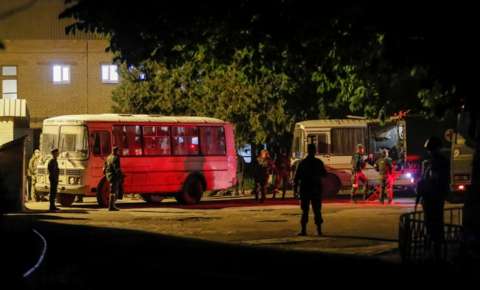
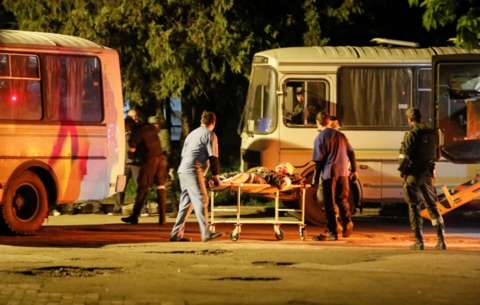
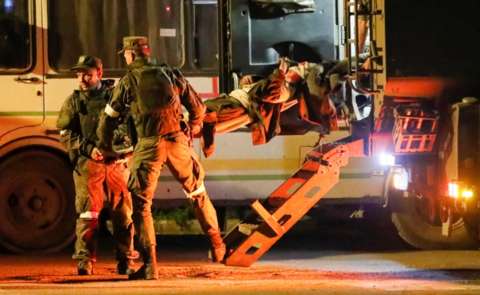
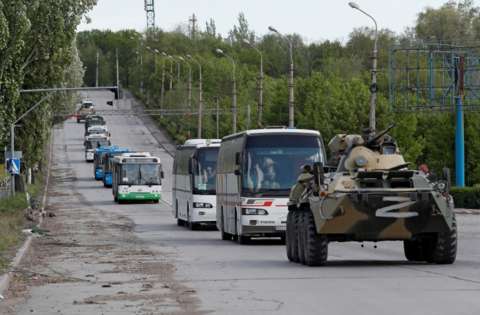
Self-proclaimed Donetsk People's Republic militia guard buses readied for Ukrainian servicemen being evacuated from the besieged Azovstal steel plant in Mariupol, Ukraine
Copyright: EPA
Image caption: Azov fighters have been among the busloads of Ukrainians taken from Mariupol
President Putin has presented what he calls his "special military operation" as an attempt to de-Nazify Ukraine - that's been one of the many excuses the Russian authorities have come up with to try to justify the decision to invade Ukraine.
Russian officials have claimed, without any evidence, that Ukraine has been overrun by neo-Nazis, fascists, ultra-nationalists.
Mariupol was the spiritual home of the Azov regiment, which back in 2014 did include some far-right volunteers but has since been integrated into the Ukrainian National Guard - and Kyiv insists the regiment now has nothing to do with politics.
Taking Azov fighters prisoner and potentially putting them on trial allows Vladimir Putin to claim to his people that de-Nazification is happening.
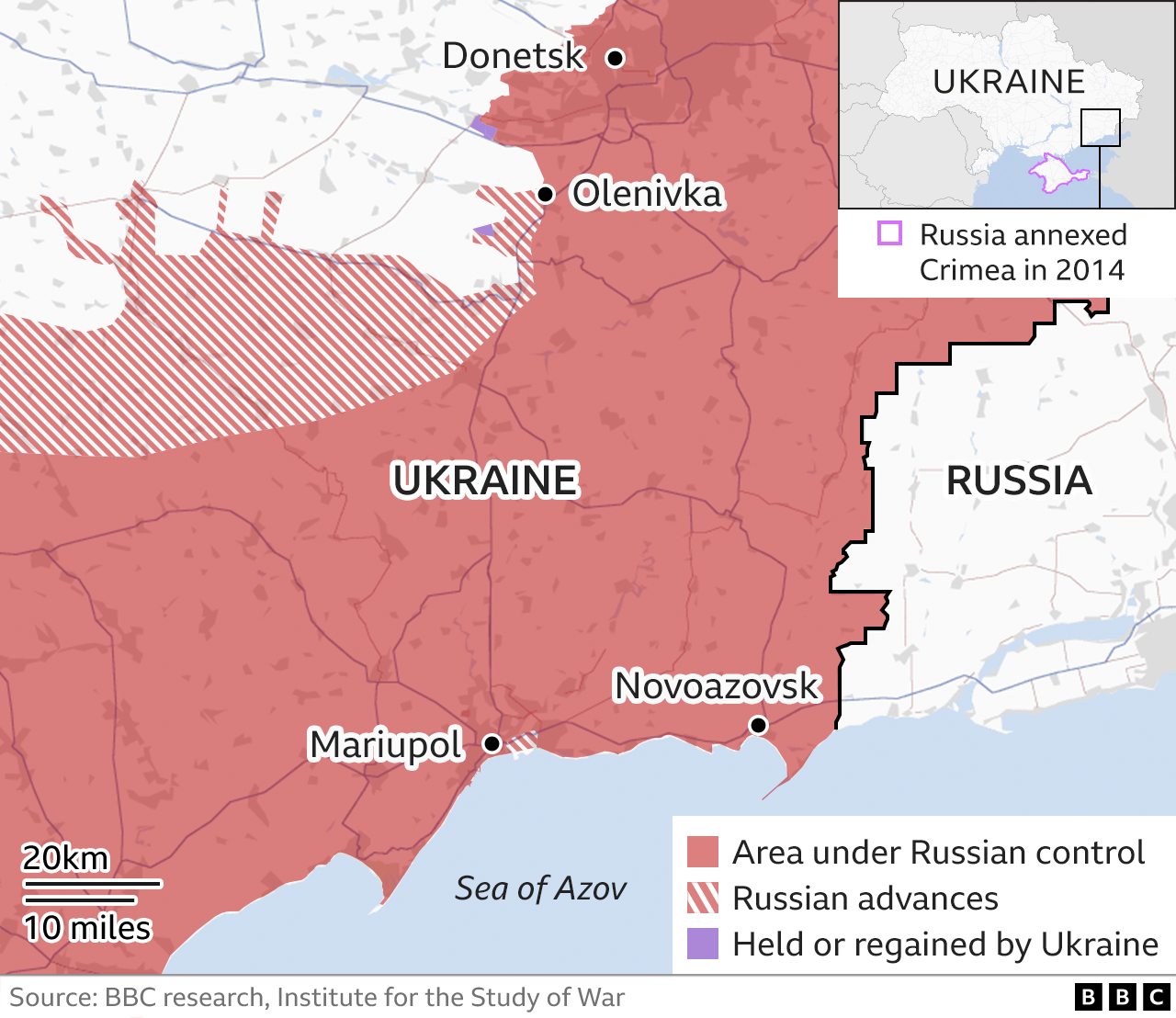
Last week one of Russia's most popular newspapers, a fiercely pro-Kremlin one, suggested that the most likely scenario now in Ukraine was what it described as a limited Russian victory. By that it meant Russia taking control of the Luhansk and Donetsk regions in their entirety plus the land corridor to Crimea - but it also mentioned seizing other Ukrainian cities like Odesa and Dnipro. That is still some way off, I have to say.
For Russia military progress has been slow and the Russians are beginning to admit this. A couple of days ago I was astonished to hear, live on Russian state television, a retired colonel painting a very sombre, very realistic picture of how things are looking for Russia in Ukraine.
I wonder whether that is a sign that the authorities here are preparing viewers for bad news about how things have gone, or at least giving themselves the option of saying that at some point in the future.
10:32
Court will decide fate of Mariupol fighters, separatists say
A court will decide the fate of the Ukrainian fighters who have surrendered at the Azovstal steel plant in Mariupol, a separatist leader in eastern Ukraine says.
According to Russian news agency Tass, Donetsk separatist leader Denis Pushilin says "if the opponent has laid down his arms, the court decides the future fate".
He says any Ukrainians who are found to be "neo-Nazi war criminals" should face an international tribunal.
Pushilin says the top commanders at the steelworks are still inside the plant and have yet to surrender, Reuters reports, citing local media.
Posted at 10:52
More than 28,000 Russians killed since start of war, Ukraine says
BBC Monitoring -The world through its media
As many as 28,300 Russian troops have been killed in Ukraine since the beginning of the full-scale invasion, the General Staff of the Armed Forces of Ukraine says on Facebook.
It adds that over the past day Russia has lost some 400 servicemen.
The General Staff says in its daily update that Russia has also lost approximately:
1,251 tanks
3,043 armoured vehicles
586 artillery systems
199 multiple launch rocket systems
91 air defence systems
202 warplanes
167 helicopters
2,137 lorries and fuel tankers
13 warships and boats
102 cruise missiles
441 drones
43 pieces of special equipment
11:44
Russia expels more than 30 French diplomats
Russia's Foreign Ministry has said it's kicking out 34 French diplomats in a tit-for-tat move. It's giving them two weeks to leave the country.
In April, France expelled 35 Russians with diplomatic status – it was part of a wave of expulsions from European capitals that saw more than 300 Russians being sent home
Later that month, France's foreign ministry declared six Russian agents posing as diplomats as "persona non grata" – which usually means their diplomatic status is revoked.
This was after French intelligence services conduced the Russians were working against French national interests.
11:58
More than 3,700 civilian deaths in Ukraine conflict - UN
The Office of the UN High Commissioner for Human Rights (OHCHR) says 3,752 civilians have been killed in Ukraine since Russia invaded on 24 February.
A further 4,062 are known to have been injured, it says.
Most of the recorded civilian casualties were caused by shelling, missile and air strikes, it added.
The OHCHR says that it believes that the true figures for civilian deaths in the conflict are considerably higher.
12:10
More than 270 'nationalists' killed in air strikes, Russia says
Russian forces have killed more than 270 "nationalists" and destroyed more Ukrainian military assets, including a battery of US-made M777 howitzers, the Defence Ministry in Moscow says in the latest update seen by BBC Monitoring.
While the BBC is unable to independently verify these claims, ministry spokesman Igor Konashenkov says high-precision air-launched missiles have hit two command posts, including a territorial defence headquarters near Soledar in what Russia recognises as the Donetsk People's Republic.
Russia also says it hit 31 areas where Ukrainian military equipment and troops are stationed, including places where "foreign mercenaries from European countries" are based.
"As a result of air strikes, more than 270 nationalists were killed and 54 pieces of military equipment were disabled," Konashenkov says.
"Missile troops and artillery hit 76 command posts, 421 areas of concentration of manpower and military equipment, as well as 147 artillery and mortar units in firing positions."
He says in total, since the beginning of the "special military operation", the following have been destroyed:
172 planes
125 helicopters
927 unmanned aerial vehicles
311 anti-aircraft missile systems
3,139 tanks and other armoured combat vehicles
389 multiple rocket launchers
1,548 field artillery guns and mortars
2,997 special military motor vehicles
12:42
Saboteurs in Belarus could face death penalty under new law
Alexander Schlichter
BBC World Service
Belarussian leader Aleksander Lukashenko has signed a bill broadening the scope of the death penalty to include attempted acts of terrorism.
When Vladimir Putin launched his Ukraine invasion, Belarus was a critical element, providing a springboard for a lightning assault on the capital Kyiv.
But one thing he didn't count on was rail sabotage. From the word go, a clandestine network of railway workers, hackers and dissident security forces went into action to disrupt railway links, wreaking havoc on Russian supply lines.
Many Russian troops were left stranded on the front lines without food, fuel and ammunition. Now, alleged saboteurs in Belarus could face the firing squad, while the same law will apply to activists who organised the anti-Lukashenko protests a couple of years ago.