The difference between promise bluff and double bluff
Posted: 23 June 2024, 20:56
· As we know, the key point of promise bluff is to tell someone that he has the connected card of the prompted card.
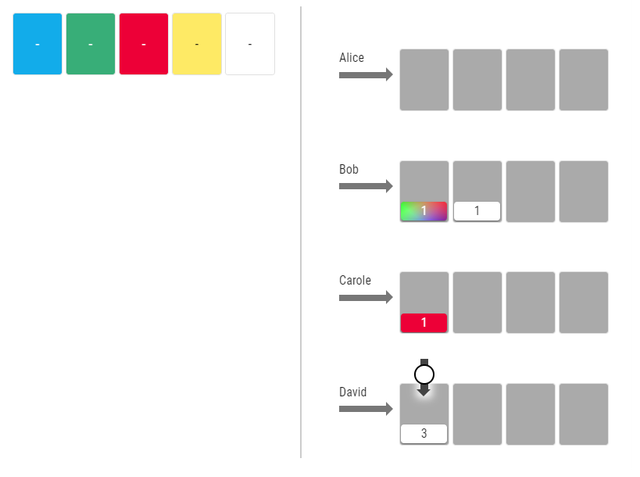
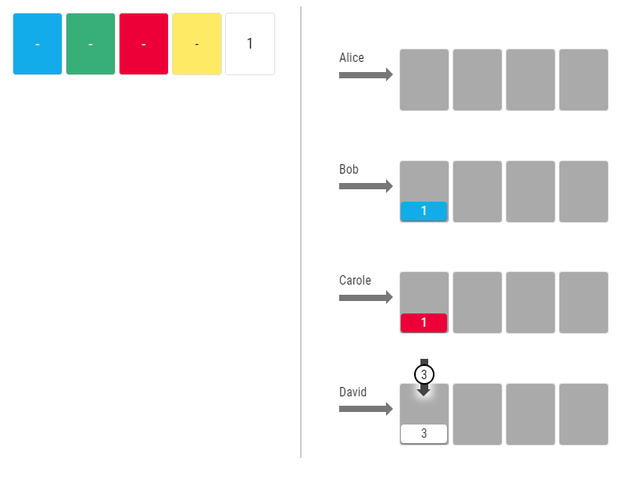
· Let's take an example to explore the difference, for example, in a four-player game with 5 color · (the order of players is Alice, Bob, Cathy, Donald).
· No colors are played on the field.
· Alice, as the first player, used white to prompt Donald's white 3, which is far from 2 playable (1-2-3).
· Bob first did not see that others had white 1, he successfully played the first card blind, but it was not white 1, but 1 of other colors(black 5 )
· What should Cathy do at this time?
· According to the meaning of promise bluff, we understand that if Cathy saw that Bob had white 2, she should not play the card, and Bob would get the promise that he had white 2 in the second position at this time, completing this promise bluff.
· At this time, Cathy did not see that Bob had white 2, regardless of whether other players had it.
·But Cathy also knows that she can't know whether she has white 2, so this white 3 clue is not a legitimate target, and Donald, as the recipient of the clue, will get an error message, and he will write his white 3 as white 2, and an accident will happen in the future.
·So Cathy now understands that she is forced by Alice to blind play the first card, and it is played successfully. This card can be any other 1 (but it can't be white 1), or it can be a 2 of the same color connected to the card played by Bob.
·Since two blind plays are triggered immediately, Donald writes his white as white 3, and the clue ends.
·Why shouldn't this be a promise bluff? Because Cathy didn't see the white 2.
·Then there is another point to note. If in this example, any player has a white 2 that has been marked but not played, after the white 3 is prompted, Bob plays the first unrelated card, and others should not continue to play cards, and this bluff clue ends (this is indeed a promise bluff, because everyone sees the real white 2, and it is a single bluff).
·But I wonder who invented the promise bluff? For example, is the promise bluff without the white 2 symbol only applicable to 3-player games? Because we know that in a 3-player game, Bob should only blindly play one card, and Donald, as the clue recipient, will not play any cards, so the clue will stop immediately.
· Therefore, I think that in 4 players or more, this clue needs to be understood as a double bluff, and Cathy needs to blindly play the first card as a double bluff.
· This double bluff is recognized by most master players, but some players still think this is a promise bluff
· This is what I think is the most essential difference between promise bluff and double bluff.
· Let's take an example to explore the difference, for example, in a four-player game with 5 color · (the order of players is Alice, Bob, Cathy, Donald).
· No colors are played on the field.
· Alice, as the first player, used white to prompt Donald's white 3, which is far from 2 playable (1-2-3).
· Bob first did not see that others had white 1, he successfully played the first card blind, but it was not white 1, but 1 of other colors(black 5 )
· What should Cathy do at this time?
· According to the meaning of promise bluff, we understand that if Cathy saw that Bob had white 2, she should not play the card, and Bob would get the promise that he had white 2 in the second position at this time, completing this promise bluff.
· At this time, Cathy did not see that Bob had white 2, regardless of whether other players had it.
·But Cathy also knows that she can't know whether she has white 2, so this white 3 clue is not a legitimate target, and Donald, as the recipient of the clue, will get an error message, and he will write his white 3 as white 2, and an accident will happen in the future.
·So Cathy now understands that she is forced by Alice to blind play the first card, and it is played successfully. This card can be any other 1 (but it can't be white 1), or it can be a 2 of the same color connected to the card played by Bob.
·Since two blind plays are triggered immediately, Donald writes his white as white 3, and the clue ends.
·Why shouldn't this be a promise bluff? Because Cathy didn't see the white 2.
·Then there is another point to note. If in this example, any player has a white 2 that has been marked but not played, after the white 3 is prompted, Bob plays the first unrelated card, and others should not continue to play cards, and this bluff clue ends (this is indeed a promise bluff, because everyone sees the real white 2, and it is a single bluff).
·But I wonder who invented the promise bluff? For example, is the promise bluff without the white 2 symbol only applicable to 3-player games? Because we know that in a 3-player game, Bob should only blindly play one card, and Donald, as the clue recipient, will not play any cards, so the clue will stop immediately.
· Therefore, I think that in 4 players or more, this clue needs to be understood as a double bluff, and Cathy needs to blindly play the first card as a double bluff.
· This double bluff is recognized by most master players, but some players still think this is a promise bluff
· This is what I think is the most essential difference between promise bluff and double bluff.