Page 1 of 2
Card order
Posted: 19 January 2025, 15:03
by brightfame
I'm honestly not sure if "long self-finesse" is a term, though I'll try to describe what I mean to preface my question:
Red 1 is played on the stacks. Alice clues red to Cathy, touching her 4r card. Bob already has a known red card in his hand that is not in finesse position. Therefore, he knows that he has 2r and 3r in his hand to play, one being the marked card and the other being his finesse card.
When giving this kind of clue, does the already marked red card in Bob's hand take precedence over his finesse card? I've come across differing opinions on this even after playing for years... In what order are the cards expected to be played?
Re: Card order
Posted: 19 January 2025, 15:21
by Romain672
Really interesting question.
Priority is on the already clued card. Then secondly on your finesse position.
Re: Card order
Posted: 19 January 2025, 15:57
by Jellby
Without further evidence, I assume marked card goes first. "Further evidence" could be just circumstantial (if you didn't clue that nice 3r when I had my r already clued, and instead forced me to discard a useful card... perhaps my clued r is not 2r and therefore I should play blind first), and that should be evaluated with care (perhaps my r is actually multi, and I have 2r 3r in finesse position).
Re: Card order
Posted: 19 January 2025, 18:42
by schoolio
I think this type of clue should be avoided because of its ambiguity. I agree with the OP that people interpret it different ways so it should be avoided.
Re: Card order
Posted: 19 January 2025, 18:59
by Blacktango
What is the difference with basic finesse vs. prompt?
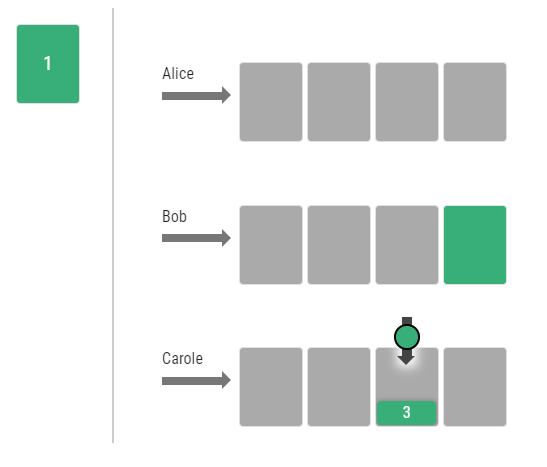
As Bob, if you don't have specific information about the number of your G card, would you blind play your left most card or would you play your marked G card to answer the G clue that Alice gave to Carole?
===
If you say "Of course I would play my marked G first", then I don't see why you would firstly blind play in this second situation with a self part:
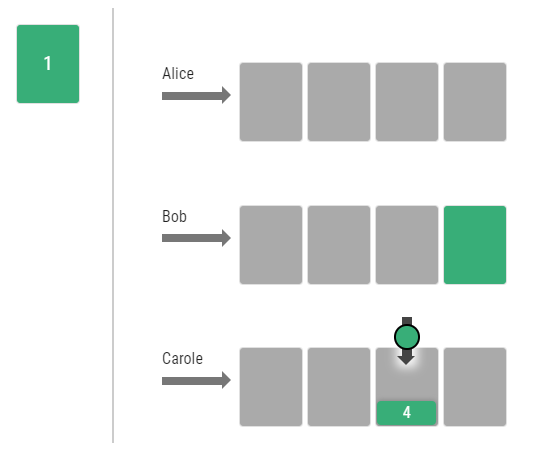
Re: Card order
Posted: 19 January 2025, 19:36
by Romain672
(removed, not enough interesting)
Re: Card order
Posted: 19 January 2025, 19:38
by Jellby
Finesse play happens because there is no marked card, so we play the newest. If there is a marked card, finesse does not apply. Otherwise we're at the "logic" of "if I don't understand a clue, I play leftmost".
Re: Card order
Posted: 19 January 2025, 20:25
by springiest
i would always assume that my clued card is r2 and my finesse card (which will have moved to slot2 before i actually play it) is r3, not the other way around. i would not call this clue a long Self Finesse, but rather a Prompt + Finesse (in that order!). i dont think this type of clue is confusing at all, imo its very clear that it is a Prompt first and a Finesse second.
as Jellby said, a Finesse generally happens BECAUSE there is no card clued in a player's hand that matches the "missing" card. otherwise a Prompt always takes precedence over a Finesse, barring exceptional situations where the player KNOWS (by explicit negative clues or simply by context) that their clued card cannot be r2.
in the original example, if bob's hand was r2 x x [r]3 ([r]3 means the card is clued with red but number is unknown), then alice has the option of clueing "3" to bob (as a Self Finesse) or simply Bluffing bob's r2 using some unrelated card in cathy's/donald's hand.
Re: Card order
Posted: 20 January 2025, 01:24
by Romain672
Ok so gw12346 in hgroup's discord convinced me with:
In addition, in a convention system with bluffs, there are generally many ways already to get finesse positions to play.
If Bob is holding r2-x-x-(r)3 then you bluff r2 and clue r4 later.
As a result, with 2 clues, you get 3 extra cards saved/played.
While if Bob is holding r3-x-x-(r)2 and if you put priority on finesse position, then you could in rare cases clue 3, but is often stuck and need to reclue r2.
As a result, with 2 clues, you get 2 extra cards saved/played.
On the two others cases, you clue r4 directly, and that work: you spend 1 clue for 2 extra cards played.
So finesse position priority use in average 1.5 clue to get in average 2 extra cards saved/played.
While saved card priority use in average 1.5 clue to get in average 2.5 extra cards saved/played.
That look like a no brainer to me now.
Re: Card order
Posted: 20 January 2025, 02:03
by _mg6maciej_
Apart from Jellby's first reply I don't think these answers are very helpful.
Despite more or less a common convention system across the platform, people play differently, so my first and the most important suggestion if you play with people you don't play frequently with is to ask before the game start how they would like to play in such situations. Always marked first unless you have a proof it's not the card you should be playing is a good default answer. This is how most masters will play anyway. Low focus/skill masters (still a majority of players with 700+ ELO) will even sometimes play marked first if they have a negative number on that card when the information is no longer visible on their cards (for example they were marked single 2 to play a card and already played it).
When you play with people you know well, you can make sure they would read context better.
Let's take Blacktango's first example (simple prompt) and add a bit of context:
1) simple prompt
Alice clues Bob on two greens
Bob plays 1g
Charlie discards
Alice clues Charlie on 3g
Bob has no reason to assume his marked green is not 2g, so plays it
2) finesse despite having marked card
Alice clues Bob on two greens
Bob plays 1g
Charlie discards
Alice sees 3g in Charlie's hand that she can easily clue with color or number, but discards
Bob also observes 3g in Charlie's hand and notes that his green is unlikely to be 2, because Alice would clue it to prompt him, then discards
Charlie discards
Alice clues Charlie's 3g
Bob thinks again why Alice did not clue it a round before (were there more important things to clue? were there plenty of tokens, yet all players discarded?) and allowed some useful (noncritical) cards to be discarded and figures out his marked is not 2g, but he must have drawn it the previous round, so plays leftmost
The above examples are when you only need to play a single card and decide between leftmost or marked, but the same logic applies when you have to play both leftmost and marked.
3) prompt + finesse
Alice clues Bob on two greens
Bob plays 1g
Charlie discards
Alice clues green on 4g
Bob knows he has two cards to play and no reason to believe his marked is not 2g, so plays it first
Charlie discards
Alice discards
Bob plays 2nd leftmost card, finding 3g
4) finesse + prompt
Alice clues Bob on two greens
Bob plays 1g
Charlie discards
Alice and Bob observe 3g on Charlie's hand, but Alice is uninterested in this card and game continues for a few rounds and Charlie finally discards it (or it's even possible he doesn't yet discard it, but all players discard at least once and Charlie draws 4g at some point)
Later Charlie draws 4g and at some point Alice clues it (as 4 if Charlie still has 3g in hand)
Bob remembers Alice was not interested in 3g in Charlie's hand earlier, so he noted it's very unlikely to be 2g, so plays leftmost first
I'll reiterate I don't recommend trying these kind of clues (example 2 and 4) that require some good context reads with people you don't know well enough. Simpler is often better and using 1 more clue to show exactly where 2 and 3 is won't break the game and make it impossible to score max most of the time.