Freedom of Information

Discuss about anything!
User avatar
DaffyVina
Posts: 761
Joined: 20 April 2020, 19:08

Re: Freedom of Information

Post by DaffyVina »

'Strict police regime' in occupied areas - US think tank
Friday's daily intelligence assessment by the Institute for the Study of War - a US think tank - offers some interesting insights into how Russia is trying to stamp its authority on territory it has captured in Ukraine.

The analysis draws largely on reports from the General Staff of the Ukrainian Armed Forces.

According to ISW, the invading forces may be attempting to establish "a strict administrative and police regime" in several areas, while also distributing food to civilians in order to maintain a positive image.

It adds that Russia continues to detain pro-Ukrainian civil servants, activists and others.

Those repressive measures come as Russia has "significantly exhausted its human resources" and is taking "extreme measures in matters of staffing", even allegedly dismissing a general for his performance.

Meanwhile, the think tank finds that Ukrainian forces have launched a successful counterattack near the encircled southern city of Mykolaiv, and halted the Russian advance into Kharkiv.
User avatar
DaffyVina
Posts: 761
Joined: 20 April 2020, 19:08

Re: Freedom of Information

Post by DaffyVina »

Ukraine war: Putin has redrawn the world - but not the way he wanted
By Allan Little -BBC News
Published10 hours ago

Photo: People walk past a poster of Vladimir Putin reading "Russia does not start wars, it ends them," Simferopol, Crimea, 10 March 2022
IMAGE SOURCE,REX FEATURES


Vladimir's Putin's invasion of Ukraine has changed the world. We are living in new and more dangerous times - the post-Cold War era that began with the fall of the Berlin Wall is over.

It is a rare thing to live through a moment of huge historical consequence and understand in real time that is what it is.

In November 1989, I stood on a snow-flecked Wenceslas Square in Prague, the capital of what was then Czechoslovakia, and watched a new world being born.

The peoples of Communist Eastern Europe had risen in defiance of their dictatorships. The Berlin Wall had been torn down. A divided Europe was being made whole again.

In Prague, the dissident playwright Vaclav Havel addressed a crowd of 400,000 from a second-floor balcony. It was an exhilarating moment, dizzying in its pace. That evening, the Communist regime collapsed and within weeks Havel was president of a new democratic state. I sensed, even at the time, that I had watched the world pivot - that it was one of those rare moments when you know the world is remaking itself before your eyes.

Photo: Vaclav Havel addresses thousands of demonstrators gathered on Prague's Wenceslas Square, 24 November 1989
IMAGE SOURCE,GETTY IMAGES

How many such moments had there been in the history of Europe since the French Revolution? Probably, I thought then, about five. This, 1989, was the sixth.

But that world - born in those dramatic popular revolutions - came to an end when Putin ordered Russian forces into Ukraine.

The German Chancellor Olaf Scholz called this moment a zeitenwende - a turning point - while UK Foreign Secretary Liz Truss said it was a "paradigm shift". The age of complacency, she said, was over.

Pivotal moments in Europe's history
The storming of the Bastille,14 July 1789 -IMAGE SOURCE,GETTY IMAGES
1789: French Revolution. Monarchy overthrown, republic founded
1815: Congress of Vienna redraws map of Europe, restores balance of power and ushers in decades of peace after the upheaval of the Napoleonic wars
1848: A wave of liberal and democratic revolutions across Europe
1919: Treaty of Versailles. New independent sovereign nation states replace old multi-national empires
1945: Yalta - great powers agree to partition Europe into Western and Soviet "spheres of influence". Iron Curtain falls across the continent
1989: Democratic revolutions in Soviet-dominated Eastern Europe tear down the Iron Curtain. The Soviet Union collapses two years later. Vladimir Putin calls this the "greatest catastrophe of the 20th Century"

Quentin Sommerville, one of the BBC's most experienced war reporters walked through the wreckage in Kharkiv recently and said of the Russian bombardment: "If these tactics are unfamiliar to you, then you haven't been paying attention."

He should know, he spent enough time under Russian rockets in Syria to be paying very close attention. But the governments of the democratic world - how much attention have they been paying to the nature of the Putin regime?

The evidence has been building for years.

Two decades have passed since he sent troops into Georgia claiming he was supporting breakaway regions.

Later, he sent spies into British cities armed with nerve agents to murder exiled Russians.

In 2014, he invaded Eastern Ukraine and annexed Crimea.


Despite all this, Germany, and much of the EU, were locking themselves into an unhealthy dependence on Russian gas. A year after the annexation of Crimea, they approved the building of a new pipeline, Nord Stream 2, to boost supplies.

The "complacency" Liz Truss refers to also indicts her own country. London has been a safe haven for Russian money since John Major was prime minister. Russian oligarchs have parked billions here, laundered their money, bought up the most prestigious private homes in the capital, socialised with politicians and donated to their campaign funds. Few questions were asked about where their vast wealth, acquired so suddenly, had come from.

So, no. The Western democracies have not been "paying attention" to the nature of the menace that has been incubating on their eastern frontier.


But Putin, too, has seemed complacent.

First, he believed the West was in chronic decline, weakened by internal division and ideological rancour. The election of Donald Trump and Brexit he saw as proof of this. The rise of right-wing authoritarian governments in Poland and Hungary was further evidence of the disintegration of liberal values and institutions. The US's humiliating withdrawal from Afghanistan was proof of a waning power withdrawing from the world stage.

Second, he misread what was happening on his borders. He refused to believe that a series of democratic uprisings in former Soviet Republics - Georgia (2003), Ukraine (2004-5) and Kyrgyzstan (2005) - could possibly be authentic expressions of the popular will. Because each was aimed at removing corrupt and unpopular pro-Moscow governments, it seemed self-evident to the Kremlin that these were the work of foreign intelligence agencies, the Americans and the British in particular - Western imperialism's forward march into territory that was rightfully and historically Russia's.

Third, he has failed to understand his own armed forces. It is clear now that he expected this "special military operation" to be over in a few days.

Russia's military incompetence has astonished many Western security experts. It brings echoes for me of a smaller, more containable, but nonetheless devastating war, in former Yugoslavia.

In 1992, Serb nationalists launched a war to strangle the newly independent state of Bosnia at birth. They argued that Bosnian identity was bogus, that Bosnian statehood had no historical legitimacy, that it was really part of Serbia. It is exactly Putin's view of Ukraine.

A Bosnian special forces soldier and civilians come under fire from Serbian snipers, Sarajevo, 6 April 1992
IMAGE SOURCE,GETTY IMAGES

Like Russia today, Serb forces enjoyed overwhelming firepower superiority. But they often stalled wherever local non-Serbs put up resistance. They seemed unable to seize towns or cities - unwilling to fight street-by-street on foot. The Bosnian defenders were initially very poorly equipped - I remember boys in tennis shoes in the trenches of Sarajevo with one AK-47 between three of them. But they defended their capital for nearly four years. There is a similar resolve in the young men volunteering to defend Kyiv.

So instead of taking the cities and towns, the Serbs laid siege to them - surrounding them, bombarding them, cutting off water, gas and electricity. It is already happening in Mariupol. Besiege a city and cut off its water supply, and within 24 hours, every toilet is a public health hazard. Citizens have to go out into the streets to find water standpipes and fill up receptacles just to flush their loos. Cut off the electricity and you freeze in your own home. Soon the food runs out. Is that what the Russians intend for Mariupol, for Kharkiv, for Kyiv? To starve them into submission?

But nearly four years of this cruelty gave Bosnian nationhood a founding narrative of resistance, suffering and heroic struggle. Ukraine's identity, too, will be strengthened further by the way Ukrainians have fought. Ukraine's Russian speakers have not felt "liberated" by the invasion. The evidence is that they, too, believe in Ukraine as a sovereign state. Putin's war, aimed at reunifying what he sees as two parts of the Russian nation, is already having the opposite effect - strengthening the will of most Ukrainians to seek a destiny free from Russian domination.

Photo: People crowd together to get their share of rationed food during the siege of Sarajevo, 1992
IMAGE SOURCE,GETTY IMAGES

In 1994, while the war in the Balkans was still raging, the rest of Eastern Europe was looking to the future - each nation eager to take what it saw as its natural place in a Europe of independent sovereign states at peace with each other. But it was still far from certain that any of them would be allowed to join Nato.

There was a debate, back then, about whether a third security block should be formed by the newly-liberated East European nations, to act as a buffer between Nato and Russia. Russia was weak in the 1990s, and the nations that had endured Soviet occupation for 40 years did not trust it to stay weak for long. In the end, they wanted nothing short of Nato membership.

Under President Bill Clinton, the US pressed ahead with Nato expansion. The Russian president Boris Yeltsin, who saw himself as a loyal ally of Clinton's, was said to be furious when he found out - at a press conference - that Nato was planning to admit new members without consulting Moscow.

And the tearing down of the Iron Curtain had raised a new question in geopolitics - how far east does the Western world extend? I was commissioned by the BBC to take a road trip through Poland, Belarus and Ukraine to address the question, "Where is the eastern edge of the Western world now?"

I went to the hunting lodge in Belarus where, in late 1991, the President of the Russian Federation, Boris Yeltsin, had met his counterparts from Ukraine and Belarus. Here, they agreed to recognise each other's Soviet Republics as independent nation-states. They then rang the Soviet leader Mikhail Gorbachev and informed him that the country of which he was head of state - the Soviet Union - no longer existed.

It was a moment fraught with both danger and opportunity. For Belarus and Ukraine, it was the chance to liberate themselves from Moscow rule - domination by Russian imperialism in both its Tsarist and Soviet forms.

For Yeltsin, it represented the chance to liberate Russia too - from its historic role as an imperial power. The UK and France had both ceased to be imperial powers after World War Two - as Austria had done after WW1. In Turkey, Kemal Ataturk had built a modern European secular republic - a Turkish nation-state - after the multi-ethnic Ottoman Empire had been defeated and dismembered in 1918.

Could Boris Yeltsin do the same thing - build a modern Russian nation-state, at peace with its sovereign neighbours, on the ruins of the Soviet Empire? In the early 1990s, he began his Westernising experiment, to try to turn an imperial power into a democratic state.

But the rush - encouraged by the Western democracies eager for investment opportunities - to turn a sclerotic, state-owned command economy into a free-market system was disastrous. It created gangster capitalism. A tiny elite became fabulously rich by plundering the assets of the major industries - especially oil and gas.

The wheels finally came off the experiment in 1998. The economy collapsed, the rouble lost two-thirds of its value in a month and inflation hit 80%.

I stood with a middle-aged couple in a queue at a Moscow bank. They wanted to take their money out in dollars or pounds - anything other than roubles. The queue was long and slow-moving and, every few minutes, a bank employee changed the displayed exchange rate, as the rouble plunged further. People could see their life savings dropping in value by the minute. The couple got close to the head of the queue when suddenly the shutters came down - there was no cash left.

Photo: People queue in front of a Russian bank, Moscow, September 1998 IMAGE SOURCE,GETTY IMAGES

I went to a former coal-mining region near the Ukraine border, where the mines were barely functioning. I met a graduate mining engineer who had lost his job - a man in his 30s with a young family. He took me to his dacha outside the city, which had about an acre of land. "About 80% of what my family eat in the year," he said. "I grow on this patch of land. The rest, like coffee and sugar, I barter for. I haven't used or even seen cash in about 18 months." Nothing spoke more powerfully about Yeltsin's failure to transform Russia than the sight of this highly educated man digging for his own dinner.

"Stalin turned a nation of peasants into an industrial superpower in a generation. Yeltsin is doing the same thing in reverse," he told me.

Ordinary Russians felt robbed. The great westernising experiment had been a con trick that had enriched a criminalised elite and impoverished everyone else. Many of the reports we filed from Russia at that time boiled down to a single question: "What are the political consequences of the profound disenchantment that Russians now feel?"

The answer was that Russia, eventually, would revert to type - a retreat from democracy and a return to authoritarian rule. A retreat from nation-statehood and return to a more assertive imperial attitude to its "near abroad" - the countries that had previously been part of the Soviet Union.

The former US Secretary of State Zbigniew Brzezinski famously said that Russia could be a democracy or an empire, but it could not be both. The Russian emblem, the double-headed eagle, looks both east and west. History has pulled Russia in opposing directions - democratic nation statehood in one direction, domineering imperial power in the other.

Go to St Petersburg and you will see another aspect of this dual character. It is the country's beautiful bay window on the Gulf of Finland. It is an 18th Century city, facing west. It is the European Enlightenment in architectural form. Under the Tsars it was the imperial capital.

After the Russian Revolution of 1917, the Bolsheviks moved the capital back to Moscow and power retreated behind the high, crenellated walls of the Kremlin. It is the architecture of defensiveness, of suspicion, even fear. When Russian leaders look west from here, they see flat open countryside rolling away to the south and west for hundreds of miles. There are no natural frontiers.


When I was the BBC's Moscow correspondent in the late 1990s, there was a driver who could remember, as a boy, seeing German troops on the outskirts of Moscow in the 1940s. Every time he took us to Sheremetyevo Airport, we would pass a monument designed to look like metal anti-tank defences - so-called Czech hedgehogs - and he would say: "This is how close they came, the Germans."

Napoleon's army had gone further the previous century. That experience - that chronic sense of an insecure western frontier - informs the way Russian leaders have thought about their "near abroad".

In another conversation about the "near abroad", a friend recited a rhyming couplet to me. In Russian it rhymes nicely, but in English it goes: "A chicken's not really a bird; and Poland's not really abroad." Russia's sense of what it is entitled to in the lands to its west penetrates popular consciousness, too.

I will borrow an anecdote from another friend in Moscow at the time. The same driver picked her up from the airport and asked her where she had been. "I've been for a weekend in Prague," she said. "Oh Prague," came the reply. "That's good. That's ours."

But it wasn't. The Berlin Wall had come down nine years earlier and the nations of Eastern Europe had ceased being "ours".

Except Ukraine. The country's name comes from a Russian word for edge, or periphery. Putin regards it not as a neighbouring country, but as the frontier land of Russia itself - and he wants it brought back into the Russian fold.

What would it take to do that? How can a nation that has put up so unified a resistance be subdued? Almost certainly he has overreached himself. Several factors must now be alarming him.

The first is the state of his own armed forces.

Photo: Smoke rises from a destroyed Russian tank in Ukraine, 26 February
-IMAGE SOURCE,GETTY IMAGES

The second is the resilience of the Ukrainian defence. Did Putin really expect the Russian-speaking people of Ukraine to welcome his troops as liberators? Did he really believe that the uprising of 2014 - which replaced the pro-Moscow government with one oriented to the West - was all a Western plot? If he did, then it reveals how little the Kremlin understands about its "near abroad".

But his biggest miscalculation has been to underestimate the resolve of the West. And this is what makes 2022 one of those pivotal years - the zeitenwende, in the words of Chancellor Scholz.

Almost overnight, Germany has transformed its attitude to its role in the world. Traditionally reluctant - for sound historical reasons - to throw its weight around, it had preferred the exercise of soft power to hard. Not now. It has announced a doubling of defence spending, and is sending lethal weapons to Ukraine. Gone, too, is the ostpolitik - the decades-old German policy of seeking peace through engagement, especially trade.

Germany, along with the rest of the democratic world, will now move to end its dependence on Russian gas. The Nord Stream 2 project is suspended - though not yet scrapped. We are seeing a root-and-branch redrawing of the map of global energy distribution, aimed at cutting Russia out of it.

Russia is highly integrated into the global economy. But now it has been expelled from the system the world uses to exchange payment for goods and services. Its industries, including oil and gas, depend on imported goods and components. Soon production will grind to a halt. Employers will have to lay off their workers. Unemployment will rise.

No-one expected the West to sanction the Russian Central Bank. Already, the rouble has collapsed and interest rates have doubled. No other major economy has ever been subjected to a package of sanctions this punitive. It amounts to the expulsion of Russia from the global economy. More workers will be laid off. Major industries will find it hard to carry on. Unemployment will rise further. Soaring inflation will erode life savings.

We will all be affected. Potentially, this is the rolling back of the globalised economy that emerged after the end of the Cold War.

The US and the EU have, in effect, divided the world up. Those states and companies that continue to trade with Russia will find themselves punished - also frozen out of trade with the rich world.

It amounts to a new economic iron curtain separating Russia from the West.

Much will depend on how China negotiates this new landscape. China and Russia are bonded by their shared antipathy to American power, and their conviction that the greatest threat is from a resurgent, more unified democratic world.

China does not want Putin weakened, or the West strengthened. Yet that is exactly what the effect the war in Ukraine has had.

Photo: Vladimir Putin and Chinese leader Xi Jinping meet in Beijing, February 2022 IMAGE SOURCE,GETTY IMAGES

Some China watchers believe Beijing will try to challenge the dominance of the dollar as a reserve currency by carving out a distinct yuan zone as an alternative space in the global economy that can be protected from any future attempt by the US to sanction China. Putin's war, therefore, could redraw the international financial map.

But above all, this is a war that pits the world's democracies against the world's authoritarian regimes.

It is also a war between two conflicting conceptions of the rules by which international relations should function.

The Oxford scholar Timothy Garton Ash says these two world views can be expressed in short form by two words - Helsinki versus Yalta.

At Yalta in 1945, Stalin, Roosevelt and Churchill carved post-war Europe into "spheres of influence" - most of Eastern Europe to Russia, the West to the trans-Atlantic alliance that would set about rebuilding Europe's democracies.

"Helsinki", by contrast, describes a Europe of independent sovereign states, each of which is free to choose its own alliances. This grew out of the Helsinki Final Act of 1975 and gradually evolved into the Organization for Security and Co-operation in Europe.

Ukraine's defenders are fighting for Helsinki. Putin has sent his troops in to impose a modern version of Yalta - which would kill off Ukraine's independence and leave it under Russian domination.

Garton Ash argues that the West has been too half-hearted in defending the values of Helsinki - that it has formally acknowledged Ukraine's right to join Nato at some unspecified date in the future without ever intending to make it happen.

But Ukraine's President Volodimir Zelensky has signalled a readiness to compromise on Helsinki principles, by agreeing to abandon Ukraine's ambition to become a Nato member. With all the risks that entails, it may yet be the price Ukraine pays for the survival of its statehood.


My generation grew up with the existential terror of the threat of nuclear annihilation. The conflict has brought that fear back to public consciousness. Putin has threatened to use Russia's nuclear arsenal.

That makes this the most dangerous moment since the Cuban Missile Crisis of 1962. Then, the Soviet Union shipped nuclear missiles to its ally Cuba. The US assembled a fleet of ships to mount a sea-borne invasion of the island.

What the Americans did not know is that the Soviets didn't only have long-range strategic missiles. They also had smaller, tactical nuclear missiles - so-called battlefield nuclear weapons. And that Soviet military doctrine delegated first-use decision making to commanders on the ground.

Had the threatened invasion gone ahead, it would have triggered a nuclear exchange.

The then American Defence Secretary Robert McNamara only found out about this when the Soviet archives opened in 1991. Only then, did he understand how close the world had come to catastrophe.

In a remarkable film called Fog of War: Eleven Lessons from the Life of Robert McNamara, he explained how the world had avoided destroying itself. Was it skilled diplomacy? Wise leadership? No.

"Luck," he said. "We lucked out."

That experience, now fading from memory, should focus minds.
User avatar
DaffyVina
Posts: 761
Joined: 20 April 2020, 19:08

Re: Freedom of Information

Post by DaffyVina »

War in Ukraine: Gordon Brown backs Nuremberg-style trial for Putin
By Kathryn Snowdon & Lauren Turner -BBC News
Published1 hour ago

Gordon Brown and Sir John Major want a new international tribunal to be set up to investigate Vladimir Putin for his actions in Ukraine.

The former PMs are among 140 academics, lawyers and politicians to sign a petition calling for a legal system modelled on the Nuremberg trials of Nazi war criminals after World War Two.

The International Criminal Court (ICC) is already investigating Mr Putin for alleged war crimes in Ukraine.

But some say its powers are limited.

The ICC cannot pursue the crime of aggression without a referral from the UN security council, which Russia could veto.

Former Labour prime minister Mr Brown told the BBC that since the fall of the Berlin Wall "we've assumed that democracy and the rule of law will prevail", but that Mr Putin "is replacing that by the use of force".

"If the message is not sent out now then we face aggression in other countries which may go unpunished as well," he told Radio 4's Today programme.

Asked if he considered the Russian president to be a war criminal, he replied: "That's what President Biden said, and that's my view."

US President Joe Biden this week called Mr Putin a "war criminal" for the first time.

The Kremlin denounced the comments as "unacceptable and unforgiveable rhetoric". Other leaders to accuse Russian of carrying out war crimes include Ukrainian President Volodymyr Zelensky and UK Prime Minister Boris Johnson.

Mr Brown said the war had seen the indiscriminate bombing of civilians, which is against international law, as well as breaches of humanitarian ceasefires and "nuclear blackmail".

Russian forces have bombed civilian areas in a number of cities in Ukraine.

On Wednesday a theatre where hundreds of civilians were sheltering was hit in the besieged south eastern city of Mariupol. And Ukraine has also called Russia's air strike on Mariupol's hospital a war crime.

A warning should be sent out that Mr Putin "will face the full force of international law" said Mr Brown, adding that the Ukrainian government was asking for such a move.

It is hoped the tribunal will act in addition to the ICC's current investigations into war crimes.

The campaign has already been backed by 740,000 people - including dozens of public figures.

Ukrainian Foreign Minister Dmytro Kuleba and the former president of the UK Supreme Court Lady Hale have added their signatures to the petition - as have professor of international law Philippe Sands QC, former prosecutor for the Nuremberg Military Tribunal Benjamin Ferencz, Labour peer Helena Kennedy QC and former president of the European Court of Human Rights Sir Nicolas Bratza.

Writing in the Daily Mail, Mr Brown said creating a new tribunal would close off this "loophole" in international law "that Putin could use to dodge justice".

"We must move with speed, to assure the people of Ukraine that we are committed to action and not just warm words - and we must make Putin's collaborators aware that the noose is tightening. If they do not distance themselves from Putin, they face prosecution and prison," Mr Brown wrote.

The Nuremberg trial - named after the German city it was held in - was the first ever international war crimes trial and saw the most notorious Nazis tried for their crimes. The offences included waging a war of aggression, violating the customs of warfare and committing crimes against humanity.

Mr Brown continued: "From Britain - which rightly prides itself on democracy and the rule of law - the message must go out. At Nuremberg we held the Nazi war criminals to account. Eight decades on, we must ensure there will be a day of reckoning for Putin."

Ukrainian MP Dmytro Gurin told the BBC he was sceptical about whether the proposal would actually lead to a trial for Mr Putin.

"You have to catch him first," he said. "The tribunal, it's a nice idea when they happen and all the European countries like Great Britain and America we thank you for all your help, but you know, we are at a totally different stage of war now.

"When this war started it was just a conditional war - army against army - and now we don't have a conditional war, we have mass murder in last two weeks."

Peace talks between Russia and Ukraine have been taking place - but UK Foreign Secretary Liz Truss has warned that the Kremlin might be using the negotiations as a "smokescreen".

In an interview with the Times newspaper, she said: "If a country is serious about negotiations, it doesn't indiscriminately bomb civilians that day."
User avatar
DaffyVina
Posts: 761
Joined: 20 April 2020, 19:08

Re: Freedom of Information

Post by DaffyVina »

6:00 Russian lieutenant general killed in Ukraine: Armed Forces
A member of the Russian military was killed in the Ukranian town of Chernobayevka after an artillery strike, said Ukraine's General Staff of the Armed Forces in a Facebook post on Saturday.

In the post, it said Lieutenant General Andrei Mordvichev, commander of the 8th Combined Arms Army of the Southern Military District of the Russian Armed Forces had died.
In its daily update, it also added that the war frontline had not changed significantly in the past 24 hours, but said Ukraine's troops had managed to destroy several columns with Russian military personnel in the Mykolaiv and Sumy regions.

The BBC has not been able to independently verify these claims.


6:34 Humanitarian corridor to be opened in Luhansk, governor says
Photo of Evacuations in Ukrinae -Copyright: Getty Images
The governor of Ukraine's eastern Luhansk region has said that an evacuations corridor will be opened later on Saturday.

In a post on Telegram, Serhiy Gaiday said Russian forces have agreed to allow residents to evacuate several towns and cities in the region after 09:00 local time (07:00 GMT), though he did not say where the people will be sent.

"The Russians continue the chaotic irregular artillery shelling of our cities," Gaiday wrote.

"However, we are waiting until 9 am, when the 'silence regime' should be established, to begin the evacuation of the region's residents, to bring food, water and medicine to those who remain."

"The humanitarian corridor has been agreed at a high level. I hope that the agreements reached by the Russians will be respected," he added.
User avatar
DaffyVina
Posts: 761
Joined: 20 April 2020, 19:08

Re: Freedom of Information

Post by DaffyVina »

How Kremlin accounts manipulate Twitter
By James Clayton -North America technology reporter
James Clayton is the BBC's North America technology reporter based in San Francisco. Follow him on Twitter @jamesclayton5.
Published11 hours ago

Olena Kurilo became the face of Russia's invasion of Ukraine. Bloodied and bandaged, the 53-year-old teacher said she couldn't believe what had happened to her and her town of Chuhuiv.
Her picture was on the front pages of newspapers across the world.

Over the next few days, Russia's government social media accounts began to post a video claiming that Olena hadn't been injured at all.

Photo of Olena Kurilo (she has a head bandage and blood all over her face and hand. Damaged buildings/ ground in background.
IMAGE SOURCE,GETTY IMAGES

"Great photos by the way, they were all over the news," the Russian narrator says.
The video then claims Olena was photographed two days later, uninjured.
"A couple of days later, good for her, not a scratch."

This claim is baseless, the BBC has verified the photo as genuine, as has Reuters. Wild conspiracy theories like these are not uncommon on social media.

But what makes this conspiracy theory so odd is that it was shared by an official Russian government Twitter account - the Russian Mission in Geneva. Two weeks on, the tweet is still live.

The Russian government has a huge network of official Twitter accounts - the BBC found more than 100 of them. They range from accounts that represent foreign missions or embassies, with a few thousand followers, to those with more than a million followers. President Putin has his own account. Many of the accounts are labelled as Russian government organisations by Twitter.

Yet, while many of these accounts have spread disinformation, Twitter deals with them differently to Russian state media - like RT or Sputnik.

On 28 February, Twitter announced it would prevent tweets from Russian state-affiliated media outlets from being eligible for "amplification" - meaning they wouldn't be recommended in the home timeline, notifications, and other places on Twitter. But Twitter has confirmed to the BBC that this policy does not include Russian government accounts.

Tim Graham, a social media analyst at QUT Digital Media Research Centre in Australia, describes this as a "loophole" in Twitter's moderation policies, which lets the Russian government pump out misinformation.

"It's certainly a blind spot in Twitter's defences against disinformation," he says.

Intrigued by this spider web of Russian government accounts, Mr Graham - who specialises in analysing co-ordinated activity on social media - decided to investigate further. He analysed 75 Russian government Twitter profiles which, in total, have more than 7 million followers. The accounts have received 30 million likes, been retweeted 36 million times and been replied to 4 million times.

He looked at how many times each Twitter account retweeted one of the other 74 profiles within an hour. He discovered that the Kremlin's network of Twitter accounts work together to retweet and drive up traffic. This practice is sometimes called "astroturfing" - when the owner of several accounts uses the profiles they control to retweet content and amplify reach.

A visualisation of Tim Graham's data - showing Russian Government accounts retweeting each other within 60 minutes

"It's a coordinated retweet network," Mr Graham says.

"If these accounts weren't retweeting stuff at the same time, the network would just be a bunch of disconnected dots. So what the network shows, very clearly, is that there's a very dense amount of connections to the way these accounts are retweeting.

"They are using this as an engine to drive their preferred narrative onto Twitter, and they're getting away with it," he says.

Coordinated activity, using multiple accounts, is against Twitter's rules.

"You can't artificially amplify conversations through the use of multiple accounts," Twitter's rules state.

But Twitter doesn't treat all accounts equally. Tweets from government and elected officials can be given more leeway when it comes to moderation. The company says on its website that there may be a public interest in seeing tweets that would otherwise violate its rules.

However, the company doesn't treat official accounts differently when it comes to coordinated behaviour - there is no exemption.

The BBC put Mr Graham's research to Twitter, however the company did not respond directly to his findings.

The BBC also asked the Russian Embassy in the UK about the suggestion that official Russian Twitter accounts behave in a coordinated way - and that many share misinformation. The BBC has not received a response.


On 10 March, the embassy itself tweeted that the bombing of a maternity hospital in the Ukrainian city of Mariupol had been faked. The account claimed that women pictured at the scene were actors.
A photo was posted of a woman being carried on a stretcher, with the words "FAKE" plastered over the image. The claim was false. A few days later it was reported that both she and her baby had died.

Twitter deleted several tweets making the "FAKE" claim, after the BBC flagged them. Yet there are many other examples of Russian disinformation still up on the Russian government's Twitter accounts.

The unfounded claim that Olena Kurilo wasn't really injured is still live - it has been retweeted by more than 20 separate Russian government accounts.

Unfounded claims that Ukraine has bioweapons have been shared by the Russian network and are still up - as are claims of an imminent chemical attack being allegedly prepared by Ukrainians.

The problem Twitter has is that proving content is false can be messy and complex in a time of war.

Savvas Zannettou, who analyses social media moderation at Delft University of Technology in the Netherlands, says war makes policing social media even harder.

"To effectively moderate is impossible… the information comes at a very rapid pace, and it's coming from all over the place," he says.

It appears two things are happening here. Muddled and incomplete information on the ground means only examples of misinformation which are easy to prove are taken down on platforms such as Twitter.

Added to that, Twitter's own public interest exceptions means tweets from government officials can be treated differently from other accounts. The BBC asked Twitter whether tweets from Russian ministries and embassies were included in its public interest exceptions, however the social media company did not respond to this specific question.

Twitter said: "We've taken numerous enforcement actions on Russian embassy accounts, including requiring the removal of Tweets."

Twitter also said it would also be doing more in the coming days to flag accounts linked to the Kremlin. "We'll be expanding our government account labels to additional Russian embassies to add context for people interacting with these accounts on Twitter."

The Kremlin's social media accounts also exist on Facebook and other platforms - this isn't a headache consigned just to Twitter.

In January 2021, after the Capitol Hill riots, Twitter banned Donald Trump for his role in repeating allegations of voter fraud. Twitter argued that repeated disinformation, posted from a position of power, had caused real world violence.

As official Russian accounts continue to post wild misinformation during a time of war, it is perfectly possible that the Kremlin will end up facing another sanction - being frozen out of Twitter.
User avatar
DaffyVina
Posts: 761
Joined: 20 April 2020, 19:08

Re: Freedom of Information

Post by DaffyVina »

Outcome of peace talks remains uncertain

Lyse Doucet - BBC Chief International Correspondent

Moves towards peace talks in this conflict are so important, but also very difficult.

The Ukrainian flag is flying higher than ever now because of the invasion of the country. I was in the central square in Kyiv yesterday and the most popular rock star in Ukraine suddenly burst into the national anthem.

The flag is draped over coffins, the flag is on shirts and the flag is flying in capitals around the world. And that's the background to this moment where Ukrainians hope there will be a movement towards peace.

Last night President Zelensky said it "is time to meet, it is time to speak". And its very interesting that he says "I want to be heard by everyone, especially in Moscow" throughout this war, knowing that people in Russia aren't hearing the full story because of new media laws and repression, that he speaks to them directly.

One thing that has come out of talks with mediators like Turkey is that President Putin has agreed to meet Zelensky.

But Putin said yesterday - in his first public appearance since the invasion began a month ago - that "we know what we have to do next and we will definitely carry out all the plans we have made".

The biggest question before the invasion, and still to this day, is what is Putin's plan for Ukraine? Especially now, after Russia has incurred so many losses and his plan is not going as hoped.

We do know that the minimum is that he's got to provide security for people in eastern Ukraine, which he recognises as independent statelets, and for Crimea.

On the ground, he isn't there yet, so he isn't ready to call it a day.


Conditions in Mariupol 'medieval', MP says
Photo A destroyed building in Mariupol Copyright: Getty Images
A Ukrainian MP has described conditions in the besieged city of Mariupol as "medieval".

Dmytro Gurin, an MP whose parents are trapped in the south-eastern city, told the BBC's Today programme that supplies of food and water in the city are reaching dangerously low levels.

"People are out of food, and more importantly out of water," Gurin said. "And several of days ago, tanks started to shoot nine-storey buildings, so people cannot get out. Everybody is sitting in their apartments and basements thinking whether they will die in the next hour".

"The shelling never stops and the shooting never stops," he added. "Airplanes, they drop hundreds of bombs over 24 hours."

Gurin also expressed pessimism over the prospect of additional humanitarian corridors from the city being established, saying "the Ukrainian side are trying to have an agreement and open it, but Russia, almost always its only words".

He added that the bombardment unleashed on the city by Russian forces has rendered it unrecognisable.

"From photos I have seen, there is no city anymore. By estimate of the mayor's office, 30% of buildings are totally destroyed and 50% are heavily damaged. My house is burned to the ground."


Extended curfew announced in Zaporizhzhia

Wyre Davies -BBC News, Zaporizhzhia

A view of a damaged building at the Zaporizhzhia Nuclear Power Plant compound in Enerhodar, 17 March 2022
ReutersCopyright: Reuters
A damaged building at the Zaporizhzhia nuclear power plantImage caption: A damaged building at the Zaporizhzhia nuclear power plant
An extended curfew has been announced in the south-eastern Ukrainian city of Zaporizhzhia, where a nuclear power plant was shelled earlier this month.

The curfew will begin today at 16:00 local time (14:00 GMT) and end at 06:00 Monday, authorities have said.

Details about the reason for the lockdown were not provided, but the city - which has seen thousands of refugees arriving from nearby Mariupol - continues to come under sporadic rocket attacks from Russian positions.

It could also be that the city may be in the path of a possible Russian advance up from the besieged port city of Mariupol.


Russia says it launched hypersonic missile at Ukrainian ammo depot
Photo: A Kinzhal hypersonic missile -Copyright: Reuters

A spokesperson for Russia's defence ministry has said that Moscow has destroyed an underground depot in western Ukraine using hypersonic missiles.
Igor Konashenkov claimed that the warehouse had been housing missiles and "aviation ammunition of Ukrainian troops".

Russia has never before admitted to using hypersonic missiles in combat.

They are cutting edge ballistic missiles that can fly in the upper atmosphere at more than five times the speed of sound.

According to the Russian military, the "Kinzhal" missile system used in the strike is capable of hitting targets at a range of more than 2,000km (1,242 miles) and can overcome all existing air and missile defence systems.


9:30 -BREAKING
Fighting in Mariupol hampers efforts to rescue trapped civilians
Hugo Bachega -BBC News, Lviv

Image: A view of destroyed theatre hall, which was used as a shelter by civilians, after Russian bombardment in Mariupol, Ukraine, 18 March 2022
Getty ImagesCopyright: Getty Images

The theatre in Mariupol that was attacked earlier this weekImage caption: The theatre in Mariupol that was attacked earlier this week
The mayor of the besieged Ukrainian city of Mariupol says street fighting in the city centre is hampering efforts to rescue hundreds of people trapped inside the basement of a theatre that officials say was bombed by Russia on Wednesday.

Vadym Boychenko tells me that teams are only able to clear the rubble and remove people when there's a lull in fighting.

"There are tanks... and artillery shelling, and all kinds of weapons fired in the area," he says.

"Our forces are doing everything they can to hold their position in the city, but the forces of the enemy are larger than ours, unfortunately."

He couldn't give an estimate on how many more people had managed to leave the area in the last 24 hours.

On Friday, authorities said 130 people had managed to escape and that more than 1,000 were still in the basement, which withstood the attack.

Russia denies shelling the building, which had been clearly marked as a civilian shelter.

The strategic port city has been surrounded by Russian forces, and an estimated 300,000 people are trapped without electricity, running water and heating.

Boychenko also said 40,000 people had managed to leave the city in the last five days, and that 20,000 others are waiting to be evacuated.


Ukraine claims over 14,000 Russian troops killed

Ukraine's general staff has claimed that over 14,000 Russian troops have been killed in the first three weeks of Moscow's invasion of the country.

In an operational update posted to Facebook, Ukrainian officials said that approximately 14,400 Russian soldiers have been killed.

The update also said that Moscow has lost a huge amount of military equipment, including around 1,470 armoured troop carriers, 60 tanks and over 100 fighter jets and helicopters.

The BBC cannot independently verify the claim, though Western intelligence sources have suggested that around 7,000 troops have been killed and between 14,000 and 21,000 more have been injured.

It comes as Ukrainian forces claimed to have killed a fifth Russian general.

Lieutenant General Andrei Mordvichev would be the most senior Russian commander killed in the conflict so far, though the BBC cannot independently verify the claim.


Victims pulled out of rubble after Russian strike on Mykolaiv base
Appalling scenes have emerged from a military base in Mykolaiv in southern Ukraine.

Belgian reporter Robin Ramaekers who visited the scene this morning has spoken of at least 80 bodies being pulled from the rubble, with "many more underneath".
The death toll hasn't been confirmed by Ukrainian authorities as it involves a military site, and the BBC has not been able to verify the reports.

Last night footage from the site showed a little girl being pulled out of the rubble, and her condition is unknown.

Here are some of the photos that Ramaekers, a reporter for Flemish public broadcaster VTM, has filed this morning from Mykolaiv. "They're continuing to search for bodies here in Mykolaiv, at the same time there's another air raid siren, so everyone down the bomb shelters," he says.

https://twitter.com/ramaekers_robin/sta ... dFgALUWzRQ

Mykolaiv Mayor Oleksandr Senkevich has said there was no time to sound air raid sirens before the raid as missiles were launched from the nearby Kherson region, to the south-east.

The Kherson area has recently been occupied by Russian forces, who invaded Ukraine from Russian-annexed Crimea.
User avatar
DaffyVina
Posts: 761
Joined: 20 April 2020, 19:08

Re: Freedom of Information

Post by DaffyVina »

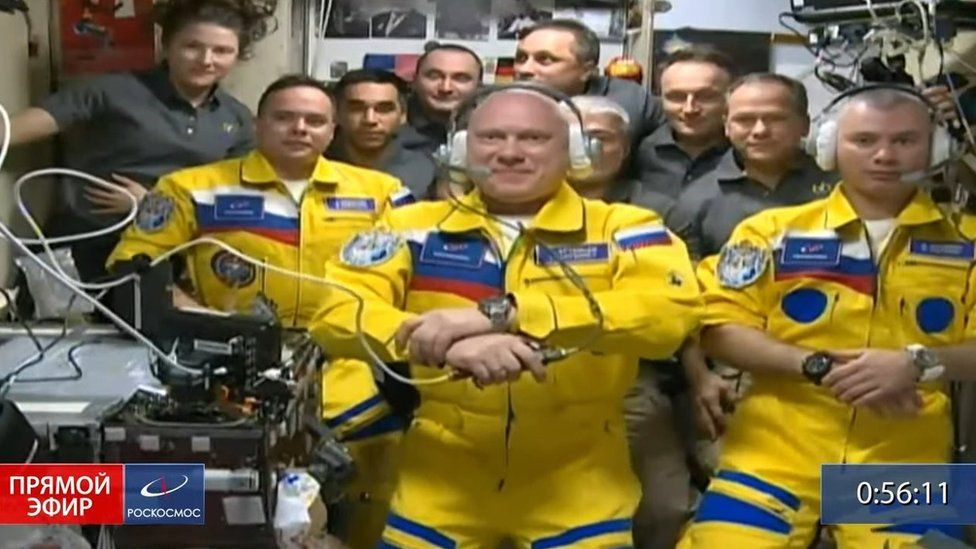
Russians board International Space Station in Ukrainian colours
Published1 hour ago
Image
Image taken from live feed shows the cosmonauts in yellow suits IMAGE SOURCE,ROSCOSMOS
Image caption,
"It became our turn to pick a colour," one of the Russian cosmonauts said with a smile later on Friday

Russian cosmonauts have arrived at the International Space Station wearing Ukrainian colours, in what appears to be a statement opposing the invasion.

The three men were the first new arrivals since Russia attacked its eastern neighbour last month.

They were warmly welcomed on board, hugging and greeting their fellow American, Russian and German crew.

The ISS is a joint project between Russia, America, Canada, Japan and several European countries.

It is led by a US-Russian partnership that has continued for two decades despite fluctuating tensions between the two world powers.

Russian cosmonauts Denis Matveyev, Oleg Artemyev and Sergey Korsakov docked at the ISS after a three-hour flight which blasted off from a Russian-owned facility in Kazakhstan.

"Congratulations on the successful docking," a voice from Russia's mission control said moments later.

A few hours later, two sets of hatches were opened and the three smiling men floated into the space station one by one wearing bright yellow space suits with blue accents.

The standard-issue Russian uniform is plain blue, and at least one of the men was seen wearing this before take-off.

The moment was live-streamed by both Nasa, the American space agency, and the Russian agency Roscosmos.

"It became our turn to pick a colour," Mr Artemyev said when he was asked about the suits in a live-streamed press conference.

"We had accumulated a lot of yellow material so we needed to use it," he joked. "That's why we had to wear yellow."

Since the invasion of Ukraine, people around the world have used the colours of its national flag to show solidarity and support.

The three Russians will begin a science mission on the ISS that is set to last just over six months.

They will replace three current crew members who are scheduled to fly back to Earth on 30 March.
User avatar
DaffyVina
Posts: 761
Joined: 20 April 2020, 19:08

Re: Freedom of Information

Post by DaffyVina »

7:36 19 Mar BREAKING
Nearly 850 civilians have been killed in war, UN says
At least 847 civilians, including 64 children, have been killed in Ukraine between the start of the invasion on 24 February and Friday 18 March, the UN human rights office (OHCHR) says.
This is an increase of 31 deaths compared to the previous daily update published on Friday.

A further 1,399 civilians, including 78 children, have been injured, mostly by shelling and airstrikes, the OHCHR says.
The actual toll is believed to be much higher, it adds.

"Most of the civilian casualties recorded were caused by the use of explosive weapons with a wide impact area, including shelling from heavy artillery and multiple-launch rocket systems, and missile and air strikes," the OHCHR said.


Change by force 'unforgivable', Japan and India say
Kishida and Modi photo -Copyright: AFP via Getty Images
Japanese Prime Minister Fumio Kishida has told Indian Prime Minister Narendra Modi that Russia's invasion of Ukraine had shaken "the foundation of international order" and required a clear response.
India and Japan are party to the Quadrilateral Security Dialogue (Quad), a security framework that also includes the US and Australia.

While Japan has imposed sanctions on dozens of Russian individuals and organisations and has accepted Ukrainian refugees, India has not condemned the invasion.
"We (Kishida and Modi) confirmed any unilateral change to the status quo by force cannot be forgiven in any region, and it is necessary to seek peaceful resolutions of disputes based on international law," Kishida told reporters after meeting Modi in New Delhi.


Join fight against evil, Zelensky urges Swiss rally
Image caption: Zelensky addressed the rally outside the Swiss parliament in Bern

Ukraine's President Zelensky has urged Switzerland to crack down on Russian elites and told the country's banks to freeze their funds.
Addressing an anti-war protest outside the Swiss parliament in Bern, Zelensky urged companies, including food giant Nestle, to stop doing business with Russia.
"Business works in Russia even though our children are dying and our cities are being destroyed," he told the rally by video link.
"Your banks are where the money of the people who unleashed this war lies. That is painful. That is also a fight against evil, that their accounts are frozen.
"Ukrainians feel what it is when cities are destroyed. They are being destroyed on the orders of people who live in European, in beautiful Swiss towns, who enjoy property in your cities. It would really be good to strip them of this privilege," The Ukrainian president said.

Despite not being an EU member, Switzerland has fully adopted EU sanctions against Russian individuals and businesses.
Zelensky said those behind the conflict had funds stashed in Swiss banks and urged them to join the "fight against evil".
"The money of the people who unleashed this war is in your banks. Help fight this. So that their funds are frozen," he said.


More than 3.3 million refugees have fled west - Ukraine deputy PM
Photo: Refugees fleeing Ukraine arrive at the border train station of Zahony on March 10, 2022 in Zahony, Hungary Copyright: Getty Images

More than 3.3 million refugees have fled Ukraine through its western border, Deputy Prime Minister Iryna Vereshchuk said.
Around 2 more million displaced inside the country, she said, according to Reuters.


Ukraine has evacuated 190,000 civilians from frontline areas through humanitarian corridors since the start of Russia’s invasion, Vereshchuk said.
Corridors in the Kyiv and Luhansk regions were functioning on Saturday, but a planned corridor to Mariupol was only partially operational, with Russian troops not allowing buses through, she added.


19:41 19 Mar BREAKING
More than 6,600 evacuated through humanitarian corridors today
A total of 6,623 people were evacuated from Ukrainian cities through humanitarian corridors today, a senior official said.
This is far fewer than more than 9,000 that managed to escape on Friday.
Kyrylo Tymoshenko, deputy head of the president's office, posted that 4,128 people had left the besieged city of Mariupol.
User avatar
DaffyVina
Posts: 761
Joined: 20 April 2020, 19:08

Re: Freedom of Information

Post by DaffyVina »

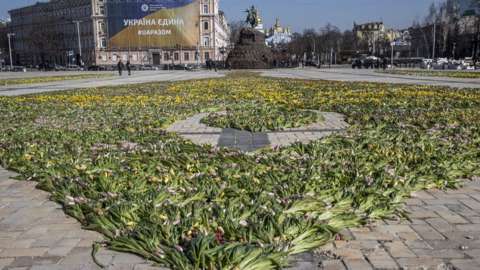
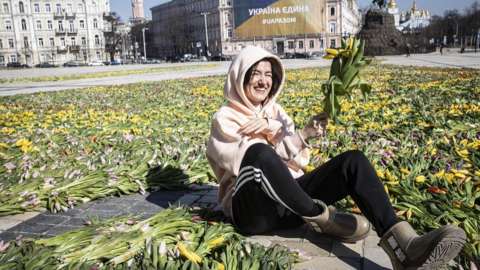
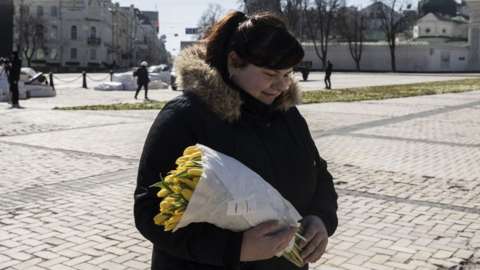
Defiant Kyiv residents arrange huge tulip display
Residents of the Ukrainian capital have come out into the sunshine in the city's central square to arrange some 1.5 million tulips into the shape of the country's coat of arms.
They say the display is intended to honour the Ukrainian women of Kyiv.

Tulip display: Copyright: Getty Images
woman in tulip display: Copyright: Getty Images


Image

Image

Image
User avatar
DaffyVina
Posts: 761
Joined: 20 April 2020, 19:08

Re: Freedom of Information

Post by DaffyVina »

Mariupol residents sent to Russia - mayor
Hugo Bachega-BBC News, Lviv

The mayor of Mariupol says several thousand residents from the besieged city have been sent to Russia.

In a message on Telegram, Vadym Boychenko, said that some were redirected to remote cities in Russia, while the fate of others remained unknown.

The BBC has not been able to verify the claim.

"What the occupiers are doing today is familiar to the older generation, who saw the horrific events of World War II, when the Nazis forcibly captured people," Boychenko said.

"It is hard to imagine that in the 21st Century people will be forcibly deported to another country.

About 300,000 people are trapped inside the city, as food and medical supplies run out and Russia blocks the entry of humanitarian aid.

Russian attacks have hit a hospital, a church and countless apartment blocks, with local officials estimating that about 80% of residential buildings are either damaged or destroyed, a third of them beyond repair.

Mariupol has seen some of the fiercest battles since Russia invaded Ukraine, three weeks ago.

The location of the port city, on the Sea of Azov, is strategic for Russia, as it would help it create a land corridor between the eastern regions of Donetsk and Luhansk, controlled by Russian-backed separatists, and Crimea, the peninsula it invaded and annexed in 2014.


Air raids pound Mykolaiv

Russian air raids on Mykolaiv have been taking place throughout the day, a regional official said.

It comes a day after a deadly strike on a military barracks in the southern Ukrainian city. About 200 soldiers are reported to have been sleeping in the barracks when three Russian missiles hit.

Vitaly Kim, head of the regional administration, said there wasn't even enough time to raise the alarm over the latest raids "because by the time we announce this tornado, it's already there".

"The (alert) message and the bombings arrive at the same time," he said on social media. He gave no details about the extent of the damage or on any possible victims.


Ballet dancer - latest artist to die in conflict
It's been confirmed that one of Ukraine's leading ballet dancers, Artem Datsishin, has died - the latest prominent artistic figure to be killed since the invasion began.

Datsishin, 43, a former principal dancer with the National Opera of Ukraine, died on Thursday after being wounded last month by Russian artillery fire.
"I can't express my heartache that is overwhelming me," his friend Tatiana Borovik wrote on Facebook.

Datsishin is among the latest Ukrainian celebrities and cultural figures to have been killed in the conflict.

Actress Oksana Shvets, 67, was killed in a rocket attack on the capital, according to the Kyiv Independent.

She was a veteran of stage and screen for decades in Ukraine, and the recipient of one of the country's highest artistic accolades.

Pasha Lee, an actor who performed voice dubbing for popular English-language films including The Hobbit, was killed on the outskirts of Kyiv on Sunday, according to reports.


Railway links between Ukraine and Belarus suspended
BBC Monitoring
There are no longer railway links between Ukraine and Belarus, according to Oleksandr Kamyshin, chairman of Ukraine's railway network.
Kamyshin made the announcement after apparently having failed in his appeal to Belarusian railway workers not to carry Russian military trains towards Ukraine.
Post Reply

Return to “Off-topic”