16:00
'The unthinkable happened here': EU chief visits Bucha
Ursula von der Leyen holds her hand to her heart as she speaks with Bucha Mayor Anatolii Fedoruk
Copyright: Reuters
Ursula von der Leyen, the president of the European Commission, has been visiting the town of Bucha near Kyiv in northern Ukraine. Bucha was the town where bodies of civilians were found lying in the street after Russia's withdrawal.
Russia denies killing civilians and has accused Ukraine of staging the deaths to discredit its troops. However, there is strong and growing evidence that war crimes have been committed by Russia.
"It is the unthinkable has happened here," said von der Leyen during her visit. "We have seen the cruel face of Putin's army."
Ursula von der Leyen lights a candle in a church in Bucha
Copyright: Reuters
She joined others in lighting a candle in a church near a mass grave in the town of Bucha
16:13
As fighting intensifies in east Ukraine, a scramble to escape
Tom Bateman
Reporting from Zaporizhzhia
More civilians fleeing the fighting in the south and east have been arriving in the town of Zaporizhzhia.
At a refugee centre helping families and small children, I met Kateryna. Her family managed to get through the front line after fleeing Chernihivka, 150km from here. Holding her little boy Demyd, Kateryna tells me they had to drive through mined areas to escape the town. "It was becoming really tense," she says.
Volunteers are handed out clothes to people arriving here. Another little boy watches us as we film, holding his teddy bear. His dad is shaking as he tells us about the shelling they had to live through in their village, before escaping on Thursday.
16:29
Russia's 'significant' losses may not cause too much of a public stir
Jenny Hill
BBC News, Moscow
Dmitry Peskov said earlier this week that Russia's troop losses in Ukraine were a "huge tragedy"
Russians know that their sons and husbands are dying in Ukraine.
Presidential spokesman Dmitry Peskov's acknowledgement to Sky News that there have been "significant" losses may not cause too much of a public stir, given that state TV does cover some funerals and the authorities have admitted to more than 1,300 deaths (although the real figure is believed to be much higher).
There may be bereaved families who now question Vladimir Putin's "special military operation".
But they're up against a muscular Kremlin propaganda machine which is parroted by state media - to which there is now virtually no independent alternative - which celebrates its fallen soldiers as heroes who have given their lives defending the motherland against the aggression of Ukraine.
It's a brazen attempt to cast Russia both as the victim and the occupier of the moral high ground.
TV and newspapers feature regular reports of the bravery and courageous exploits of individual soldiers. In one such report the author noted that "the fight between good and evil is not stopping".
17:24
Russian TV airs false ‘dummy’ claim
BBC Monitoring
A still from the footage that a Russian TV station falsely claimed showed Ukranians moving a dummy
Copyright: Rossiya 24
A Russian TV channel aired footage of a dummy, calling it evidence that Ukrainians were preparing a fake incident to discredit its armed forces. But it turned out to be part of a TV drama being filmed near St Petersburg.
State-run rolling news channel Rossiya 24 showed footage of two people moving the dummy yesterday and reported "they are obviously intending to present it as a corpse”.
Rossiya 24’s reporter claimed that the use of dummies is widespread in Ukraine. “Dozens of fakes with similar dummies regularly appear on Ukrainian Telegram channels,” the report said, without offering evidence.
However the footage was quickly debunked. TV director Nadezhda Kolobayeva wrote on Facebook that the footage wasn’t from Ukraine. Instead, she said, it was filmed on 20 March in Vsevolozhsk, just east of St Petersburg.
The director said the two people in the shot were the show’s stunt coordinator and an assistant. The dummy, she said, goes by the name Albertik.
The BBC has contacted Rossiya 24 for comment.
17:54
Ukraine wants to use civilians as human shield - Russia
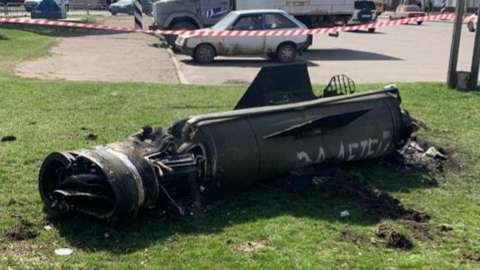
More now on Russia's denial of accusations that it carried out Friday's deadly missile attack on Kramatorsk railway station.
The defence ministry in Moscow blamed Ukraine's armed forces for carrying out the attack. It said they were trying to stop civilians from leaving so that they could use them as human shields.
The ministry also claimed -
without providing any evidence - that the rockets had been fired from the nearby Ukraine-controlled town of Dobropillia.
It insisted it did not use the type of Tochka-U missile that was reportedly fired, whereas the Ukrainian military did.
However, analysts point to images and videos on social media that appear to show the Russian military using the Tochka-U.
Tochka-U rockets are extremely inaccurate, regularly missing their targets by half-a-kilometre or more, according to Amnesty International weapons experts.
18:37
EU offers Ukraine possible fast-track entry
European Commission President Ursula von der Leyen shaking hands with Ukrainian President Volodymyr Zelensky and smiling at camera
Copyright: Reuters
The EU has handed President Zelensky a questionnaire which will lead Ukraine a step further in being granted EU candidate status at a conference in Kyiv.
Speaking to the Ukrainian President, European Commission chief Ursula von der Leyen said the EU will support Ukraine to ensure its completion takes "weeks, not years", as the process has been somewhat accelerated due to the war.
"Russia will descend into economic, financial and technological decay, while Ukraine is marching towards the European future, this is what I see," she said.
Receiving the questionnaire in an envelope, Zelensky assured journalists that it would be ready in a week.
Josep Borrell, the EU's foreign policy chief, added that more than €7m had been allocated to support Ukraine in gathering and presenting proof of war crimes to the International Criminal Court.
Borrell also mentioned that EU delegates will soon return to the capital and he believes embassies will follow suit.
19:26
Slovakia sends entire surface-to-air missile system to Ukraine
As President Biden mentioned, Slovakia says it has sent its entire S-300 surface-to-air missile system to Ukraine, to help bolster the country’s air defences from Russian attack.
It is the first known case of a country sending an air defence system to Ukraine since Russia invaded in February, according to Reuters.
Confirming the news, Slovakia's Prime Minister Eduard Heger said: "I believe that this defence system will help save as many innocent lives as possible from the aggression of Putin's regime".
However, Heger emphasized donating the system to Ukraine "does not mean Slovakia has become part of an armed conflict."
Slovakia recently received the American Patriot missile system - another surface-to-air missile - from fellow-Nato members Germany and the Netherlands. Heger said the country would now get a fourth instalment of the Patriot system next week.
In the meantime, German and Dutch Patriot batteries - the units used to fire missiles - have been deployed to Slovakia as part of a temporary bolstering of Nato's eastern flank, and the US said it would put one Patriot missile defence system and troops to operate it in Slovakia.
"[The Patriots'] deployment length has not yet been fixed, as we continue to consult with the Slovakian government about more permanent air defence solutions," US Defence Secretary Lloyd Austin said in a statement.
19:53
'I didn't know whether they were wounded or dead'
Ukrainian woman who witnessed Kramatorsk station attack
Copyright: BBC
Image caption: A Ukrainian woman witnessed casualties from the missile strike
The BBC has been to the scene of the strike in Kramatorsk that left dozens dead. The once busy station is now quiet, and food carried by those trying to flee is lying in the street.
One woman who witnessed the blast recalled those around her panicking, saying “people were screaming and crying”.
“Then I saw a wounded woman who was bleeding heavily, she was taken into a room with several wounded people there," she said.
“I saw people lying in front of the building - I didn't know whether they were wounded or dead.”
A man who also witnessed the attack said “people were panicked and stressed".
“Some of them were badly wounded and we tried to help them," he said.
21:11
'We are defending the right to live' - Zelensky
Ukrainian President Volodymyr Zelensky said Ukrainians are "defending the right to live" in an interview with CBS news from Kyiv.
"I never thought this right was so costly. These are human values -so that Russia doesn't choose what we should do and how I'm using my rights," he said.
He said that on a recent visit to Bucha, where Russia has been accused of war crimes, he witnessed "death, just death".
21:40
EU adopts fresh raft of sanctions
The European Union has adopted a new raft of sanctions against Russia and entities with ties to the Kremlin. Details were published on Friday.
They include:
Asset freezes and travel bans for 216 individuals, including Vladimir Putin's two daughters, Ekhaterina Tikhonova, 37, and Maria Vorontsova, 37
Also affected are German Gref, head of Sberbank, Russia's largest bank; arms manufacturer and billionaire Oleg Deripaska; and defence ministry spokesman Igor Konashenkov
Sanctions on 18 more firms, including five of Russia's biggest banks
A ban on coal imports, the first action the EU has so far taken against Russia's energy sector
An import ban on others goods - including wood, vodka and chemical products - estimated to make up at least 10% of all imports from Russia
A ban on the export of goods including jet fuel and transportation equipment
An export ban on technologies including quantum computers, advanced semiconductors and high-end electronics
A ban on Russian ships using EU ports
A ban on Russian and Belarusian trucks entering the EU's territory unless they are carrying medical products, food or humanitarian assistance
22:04
Russia closes 15 human rights offices over 'law violation'
Russia is closing the offices of 15 NGOs, including the two leading rights organisations, Amnesty International and Human Rights Watch.
The Russian Ministry of Justice said the decision was taken due to Russian laws being violated, without providing details.
Amnesty International's director, Agnes Callamard, said it was the latest in a long list of organisations being punished for speaking the truth to the Russian authorities.
She said Amnesty would redouble efforts to expose what she described as Russia's "egregious human rights violations at home and abroad".
“The authorities are deeply mistaken if they believe that by closing down our office in Moscow they will stop our work documenting and exposing human rights violations," she said.
Russia tightened its already restrictive media law after invading Ukraine by introducing a new law which threatens to jail anyone Russia deems to have spread "fake" news about the armed forces.