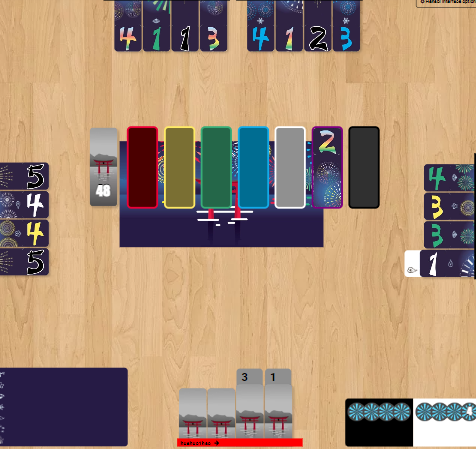
It's a shadow finesse and you play slot 3 (first finesse position) to indicate the position of m4 (first finesse position). Hum... That don't even work, and I believe even if you remove k5, having k5+k4+k3 or like y1+y2+y3 should got priority above self shadow finesse? I'm not even sure. Joke aside,
Yeah this is a great example of not knowing if it's a layered finesse or not for the second player after you.
If I simplify it:
Bob: x-x-x-(b1)
Cathy: r1-x-x-x
Donald: g1-x-x-x
Emily: x-r3-x-x
Alice clues red to Emily.
Bob then can either assumes they got r2 and clue g1 for any reason.
Or they can let the situation goes and plays b1.
1a) If Bob have no clue left, know what is going on (either they have negative r2 on all his hand)(or they are locked: have all cards on their hand saved), or shouldn't clue anyway (per example because they got three 1s in a 5players games), then the clue should work on bga, and this would not be a layered finesse.
1b) If Bob didn't got a b1 playable, but can discard normally or clue normally, then that clue should be a layered finesse to get r2 on Donald's hand.
1c) If none of the two are true, like it is in your situation, then you got an ambiguou situation where some players could assume Bob should never clue, and others could assume Bob could clue if they want to. And that lead to bomb and descynchronisation.
2) With hgroup even case 1a has been negliged for simplicity, and it's always the case 1b even if Bob has 0 clue left, which just resolve the problem.
So yeah... That clue shouldn't happen with strangers

And note that even case 1a have some risk since it require everyone around the table to understand what is going, so I would not advise it without great upside if you want elo, but it's a very fun clue to do though imo.