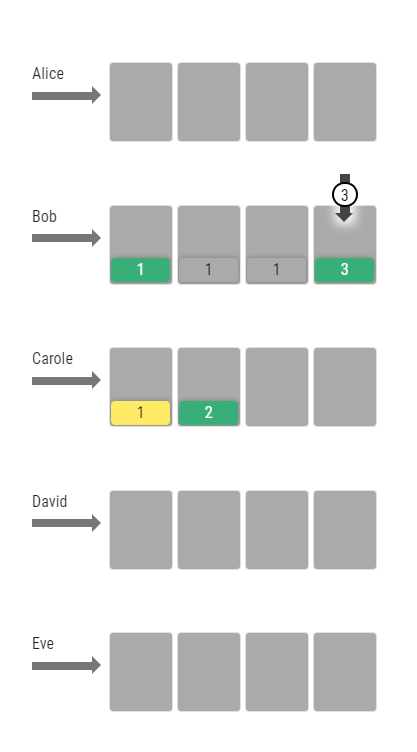
Travis Hall wrote: ↑04 October 2024, 04:08Player 3 can see that the 3 is 3g. They look for 1g, and see it in player 2’s hand, but player 2 refused to play, so player 3 must assume ambiguity
Right.
and respond as if they hold 1g as well. They play 1y.
That part is really interesting though. I talked about it to Blacktango then to hgroup's discord yesterday.
The best answer seem to be that player 3 should not answer the ambiguity.
[
For those not aware of the danger of playing from an hesitation here is an example (chop right):
Played: r2, g1, b1, w1
Bob: x-r3-x-x
Cathy: ?-?-?-?
Alice clue 3 to Bob.
Bob discard.
Cathy assume an hesitation and know her slot 1 is playable (and is not a duplicate with Bob's hand), but she can't play it. If it's g2, b2 or w2 then it will work fine, after that player Bob should assume his 3 is playable, and even if it could be gentleman's discard, in my opinion hesitation have priority. But problems arise when Cathy plays y1, on that case, Bob will assume y2+y3 and will bomb his finesse position.
And so Cathy should not play from hesitation (25% chance to fail) since that causes too much troubles in cases it goes wrong.
And so Cathy is allowed to discard (if there was no clue Alice could expect Cathy to give in nearly all cases).
]
Let's restart with the situation of this subject (chop right):
- player 1 clue 3
- player 2 hesitate because of yellow and do something unrelated (like 5 to player 5)
- let's said now that player 3 play from that hesitation and he is holding y1-y2-g2-x (~3% chance from player 3's pov)
- then let's said that player 4, 5, and 1 don't intervene
- so we are back in player 2's pov, he is holding y3, and is allowed to discard
- then we are back in player 3's pov, and player 2 just did what look like a second hesitation (player 3 could have y1-b1-g2-x), make player 3 be now in a much tricker spot since playing y2 from that hesitation would lead to a lot of mess. So you could decide to play anyway, and let other fix the clue if it's y2. But you need other (players 4/5/1) to follow what you are doing. Or you could pass let's said you pass again
- and let's said that other players don't intervene
- we are back to player 2, and here it's extremely tricky:
-- If player 3's hand was y1-b1-g2-x, then everything is fine and player 2 just have y2+y3, and so player 2 play g1 as y2. Which after... Should make player 3 plays b1 then g2. But you need player 2 to not assume a layered (which he should be doing but that's scary).
-- If player 3's hand was y1-y2-g2-x, then player 2 can't have only y2+y3, because player 3 is the one which should play from the two y2 in both player 2 and player 3's hand. When he doesn't, player 2 need to assume something else: understanding the initial play from hesitation, error from player 3, w1-y2-x-y(3) which would explain why player 3 pass back (depending of the risk player 3 have taken during his last turn: if he discarded a potential 5 that's not possible), or you could assume it's a mess something doesn't feel right and you don't find what and you just play because that look good, but you are not playing y2 on that case, you are playing because it seem the play which lead to the most positive outcome.
And to come back to the initial point, should player 3 play from that hesitation?
I personnally would not because of y1-y2-g2-x possibility.
And what I would do is present on my first post.
I will add that part of answer from spring in hgroup's discord:
if [player 3] does have g1 g2 x x then it just comes down to alice gave a super confusing clue and should choose a more clear line.
To conclude that post, just having the first action of player 3 unclear is already pretty bad. The initial clue is bad and should not be done without two g2s xor a y2 on board imo (guess it's the first time i use an xor in a 'casual' conversation

).