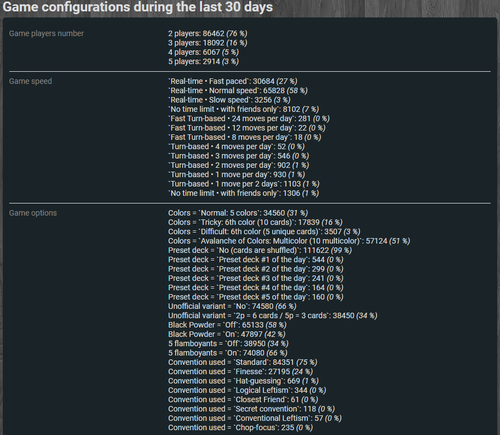
First a bit of history as I remember it:
The classic conventions were based on the most "polarizing" discussions in 2014 - 2016:
a) Chaining or no chaining?
b) Where lies the focus of a clue?
c) How to deal with double discards?
When new players actually started to worry about a convention; they quickly adopted
"Standard"
- Colour to play (newest);
- Number to save;
- Discard from oldest position.
(- For good measure, more advanced players added the "good touch" rule later.)
Most new players would apply a chaining rule: If multiple cards are marked by a colour-clue, then they would keep playing all the marked cards. Since it is most common for clues marking multiple cards happens in the early game, it was easy to see that chaining was not viable. For 1s, there is only a 2/7 chance that the next red card is actually a 2; and for 2s there's only a 2/5 chance that the next card is a 3. (Don't design for niche situations.) In addition it is too expensive (clue-tokens) to make a player stop playing by giving another clue.
Then you had
"Conventional Leftism"
It allowed for finesses, but the focus of the clue was always on the left-most logical card.
Code: Select all
(EXAMPLE)
Discard: r2, g1, g2
Played: r1, y1, g1, b0, w0.

Alice: (new) g4, y4, w3, y4  , r(2) (old) -- r2 is "saved" and marked as 2.
Bob:   (new) r4, r3, y2, b(1), w(5) (old) -- b1 and w5 are "saved" and marked with a number-clue
Cathy: (new) y5, w2, r1, g1  , b1   (old)

Alice discards y4, and draws r5.
Bob plays b1, and draws b1.
Cathy clues red to Alice.

Discard: r2, g1, g2, y4
Played: r1, y1, g1, b1, w0.

Alice: (new) (r)5, g4, y4, w3, r(2) (old) -- r2 is "saved" and marked as 2.
Bob:   (new)   b1, r4, r3, y2, w(5) (old) -- w5 is "saved" and marked as 5.
Cathy: (new)   y5, w2, r1, g1, b1   (old)
In Conventional Leftism, the focus of the red-clue would be on r2. Hence Alice would interpret: play r2, and save other red.
In Finesse convention, the focus of the red-clue would be on r5. Hence Alice would interpret: play r3 after playing r2.
Beri (
https://boardgamearena.com/player?id=4560436) was, at the time, a large advocate of the
"Logical Leftism", because he despised the CL interpretation. He was right in that such an interpretation is inferior. Simple example: it's 2x more likely to draw r3 than r5, so the Finesse interpretation would be more common (don't design for niche situations). In addition, when r3 isn't visible, there is no need to "rush" the r2, so a token is best used for something more useful.
In addition he advocated the saving of non-unique cards (which as revolutionary at the time). However, Beri's Logical Leftism violated "good touch", so was never accepted, and rarely lead to perfect games (making people think that saving non-uniques was too expensive on the tokens, instead of blaming it on "good touch").
Since Beri isn't playing Hanabi anymore, I think no-one plays it. CL is still played by a lot of players, especially those who only play 2-player games. In such games a "full hand" is something players worry about, so they rush cards more easily. Unfortunately I played with 5 players today who still interpret "finesse" as "CL" (extremely frustrating to me).
"Finesse" convention was the most common way to play:
- "Good Touch"
- Number-clue on CHOP always mean "save"
- All other clues mean play (focus on newest unmarked)
- Assume CHOP is safe to discard
- Clues are given by the last possible player (no skipping)
There was no promise of bluffing only with 1-aways; and no layered.
"Layered finesses", at the time, was considered the return of chaining and the arguments hadn't changed: don't design for niche situations, and layered also destroys some of the information promised by (regular) finesse convention (in particular the ability to bluff). Ben Small was a large advocate of that playstyle (still has it in his profile description), and because of this he became a bit of a paria in the BGA community. He even had to make several accounts at the time, because he was constantly blocked from chatting / posting. He still has two active accounts at the moment:
https://boardgamearena.com/player?id=81694356
https://boardgamearena.com/player?id=84363613
Postmans (
https://boardgamearena.com/player?id=84315928) had made an attempt at describing the most common wat to play in this Google Doc:
https://docs.google.com/document/d/1sz3 ... 8fl7o62h8c
AenarionJD (
https://boardgamearena.com/player?id=83880676) introduced the
"JD convention" (
viewtopic.php?f=3&t=5288) where a colour-clue would be used to tell you which card to play (red = position 1; yellow = position 2; green = position 3, etc.) and numbers would tell you which card to play in reversed order (1 = position 5; 2 = position 4, etc.) and white/5-clues would mean something special.
Remember, at the time flamboyants weren't invented yet. So it was considered much harder to get perfect score. And for advanced players the most common way to lose, was by a double discard. In 2-player games, the rule to save 2s and not to double discard was quickly adopted. But in 3-(or-more)-player games there was still debate going on. Some people wanted the avoid-double-discard-rule, but most people had difficulties recognizing the forced clue. And a lot of people had swiss cheese memory, so forgot that their CHOP couldn't be a copy of the just discarded card. So eventually it was settled that, since there's always a player who can see the danger, that player can give the save clue. Hence, number-clues on CHOP are always considered "save it" (because it's given by the last possible player), and not as a finesse (even when a there's no double discard situation).
After this bit of history, I would like to endorse and ammend to Sammy McSam's and Silene's post:
- Other (don't call it unspecified please)
- Beginner (meant for apprentices) | No chaining, Colour-focus on newest; Number-focus on oldest; Double discarding allowed; Good touch optional; saving non-uniques allowed
- Finesse (most played historically) | No chaining, Number-focus on CHOP; all other focus on newest; Double discarding allowed; Good touch required; saving non-uniques allowed
- Conventional Leftism (most played historically) | No chaining, Focus on logical card; Double discarding allowed; Good touch required; saving non-uniques disallowed
- Layered finesse (relatively new) | Chaining, Focus on newest card; Double discarding allowed; Good touch required; saving non-uniques disallowed
- Hgroup (blown over from the-site-that-shall-not-be-named) | Too convoluted for me.
Unfortunately, I've noticed that most players "play however they find it the most fun", and will refuse to play the convention that the table is set to (playing finesse in beginner tables, playing CL at finesse tables, etc.) But, at least this way we give players the option to set the table to whichever they like - fixing players.... well....