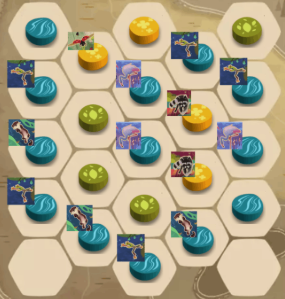
It’s fun to imagine the highest‑scoring Harmonies boards—huge mountains, towering forests, long rivers, and harmony chains everywhere. But there’s another angle that’s just as interesting: what is the strongest possible scoring combo using the fewest tiles?
On Side A, the board has 23 hexes, so in theory you can end the game in 7 turns by placing 21 tiles (since each turn you place 3 tiles).
On Side B, the board has 25 hexes, which means the fastest possible ending is 8 turns with 24 tiles placed.
This raises a fun challenge: what’s the maximum score you can squeeze out of a minimal‑tile game, and what would that build even look like? Would any slower build—one that doesn’t end the game as quickly—be able to keep up in total points? In other words, what is the most efficient build in the game?
On Side A, the board has 23 hexes, so in theory you can end the game in 7 turns by placing 21 tiles (since each turn you place 3 tiles).
On Side B, the board has 25 hexes, which means the fastest possible ending is 8 turns with 24 tiles placed.
This raises a fun challenge: what’s the maximum score you can squeeze out of a minimal‑tile game, and what would that build even look like? Would any slower build—one that doesn’t end the game as quickly—be able to keep up in total points? In other words, what is the most efficient build in the game?