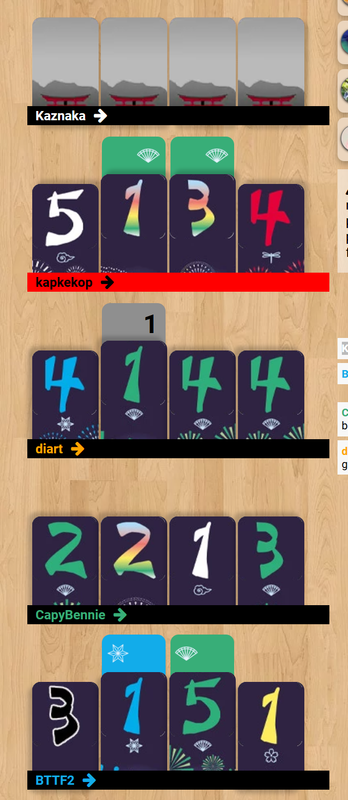
Kapkekop know m1 and received a green clue on m1 and another green/multi card. Their chance to hold g3 is high (maybe 30/40%), m3/m4/m5 (m2?) are possible too.
But now you clue g5, and so Kapkekop will be able to fix only after m2 play, before trusting they hold g3 is good (I was going to said they should wait to see if m2 play or not, but after second though I think they should not, but it mostly depend of what you are doing in the following turn).
But as BTTF2, I would put priority on b1 myself, since g5 look possible on that spot, but I understand the g3 priority.
Kaznaka wrote: ↑14 April 2026, 14:34What I'm trying to understand is, why do you guys default to 3g?
You usually want the simplest explanation, the good explanation which require the less blind play for you.
Per example with r1 and y1 played, and if someone clue 3 to that hand: : x-x-y3-(r)3
And your hand is x-x-x-(r), you should assume the explanation which require the less blind plays, which is playing your r.
But that example is really close and depend a lot of how your red card was saved.
Here on your example it's the same thing for BTTF2, you either assume g3, or assume g5 with a fix. g3 is the conventionnal interpretation.
I already talked about it in my last post, but the problem with fix clues is that you don't know what will happen next, and so you force yourself into a weaker spot, and force everyone to keep track of one extra thing. And make everyone do worst clue while this is going on because they don't know the actual state of the game.
Do I advise that kind of clue? No. Do I like doing them? Yes.
At one point, having fun and adding some more or less controlled chaos is fun, but it's not for everyone, and from my experience, not everyone like that.
To others: I'm curious of your thoughs about BTTF2's play? Would you play b1 or g3 (g5?) first?