Can someone explain to me the idea of "gap"?

Forum rules
Please DO NOT POST BUGS on this forum. Please report (and vote) bugs on : https://boardgamearena.com/#!bugs
Post Reply
Kaznaka
Posts: 18
Joined: 20 October 2023, 22:32

Can someone explain to me the idea of "gap"?

Post by Kaznaka »

Replay: https://boardgamearena.com/gamereview?table=875968976
Image
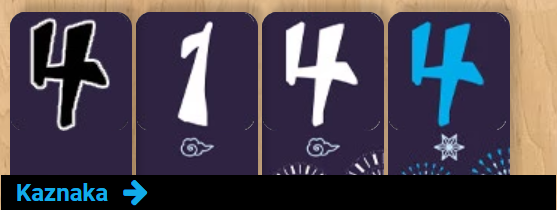
this was my hand
Image
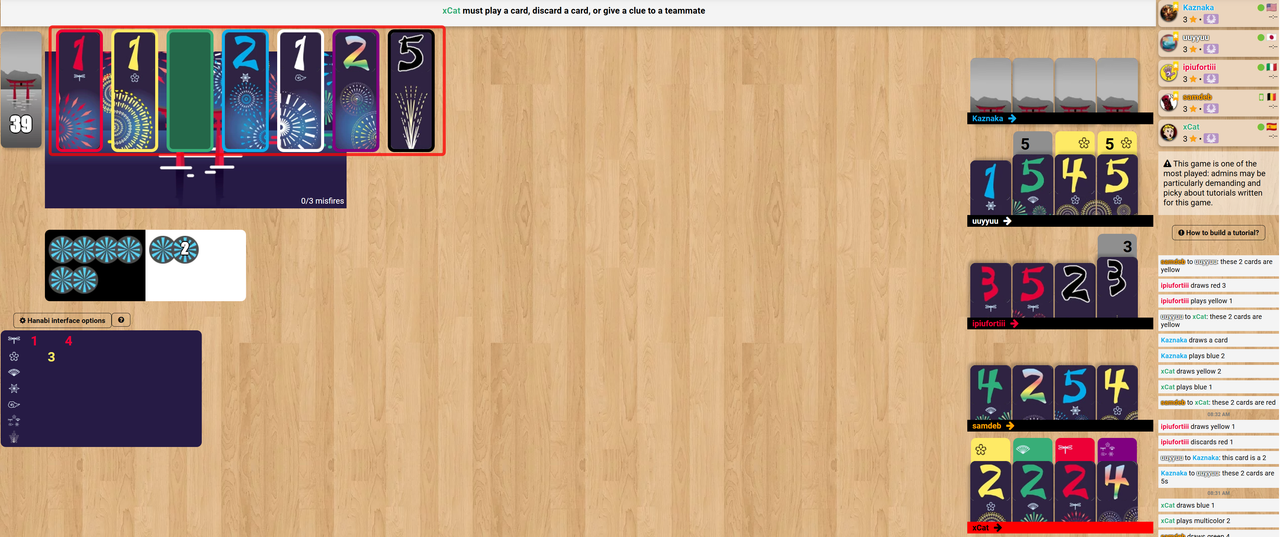
Yellow was clued on y4, y2 played, I blind played k4 leftmost, then next turn I bombed w1 as y3. People are saying there's no gap, therefore it's a bluff, and that you can bluff anyone, it doesn't have to be the person directly in front of you. Can someone explain this idea of "gap"?

Image
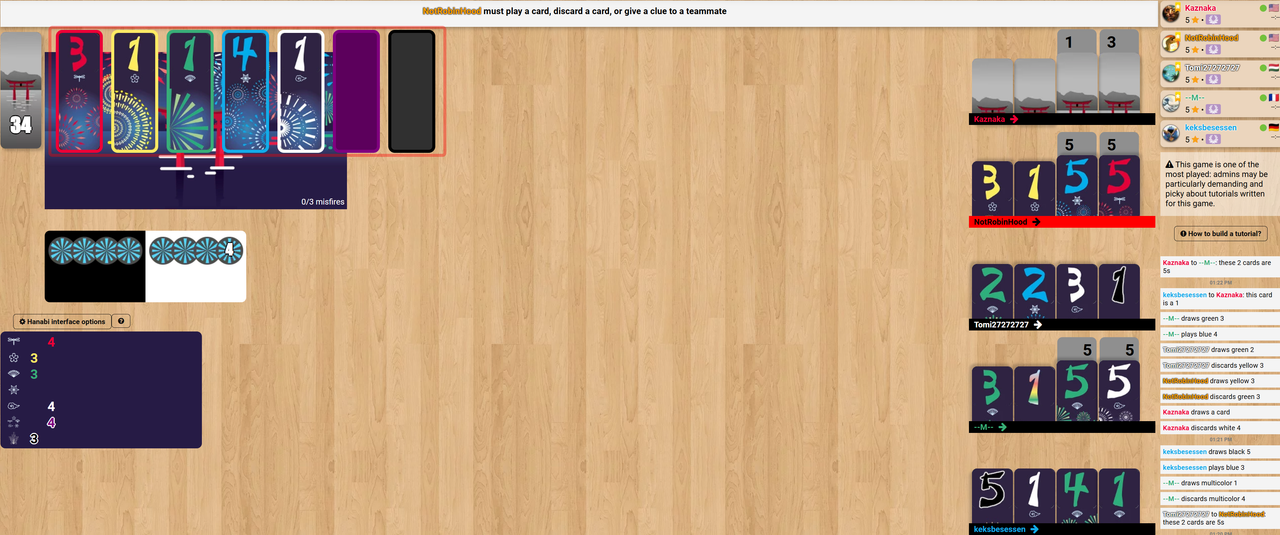
in a different example (#2), 5s are re-clued on g5 w5, B played b5 (it was known playable), C D and E blind played. Because 3 consecutive players blind played, there is no gap.
Last edited by Kaznaka on 03 July 2026, 15:37, edited 1 time in total.
User avatar
Jellby
Posts: 3546
Joined: 31 December 2013, 12:22

Re: Can someone explain to me the idea of "gap"?

Post by Jellby »

In this case, a gap means someone who could have tried to play 3y blindly and didn't.

A normal bluff works when A clues something to C or D or E, and B plays. If it matches the clue, we assume finesse, if it doesn't we assume bluff and no one (neither B nor anyone else) tries to find the missing card.

A layered finesse (where you keep playing, searching for the missing card) works when A clues something to D or E, B doesn't play and C plays blindly something unrelated. Since B didn't play, C must assume the missing card is visible to them. And since the blind play is unrelated, C must keep playing searching for it.

A layered finesse wouldn't work on B if A is the one who clues, because it would be just a bluff. It requires someone to "pass", signaling that the card is indeed visible, even if it's not the first blind play. In this case nobody passed, you were technically in the bluff position, and your blind play actually told ipiufortii that their 3 is not yellow.

Also, since xCat's hand is fully clued, a plain bluff on you (say cluing a hypothetical 3w) would have been possible too. xCat just cannot react to such clue, you're the first one that can respond, you play 4k and you don't keep searching.
Kaznaka
Posts: 18
Joined: 20 October 2023, 22:32

Re: Can someone explain to me the idea of "gap"?

Post by Kaznaka »

https://boardgamearena.com/gamereview?table=876589345
Image
In example #2, I re-clued 5s, touching g5 w5. There is a gap (NotRobinHood didn't play). G2 G3 K5 played. Would kek bomb w1 as g4, so we need to fix? Or is this a finesse-bluff? How do finesse-bluffs work? In the actual game, Tomi bombed b2.
Last edited by Kaznaka on 03 July 2026, 15:40, edited 1 time in total.
User avatar
Jellby
Posts: 3546
Joined: 31 December 2013, 12:22

Re: Can someone explain to me the idea of "gap"?

Post by Jellby »

That's not really a gap, but it's risky. I'll use A-E labels instead of usernames

B (and for that matter C and D) will think they have 4g. B could then choose to clue 5k, and then 1w would bomb immediately. In any case B cannot play until 3g is out. After C and D play 2g and 3g, the first person who can respond is E, and E played blind, so no gap.
User avatar
Romain672
Posts: 1348
Joined: 05 April 2016, 13:53

Re: Can someone explain to me the idea of "gap"?

Post by Romain672 »

That last exemple is trickier.
If you hold k4 then NotRobinHood can clue it, and then NotRobinHood will play y3 as g4.

Now should NotRobinHood not clue the k5+k4 finesse in case they don't hold g4?
Here NotRobinHood got two 5s so forcing them to discard is bad, especially at 5 players. So I would definitively try to not discard, I guess white to --M-- is pretty safe here. (if there wasn't that option I could clue the finesse personnally)

Now to take back your position, why not clue white to --M-- and let NotRobinHood do that same clue, that's a much better line since that cause 0 problem.


It's a spot where your initial question is ambiguous. With full trust, I'm okay with forcing you to clue white here, and so assuming that 5 mean NotRobinHood got g4 (but still I would try to play it safe personnally).
Kaznaka
Posts: 18
Joined: 20 October 2023, 22:32

Re: Can someone explain to me the idea of "gap"?

Post by Kaznaka »

Jellby wrote: 03 July 2026, 08:58 That's not really a gap, but it's risky. I'll use A-E labels instead of usernames

B (and for that matter C and D) will think they have 4g. B could then choose to clue 5k, and then 1w would bomb immediately. In any case B cannot play until 3g is out. After C and D play 2g and 3g, the first person who can respond is E, and E played blind, so no gap.
I see, this is starting to make sense. Is it risky because B might intercept and clue k5? Otherwise, let's say B sees the plan and won't respond. When the blind plays happen, 3 consecutive (no gap) people blind played. Now I think in the game, C thought he had g2 k4 g4 and that's why E played, in order to patch k5 k4. So C ended up bombing b2 as k4. So I think there might be confusion around the perceived gap (player B) and the no-gap in blind plays.

I think C assumes that because of the perceived gap (player B), it cannot be a bluff. It HAS to be long finesse. However, the no-gap in blind plays revealed a bluff. Which of these two ideas is correct? Long finesse or finesse-bluff?
_mg6maciej_
Posts: 23
Joined: 07 January 2025, 22:43

Re: Can someone explain to me the idea of "gap"?

Post by _mg6maciej_ »

The gap must be after any card played for a long finesse clue not to be a bluff at any point.

For example at the start of game if a 4 clue on 4g is given to E:
B: 1g X X X
C: X X X X
D: 2g X X X
E: 1r 4g X X

B will play 1g, C will discard, D will play 2g and E will play 1r. It's a 1r bluff because there was nobody that could have played after 2g played and before 1r.

These situations are not bluffs:
B: 1g Z Z X
C: 2g A A X
D: X X X X
E: 1r 4g Y X

because after 2g played, D did not attempt to play 3g, so he claims he sees a way for 4g to play:
a) Y is 3g and it's a layered finesse
b) Z Z or A A are 2r 3g and it's a patch finesse

These kind of bluffs are not recommended under normal circumstances. Many master level players will mess it up by either directly marking a card intended to be bluffed or do a finesse or bluff for that card.
In my first example C could clue a color like red or yellow to A or B on 2r / 2y to finesse or bluff 1r and assume they have 3g on slot 1, so A should not attempt it.
In your second example NRH could either clue 5k directly or 4k to you if you had it and assume they have 4g on slot 1. NRH will only be aware of distant bluff for 5k if you have another copy of 4g and you can't know you have it, so you should not attempt it.
Kaznaka
Posts: 18
Joined: 20 October 2023, 22:32

Re: Can someone explain to me the idea of "gap"?

Post by Kaznaka »

in your first example, some people will say
B: 1g x x x
C: x x x x
D: 2g 2r 3g x
E: 1r 4g x x

D will think E played in order to patch the path to 4g. Is this a faulty assumption that doesn't work with BGA convention? It seems there is a convention conflict here.

Your 2nd example clarifies things. D is the gap between two played cards that aren't supposed to connect; therefore, it cannot be a bluff. That means in your 1st example, even if D had 2g 2r 3g x, because there is no gap between 2g and 1r, players are supposed to stop looking for 3g. Is that right?
User avatar
Jellby
Posts: 3546
Joined: 31 December 2013, 12:22

Re: Can someone explain to me the idea of "gap"?

Post by Jellby »

Kaznaka wrote: 03 July 2026, 23:50 in your first example, some people will say
B: 1g x x x
C: x x x x
D: 2g 2r 3g x
E: 1r 4g x x

D will think E played in order to patch the path to 4g. Is this a faulty assumption that doesn't work with BGA convention? It seems there is a convention conflict here.
What each player believes of their own hand:

B: 1g 3g x x
C: 3g x x x
D: 2g 3g x x
E: 3g 4g x x

So, after D plays 2g, C and E are ready to play 1st, B and D are ready to play 2nd.
E plays blind, it's not 3g, and there was no gap, nobody "passed" after 2g, therefore it's a bluff and no one should keep playing. There's no reason for anyone to believe they have 3g anywhere.
_mg6maciej_
Posts: 23
Joined: 07 January 2025, 22:43

Re: Can someone explain to me the idea of "gap"?

Post by _mg6maciej_ »

Kaznaka wrote: 03 July 2026, 23:50 because there is no gap between 2g and 1r, players are supposed to stop looking for 3g. Is that right?
Exactly.

If instead E sees a way for 3g to play and does something unrelated (e.g. discard), someone must find 3g.

1) good patch finesse
B: 1g 1r x x
C: x x x x
D: 2g 2r 3g x
E: x 4g x x

Here E passes to B and B assumes he will play the other copy of 3g. Plays 1r instead, but that doesn't stop the hunt for 3g, because E created the gap, proving 3g exists. C is fully aligned with A from the start and will not mess up the clue. Clue is 100% safe even tho B's pov is his own cards should be 1g 3g x x.

2) bad patch finesse
B: 1g x x x
C: 1r x x x
D: 2g 2r 3g x
E: x 4g x x

Here both E and B would pass to C and C assumes she will play the other copy of 3g. Plays 1r instead... but if C on her first round does not realize it can be a patch, she can mess up the clue for example by clueing 1r on A or red to D for A to play 1r from slot 1, so A should not attempt this clue under normal circumstances* and instead go for simpler 3 to D.

* it's okay to give this clue when A knows C will not mess it up.
a) A uses the last clue and C will be forced to discard
b) both A and C see the other copy of 3g (e.g. E: x 4g x 3g), so C is fully aligned from the start
c) C is forced to respond to another clue, e.g. in the middle of layered or E just clued finesse for C to play first
d) the clue count is low enough (usually 1) for C to feel obliged to discard and generate another clue even if she could have given A-D red finesse; bga conv system doesn't, but there are convnetion systems in which going to zero clues changes how players will act on future turns, look up referential sieve and reactor conv systems; even tho in bga conv going to zero clues usually doesn't change anything (meaning of clues or how players will act on their next turn), it's often not a good idea to do so for simple 2-plays finesses and even more so for direct play clues

3) simple layered finesse
B: 1g x x x
C: x x x x
D: 2g 1r 3g x
E: x 4g x x

Just for completeness.
Post Reply

Return to “Hanabi”