Loads of doubles

Forum rules
Please DO NOT POST BUGS on this forum. Please report (and vote) bugs on : https://boardgamearena.com/#!bugs
User avatar
Romain672
Posts: 1348
Joined: 05 April 2016, 13:53

Re: Loads of doubles

Post by Romain672 »

Ze Monstah wrote: 15 April 2021, 08:00Romain, I don't know how to calculate the probability, with what program... So i ask you: What is the probability to get a sum of 10 doubles in a game with a total of 27 rolls? Thanks in advance. So more than 1/3 doubles.
And how often does this type of game occur? You gave an example of 1/60 earlier or something, for 2 games relatively close to 1 another.

https://boardgamearena.com/table?table=164335563

I just played a game, for the... fun of it, to see if doubles come. And what do you know... 10/27. According to your program, numbers or whatever, it should be near 100, seeing from different replies of yours.

I think the conclusion is that for me, these games happen too often than what you consider to be ok, sorry.
So different opinions, based on different limits of acceptance. Even if it was 27/27 doubles, i think that percentage of yours would be 100%, right? So you might think of it... like a "really weird and rare game, but acceptable. Nothing weird... :("

Perhaps I am unlucky to get more games with a lot of doubles than you.
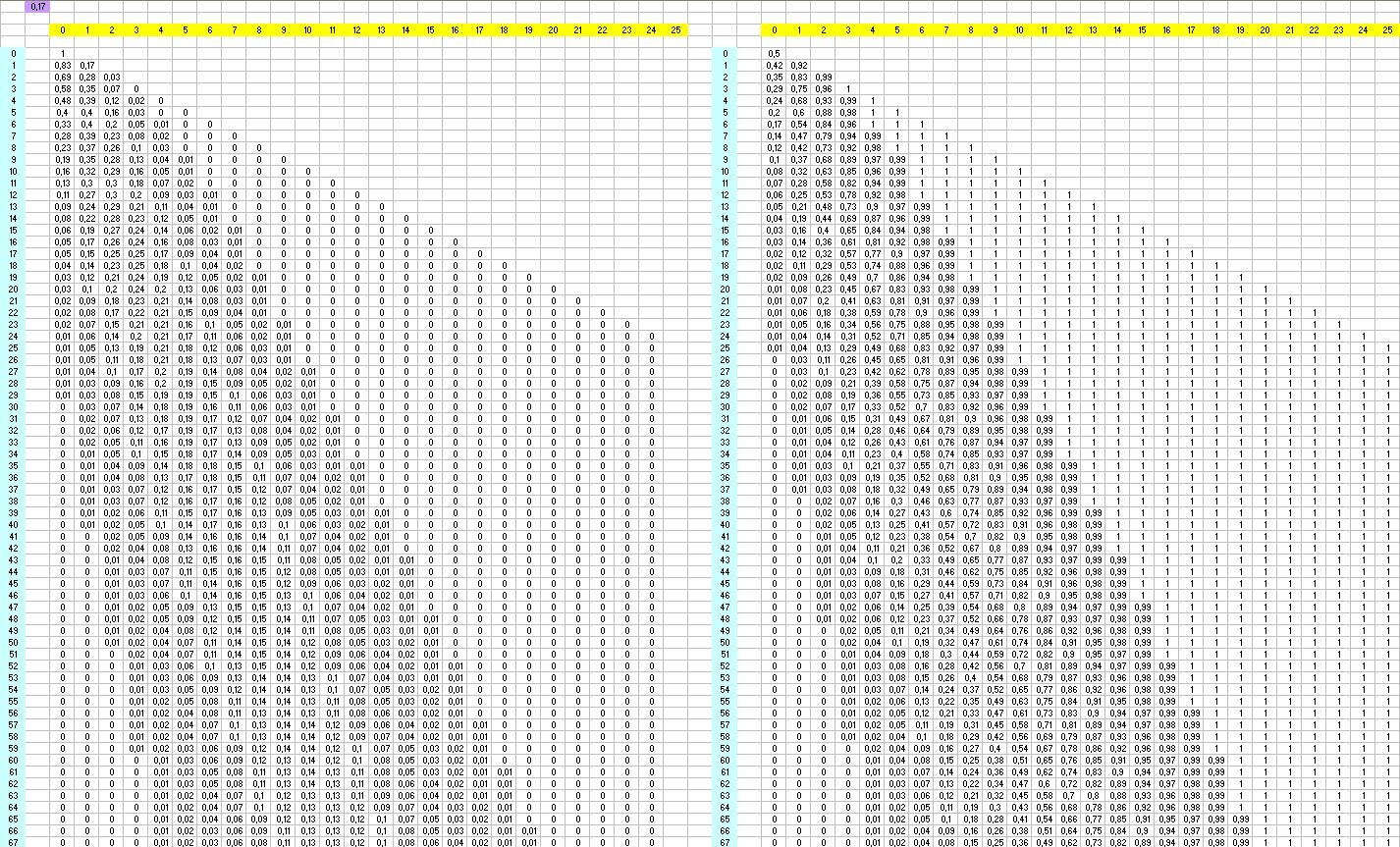
I'm working mainly with that: https://www.zupimages.net/up/21/15/kp44.jpg
It's just a table which tell you the probability to get X number of double in Y roll. The second table is the same than the first one, but with added probabilities (minus 50% of the probability of that tile).
Per example, with 2 rolls (so line '2' ), there is 69% chance to get 0 double, 28% 1 double, and 3% 2 doubles.

For your question, I got 0.629%.
I got 99.42% in my 'program' yup.
You did 20 games since the start of that subject. You should get one result of above 95%, so one of ~97.5% in average, this one is way higher than what you should have yup.
Ze Monstah wrote: 15 April 2021, 15:19Last 21 games, actually, not last 40 or last 60...
You need some big numbers where the last game doesn't stop whenever you want. Since the last time we talked you did 170+20 games, so 190, we should take all of them into account.
Here is the probabilities to get X games to be '99% unlikely' in 190 games:
0/1/2/3/4/5/6/7/8/9/10/
15%/28%/27%/17%/8.1%/3.1%/0.95%/0.25%/0.058%/0.012%/
There is still the biais to make you stop that count whenever you want but we remove the biais to make you start the count whenever you want.

As you can see, 3 games is pretty high, but still on the main 'branch'.
I really would like from now on just after this game, you do that thing again, and try to find games with lots of doubles.
Just wrote down your games with lots of doubles in your next 100 games. If you respect it, we will be able easily to tell you how likely/unlikely it was to get those in ~100 games.

What happen here, is that you play 190 games, and can take any series of any number of games you want between those 190 games. It can be one game (190 choices), it can be two games (189 choices), three games (188 choices) and so on. So you can choose between 17.955 series (189*190/2) the one you want which will be the most unlikely.
I caricature since I don't believe you would see which series of (random number) to take but you can see how fast this number grow. I got no probability under 0.5%, and yet, you should have one series unlikely as 0.006% between those 190 games.
(here is another way to explain it: If, in your next 100 games, you want to start a series and stop a series which seem weird for you whenever you want, you will be able to choose between 4950 series, so you should be able from that choice only, to see a probability of 0.02% event happen)
series=any sucessfull number of games of your choice

edit4: to be fair, I believe those number are too high. There is no way on 100 games Ze Monstah would show like 97 games.
So if I assume any numbers of games between 1 and 20, then 30/40/50/60/70/80/90/100 games, I got 2098 possibilities (100+99+98+97+96+95+94+93+92+91+90+89+88+87+86+85+84+83+82+81+71+61+51+41+31+21+11+1), which gave 'only' 0.04%. Which is still a very low number.
Last edited by Romain672 on 15 April 2021, 19:38, edited 4 times in total.
User avatar
Romain672
Posts: 1348
Joined: 05 April 2016, 13:53

Re: Loads of doubles

Post by Romain672 »

Ze Monstah wrote: 15 April 2021, 15:19Game 6th. 163880903: 11/39
Game 10th. 163863207: 12/37 (????)
Game 23th. 163722374 - NOT SURE ABOUT THIS ONE: 14/49
Game 25th. 163682276: 7/24
Game 27th. 163687761: 5/15
Game 52nd. 163583803: 10/33
Here is the results (in random order): 94%/94%/97.4%/98.1%/99.04%.
On a sample of 50 games. We should got one number between 98 and 100%, one between 96 and 98%, and one between 94 and 96%.

We are really not far from that on a biaised serie (since that person only talked because something weird happen).
That's why I really prefer your games to take into account, because you remove this biais.
User avatar
Ze Monstah
Posts: 676
Joined: 10 October 2019, 08:08
Location: Brăila, Romania

Re: Loads of doubles

Post by Ze Monstah »

:idea:
Last edited by Ze Monstah on 08 April 2022, 09:30, edited 1 time in total.
When life gives you a ZeMon, make ZeMonade...
https://youtu.be/fq_EAESWlOs
User avatar
Romain672
Posts: 1348
Joined: 05 April 2016, 13:53

Re: Loads of doubles

Post by Romain672 »

Ze Monstah wrote: 15 April 2021, 19:36IMO, the fact that my first game after all this everlasting debate, was... the strongest regarding the number of doubles, is a sign... And I need nothing more :)
You did 20 games since the start of the subject, not 1, that's really important. There would be others games where you would think the same.
User avatar
Ze Monstah
Posts: 676
Joined: 10 October 2019, 08:08
Location: Brăila, Romania

Re: Loads of doubles

Post by Ze Monstah »

:idea:
Last edited by Ze Monstah on 08 April 2022, 09:30, edited 1 time in total.
When life gives you a ZeMon, make ZeMonade...
https://youtu.be/fq_EAESWlOs
User avatar
Romain672
Posts: 1348
Joined: 05 April 2016, 13:53

Re: Loads of doubles

Post by Romain672 »

Ze Monstah wrote: 15 April 2021, 19:46
Romain672 wrote: 15 April 2021, 19:40
Ze Monstah wrote: 15 April 2021, 19:36IMO, the fact that my first game after all this everlasting debate, was... the strongest regarding the number of doubles, is a sign... And I need nothing more :)
You did 20 games since the start of the subject, not 1, that's really important. There would be others games where you would think the same.
The last game was today. The 2nd. last was on 13th. April. The post of the original poster was made on 12th. of April.
I rephrase then... My first game after getting more involved in the debate, while having played some more games while debating (12-13th. April).
Then 2 days hiatus then 1 random non-arena game, where the % of doubles was... a lot.
Yeah true, it's a pretty big gap.
You could read back the end of the post I edited 4 times at the top of this page.
Feel like this game enter totally into that count, since we are talking about 10/20/80 games since the start, but for one time we only talk about one game.
Ze Monstah wrote: 15 April 2021, 19:36Game 6th. 163880903: 11/39
Game 10th. 163863207: 12/37 (????)
Game 23th. 163722374 - NOT SURE ABOUT THIS ONE: 14/49
Game 25th. 163682276: 7/24
Game 27th. 163687761: 5/15
Game 52nd. 163583803: 10/33
Game 78th. 163289604: 8/23[/b][/color]
Ok let's work for 80 games and those number: 93.6%/94.1%/97.4%/98.1%/98.2%/99.04%.
Let's give points in functions of how close they were from 100%. Like 100 points for 99%+, 50 points for 98%+, 34 points for 97%+ and so on, until 94.
So we got: 0+16.66+33.33+50+50+100=248 points.


Now I will create some others series of 80 games too and compare the points.
751 series out of 2560 were above 248 points. It's 29%.

And this way of counting points seem to be on your favor because that 99.04% count for 100 points instead of 50 points if it was 98.99%.

You would like more explanations but 29% is pretty much in the middle. Since I decided to count double for any player, there seems to have 0 biais for this number.

I should learn back how to do variance :p
User avatar
Ze Monstah
Posts: 676
Joined: 10 October 2019, 08:08
Location: Brăila, Romania

Re: Loads of doubles

Post by Ze Monstah »

:idea:
Last edited by Ze Monstah on 08 April 2022, 09:31, edited 1 time in total.
When life gives you a ZeMon, make ZeMonade...
https://youtu.be/fq_EAESWlOs
User avatar
Romain672
Posts: 1348
Joined: 05 April 2016, 13:53

Re: Loads of doubles

Post by Romain672 »

Ze Monstah wrote: 15 April 2021, 20:12Player Romain, sorry... I got tired after all those exhausting replays :( But I learnt how to replay 8 times more games than I was usually able to, without being Premium. So this thing kind of helped me.

I will reread what you said, but tomorrow, because as I already told you 4 or 5 times, i am not capable of easily comprehending what you try to say (I usually understand 64.39%).
Yeah I took a small break too after all that so I believe I goes too deep/speak too much to myself.

If I try to summarize: your series of 80 games with my method of calculation (which I believe favorise you) got the 27% of results which got the most doubles*.
That means more than one forth of the random series got more double than you.

(I'm not sure if you think there is flows on the random generation on general, or if there is too much doubles, but if it's the first one, then there is then 54% (27*2) of games which got more weirdeness in number double (low number or double or high number of double)

With a second look, 27% seems totally not weird to me.

*to be exact, it's not the most doubles, but the most games which got a really high number of doubles which are 94% unlikely or more. 94% got a weight of ~17, 95% got a weight of 20, 96% got a weight of 25, 97% got a weight of ~33, 98% got a weight of 50, 99% got a weight of 100.
User avatar
dschingis27
Posts: 745
Joined: 27 June 2015, 18:30

Re: Loads of doubles

Post by dschingis27 »

One important note: The number of doubles in a Backgammon game can NOT be modeled accurately with a binomial distibution. For a binomial distribution, you assume a fixed number of trials (dice rolls). But in a Backgammon game, the game length will actually depend on the number of doubles. Higher proportion of doubles will be associated with shorter games.

In games where lot of doubles happened, you skipped more pips per turn, hence games will tend to be shorter and therefore a higher proportion of doubles will not be as rare as derived from a binomial model. Of course the relation between game length and number of doubles is more complex in reality, it even depends on play style. It is really hard if not impossible to find a proper probabilistic model for this.

The variance for proportion of doubles in a Backgamomon game should definitely be higher than indicated from calculations with the binomial distribution.

To make things much more intuitive, let's play a much simpler game: A solo game called "coinflip once or twice" and it consists of one or two coinflips:
1st round: You flip a coin, if it shows heads, you win and stop the game. If not, move to 2nd round.
2nd round: You flip the coin again, if it shows heads, you win. If not, you loose the game.

Clearly the game length here depends on the actual results of the coinflips. (In Backgammon, when you roll a double (the higher ones: 3-3, 4-4, 5-5, 6-6), this also simultaneously will usually help you to win the game and usually shortens the game length.)

You can observe 3 things when you play the coinflip game 100 times (I use "expect" here in the sense of a probabilistic expected value):
1. You will expect to win 75 of 100 games. You expect to win 50 games in the 1st round and 25 games in the 2nd round.
2. You expect 150 coinflips to happen over the course of 100 games. You expect 75 times to flip heads and 75 times to flip tails. So even though the rules of the game kind of bias towards heads, you still get equal probability of 50% for both outcomes. After all, you perform independent coinflips and each coinflip has 50% probability for either heads or tails.
3. If you calculate the proportion of heads for each of the 100 games, then the expected average of these proportions is 62.5%, not 50%. (You expect 50 of 100 games with only one flip that shows heads, these have 100% heads. 25 of 100 games show 50% heads, and the remaining 25 of 100 games show 0% heads. Taking the average (50*100% + 25*50% + 25*0%) / 100 yields 62.5%)

The 2nd and 3rd point are the most interesting. Heads will be shown in 50% of all flips (2.), however, if you look at the average of proportions of heads in all single games, it is much higher than 50% (3.). In the same vein, even though the proportion of doubles in all Backgammon dice rolls will be close to 1/6, that dooesn't mean that the average of all final proportions of doubles from single games needs to be 1/6.

Conclusion: All in all, things are more complicated for Backgammon. But the example goes to show that not even the expected value of the proportion of doubles calculated from the Backgammon game results shown by BGA needs to be 1/6. The more interesting parameter would be the variance of these proportions, it should be higher than derived from a simple binomial distribution, making rare events of high proportion of doubles more likely than assumed at first glance.

What can I do if I still suspect the RNG to show too many doubles?
This is easy to investigate in general but tedious/limited on BGA. Pick a large number of played games. For each game, count how many non-double rolls happened until the first double happened. This number should follow a negative binomial distribution. https://en.wikipedia.org/wiki/Negative_ ... stribution In particular, the average number of non-doubles until the first double should be 5. We can also count the number of non-double rolls until 2 doubles happened. The average of these should be 10.
Last edited by dschingis27 on 17 April 2021, 11:36, edited 1 time in total.
User avatar
dschingis27
Posts: 745
Joined: 27 June 2015, 18:30

Re: Loads of doubles

Post by dschingis27 »

@Ze Monstah: Congrats, you finally provided some real indications that something looked fishy. I can totally understand how the games you collected look fishy for people without in-depth experience in statistics. (I am a professional statistician and it took me a while to figure out what is going on.) Your findings were fishy enough for me to dive deeper into this and I hope my previous post will help people who are interested to understand the complexity of the issue.

There is also another issue with the games you listed. At least 2 of them are aborted games, Game 25th. and Game 27th. I would say that they have been aborted exactly because many doubles already happened in them. Both were aborted in the turn exactly after a double just happened. But because they were aborted, they were artificially shortened and cannot count in the same way like properly finished games. (Strictly speaking, the probability that a high proportion of doubles occors after any of the first X moves of a game is much higher than the probability for a high proportion of doubles in a finished Backgammon game.)
Post Reply

Return to “Backgammon”