
Link: https://boardgamearena.com/bug?id=13021
Hi everybody
I would like to share here some ideas about the current Elo system (which applies both in Arena and non-Arena games) and the player categories associated with it. I think that system is already very good but I wish it was even better!
Why Elo is good? Well, basically, it measures a theorical strenght of a player comparatively to each other. Based on the past results of this player on a given game, it tells you about the probability you can beat him comparing his Elo with yours.
More specifically, if you have both the same Elo, those odds are theorically 50%, the same as flipping a coin. I think most of you are aware of that.
But what if the Elo are not the same? In that case, there is a formula that links the difference of Elo D with the probability to win or lose p(D).
The exact formula for the Chess system is:
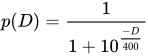
As far as I know, BGA currently uses that same formula.
For example, if you have Elo 240 and you opponent 160, the difference is +80 that gives you 61% chances you win against that player (and 39% to lose, if you neglect the possibility of a tie).
What if now you have Elo 440 and your opponent 360, well the difference is the same +80, so the odds are the same: 61% vs 39%.
You may wonder where I want to lead you with this. So let's talk about the players categories as defined in BGA. Here's the recap:
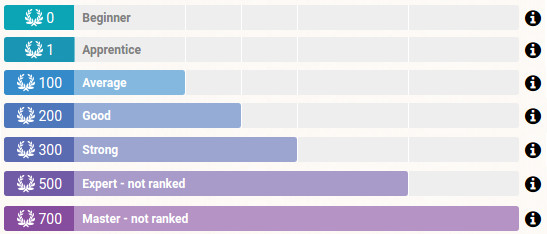
The first categories are special: below 100 it is not possible to loose any Elo and when you reach 100 you can't go below 100 anymore. These are minor differences with a true Elo system but I like them because it positivate a beginner progression and limits frustration after that.
Now, I will pinpoint the range (width) of the main categories starting with average:
Average player: 100 (Elo 100 to 199)
Good player: 100 (Elo 200 to 299)
Strong player: 200 (Elo 300 to 499)
Expert player: 200 (Elo 500 to 699)
See the problem coming? The range is not the same for all categories but I showed before that the difference of Elo shows the probability to win/lose, hence the relative strenght between players. A 250-Elo player has the same probability to win against an 350-Elo (approx. 36%) than a 350-Elo player against a 450-Elo. Yet in the second case both players belong in the same category (Strong players) whereas in the first they don't (good player vs strong). This seems a bit inconsistant to me.
As a casual player of Race for the Galaxy, I often experience this fact (and you may have seen it too). My level is around Elo 300 and I know I have little chances to win against a 450-ish player (30% chances to win or less). I does not seek to win at all cost but I wish I could set the matchmaking up to Elo 400 to have a fairer set-up).
Now I would like to have your opinions about this subject. Maybe I am wrong in my approach and this classification is fine.
But with the new design of achievements and Xp, it saw the occasion to truly discuss this subject and maybe get the BGA admins involved.
If you are interested, you can read my proposal I made some time ago to divide the strong player class into 300-399 and 400-499 and maybe vote for it if you wish: https://boardgamearena.com/bug?id=13021
Note that there is the same problem for Expert players but I am personally OK with this because there are much fewer players in this category. But maybe some skillful players would disagree because they feel aggrieved too
But I repeat, I already consider the ranking system very good and this are only two-cents to improve it just a bit more. After all, for games with weak audience, nobody cares for that level of detail (and the Elo rating system mechanically lose accuracy anyway because there is less diversity in player encounters). Some people can object that the Elo does not reflect the true world ranking for lots of reasons which have been debated elsewhere in the forum, but I consider main problems of that kind have been solved with the introduction of Arena. Anyway I personally don't care much about player ranking and just take the Elo for what it is: an indication of the general level of the players I play against.
Thanks a lot for reading, and looking forward to hear from you!
Take care of yourself and have fun
Woodruff
Fun fact : Elo must not be written in full uppercase "ELO" because it is not an acronym but the name of the guy who invented this ranking system! His name was Arpad Elo.
Sources:
Hi everybody
I would like to share here some ideas about the current Elo system (which applies both in Arena and non-Arena games) and the player categories associated with it. I think that system is already very good but I wish it was even better!
Why Elo is good? Well, basically, it measures a theorical strenght of a player comparatively to each other. Based on the past results of this player on a given game, it tells you about the probability you can beat him comparing his Elo with yours.
More specifically, if you have both the same Elo, those odds are theorically 50%, the same as flipping a coin. I think most of you are aware of that.
But what if the Elo are not the same? In that case, there is a formula that links the difference of Elo D with the probability to win or lose p(D).
The exact formula for the Chess system is:
As far as I know, BGA currently uses that same formula.
For example, if you have Elo 240 and you opponent 160, the difference is +80 that gives you 61% chances you win against that player (and 39% to lose, if you neglect the possibility of a tie).
What if now you have Elo 440 and your opponent 360, well the difference is the same +80, so the odds are the same: 61% vs 39%.
You may wonder where I want to lead you with this. So let's talk about the players categories as defined in BGA. Here's the recap:
The first categories are special: below 100 it is not possible to loose any Elo and when you reach 100 you can't go below 100 anymore. These are minor differences with a true Elo system but I like them because it positivate a beginner progression and limits frustration after that.
Now, I will pinpoint the range (width) of the main categories starting with average:
Average player: 100 (Elo 100 to 199)
Good player: 100 (Elo 200 to 299)
Strong player: 200 (Elo 300 to 499)
Expert player: 200 (Elo 500 to 699)
See the problem coming? The range is not the same for all categories but I showed before that the difference of Elo shows the probability to win/lose, hence the relative strenght between players. A 250-Elo player has the same probability to win against an 350-Elo (approx. 36%) than a 350-Elo player against a 450-Elo. Yet in the second case both players belong in the same category (Strong players) whereas in the first they don't (good player vs strong). This seems a bit inconsistant to me.
As a casual player of Race for the Galaxy, I often experience this fact (and you may have seen it too). My level is around Elo 300 and I know I have little chances to win against a 450-ish player (30% chances to win or less). I does not seek to win at all cost but I wish I could set the matchmaking up to Elo 400 to have a fairer set-up).
Now I would like to have your opinions about this subject. Maybe I am wrong in my approach and this classification is fine.
But with the new design of achievements and Xp, it saw the occasion to truly discuss this subject and maybe get the BGA admins involved.
If you are interested, you can read my proposal I made some time ago to divide the strong player class into 300-399 and 400-499 and maybe vote for it if you wish: https://boardgamearena.com/bug?id=13021
Note that there is the same problem for Expert players but I am personally OK with this because there are much fewer players in this category. But maybe some skillful players would disagree because they feel aggrieved too
But I repeat, I already consider the ranking system very good and this are only two-cents to improve it just a bit more. After all, for games with weak audience, nobody cares for that level of detail (and the Elo rating system mechanically lose accuracy anyway because there is less diversity in player encounters). Some people can object that the Elo does not reflect the true world ranking for lots of reasons which have been debated elsewhere in the forum, but I consider main problems of that kind have been solved with the introduction of Arena. Anyway I personally don't care much about player ranking and just take the Elo for what it is: an indication of the general level of the players I play against.
Thanks a lot for reading, and looking forward to hear from you!
Take care of yourself and have fun
Woodruff
Fun fact
: Elo must not be written in full uppercase "ELO" because it is not an acronym but the name of the guy who invented this ranking system! His name was Arpad Elo.Sources:


