Page 1 of 1

Double bluff or layered

Posted: 03 October 2024, 18:04
by paino
Hi, i have a question for the community.
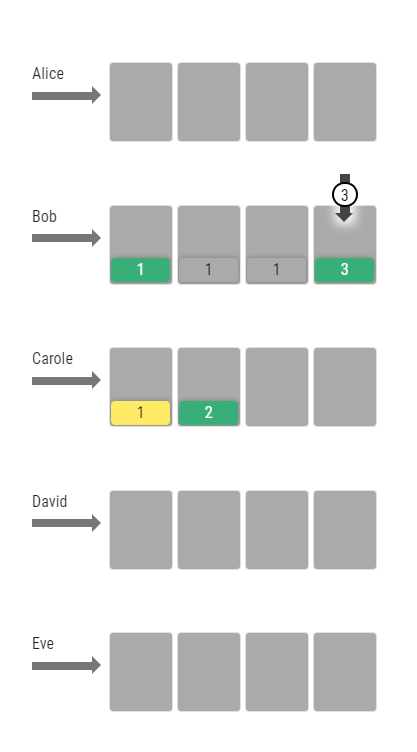
This is the situation at first round

Playwr 1
Player2: 3g 1 1 1g
Player 3: x x 2g 1y
Player 4
Player 5

Player 1,4,5 hands not relevant.

As first player of the match, player1 clued 3 to player2.
(there was a miss, so player 2 didnt see his 3)
There were no relevat clue about this situation..
In the second turn, player 2 played his 1g and player 3 his 1y.

Now i ask if this situation:
1. it is closed becuse it is a double bluff for sure, after 1y is played
2. it can be a layered to player 3, so player 2 have to wait to underatand it

Thanks

Re: Double bluff or layered

Posted: 03 October 2024, 18:22
by kapkekop
My view is that it is double bluff since both player 2 and player 3, directly after clue giver, respond. This means, it cannot be layered. The confusion happens because of the miss in the first round. As long as we ignore that, its double bluff.

Re: Double bluff or layered

Posted: 03 October 2024, 18:27
by Blacktango
I agree. Since no one has the opportunity to bomb, this is not a layered situation.
If you switch player 3 and player 4's hands, then this is a layered, because player 3 has an opportunity to bomb before player 4 answers the clue.

Note: I suppose the newest cards are on the right most side of the hands? This is a bit confusing as on BGA it is always from the left :geek:

Image

Re: Double bluff or layered

Posted: 03 October 2024, 20:01
by Romain672
Disagree with others.
There was no miss, everything goes as it should. The initial clue is pretty slow though which could be bad.

When you clue 3 to player 2, player 2 need to assume the lowest risk possible. Here he can have x1+x2+x3 on his hand. Or he can have g1+g3 (or g1+g2+g3). Or he can have y2+y3.
Because of yellow, he need to wait, and can't interfere with yellow or green.
So he must clue something else, most likely a 5.

Player 3 assume g2 and don't interfere neither.

At the second turn, g1 is played, and y1 is played.
The problem here is that player 4 and player 5 can clue y1 if they want to, they can clue yellow on y2 to player 1 which would create bombs (since without g2 in player 3's hand they assume they hold g2 themselves).
For that reason, y1 can't be the only card gotten by the clue.
And so g2 is gotten and it's layered.


Let's change the situation into:
Player 1
Player 2
Player 3: 3g 1 1 1g
Player 4: x x x 1y
Player 5
Player 1 clue 3 to player 3.
Here player 2 assume g2 and clue y1.
Player 3 plays g1. Player 4 plays y1. Player 5 bomb.
For me those two situations are similar.

Re: Double bluff or layered

Posted: 03 October 2024, 20:15
by kapkekop
The difference you put there romain is exactly the point. The example at the bottom has player 2 in between the clue giver (player 1) and the person that first responds (player 3). That makes it layered.
In the example before, the first and second response (player 2, and 3) were directly after the clue giver (player 1). That ends it as double bluff.

Re: Double bluff or layered

Posted: 03 October 2024, 20:19
by Romain672
kapkekop wrote: 03 October 2024, 20:15
Problem is that the clue giver know it wasn't going to be resolved immediately, that create others players in between.
To quote myself:
When you clue 3 to player 2, player 2 need to assume the lowest risk possible. Here he can have x1+x2+x3 on his hand. Or he can have g1+g3 (or g1+g2+g3). Or he can have y2+y3.
Because of yellow, he need to wait, and can't interfere with yellow or green.
So he must clue something else, most likely a 5.
For the general case, you are right for me, but not here.

Re: Double bluff or layered

Posted: 03 October 2024, 21:34
by Blacktango
Actually, I agree with Romain about what the player 2 should assume: they have Y2 and Y3, so they have to wait.
But since they haven't answered the clue, player 3 should.

- P2 discards
- P3 plays Y1

At this point we have Y1 played from a 3 clue on G3, and no bluff is revealed.
Player 4 looks at the hands, and sees that the cards are in the right position to get the G3 played: G1 + G2 + G3.
So they don't need to answer, and neither do player 5.

- P4 discards
- P5 discards

Finally, player 2 plays the G1, but it is too late for a bluff because player 4/5 would have bombed.
So this is a layered and they most keep playing until their 3 becomes playable.

- P2 plays G1

Here is what I thought first:
Here I don't know what player 3 should think:
- We need a G2 to make the G3 playable, and we have it because P4/P5 didn't answer, so I'm playing mine right now.
- Player 2 has two more playable 1, and will still be playing to find a Y2, so I will just wait and play it only when player 2 has played all their 1.
Here is what I think after some more thinking:

A G2 is still needed because P4/P5 didn't answer, so it must be the next card in player 3's hand.
Player 3 has a play, so is not expected to discard.

- P3 plays G2
- P2 plays G3 (finally)

Re: Double bluff or layered

Posted: 04 October 2024, 04:08
by Travis Hall
Assuming paino posted the hands the reverse of how we normally see them, I think Romaine and Blacktango are at least looking at the problem in generally the right way, but I really doubt that this is what player 1 intended.

The 3 clue indicates a play, but not an immediate one. Player 2 looks to see whether another player holds a card that could lead to a 3 being playable, sees 1y, and does not play.

Player 3 can see that the 3 is 3g. They look for 1g, and see it in player 2’s hand, but player 2 refused to play, so player 3 must assume ambiguity and respond as if they hold 1g as well. They play 1y.

Players 4 and 5 know we are actually seeking 1g, and see that it is available in player 2s hand. Player 2 should hunt (as we will see in a moment) so players 4 and 5 do not respond.

Player 1 gave the clue, so acts independently of all this.

Player 2 sees that 1y has played, so now expects to be seeking 2y. This is not available anywhere else, so should attempt to play it. The non-response from players 4 and 5 confirms the presence of… well, not necessarily 2y, but something to come from player 2’s hand. The played card is 1g, which is a surprise to player 2.

Player 3 sees player 2 play 1g, and knows that the original clue is for green. 2g is now being sought. Player 3 does not see that anywhere, so attempts to play it. And succeeds.

The play of 2g tells player 2 that they do not have a 2 in hand that will lead to the play of the 3 (because then player 3 would not have responded). So now player 2 plays the 3.

Theoretically. But that’s a lot of hard deduction for the various players. If anyone messes up the deduction, info desyncs and nobody can predict the outcome.

My prediction is that player 1 did not actually expect that. They expected an immediate self-finesse response (which is incorrect) and for player 2 to hunt for 2g as if layered (which is also incorrect).

Re: Double bluff or layered

Posted: 04 October 2024, 13:20
by Romain672
Travis Hall wrote: 04 October 2024, 04:08Player 3 can see that the 3 is 3g. They look for 1g, and see it in player 2’s hand, but player 2 refused to play, so player 3 must assume ambiguity
Right.
and respond as if they hold 1g as well. They play 1y.
That part is really interesting though. I talked about it to Blacktango then to hgroup's discord yesterday.
The best answer seem to be that player 3 should not answer the ambiguity.

[
For those not aware of the danger of playing from an hesitation here is an example (chop right):
Played: r2, g1, b1, w1
Bob: x-r3-x-x
Cathy: ?-?-?-?
Alice clue 3 to Bob.
Bob discard.
Cathy assume an hesitation and know her slot 1 is playable (and is not a duplicate with Bob's hand), but she can't play it. If it's g2, b2 or w2 then it will work fine, after that player Bob should assume his 3 is playable, and even if it could be gentleman's discard, in my opinion hesitation have priority. But problems arise when Cathy plays y1, on that case, Bob will assume y2+y3 and will bomb his finesse position.
And so Cathy should not play from hesitation (25% chance to fail) since that causes too much troubles in cases it goes wrong.
And so Cathy is allowed to discard (if there was no clue Alice could expect Cathy to give in nearly all cases).
]

Let's restart with the situation of this subject (chop right):
- player 1 clue 3
- player 2 hesitate because of yellow and do something unrelated (like 5 to player 5)
- let's said now that player 3 play from that hesitation and he is holding y1-y2-g2-x (~3% chance from player 3's pov)
- then let's said that player 4, 5, and 1 don't intervene
- so we are back in player 2's pov, he is holding y3, and is allowed to discard
- then we are back in player 3's pov, and player 2 just did what look like a second hesitation (player 3 could have y1-b1-g2-x), make player 3 be now in a much tricker spot since playing y2 from that hesitation would lead to a lot of mess. So you could decide to play anyway, and let other fix the clue if it's y2. But you need other (players 4/5/1) to follow what you are doing. Or you could pass let's said you pass again
- and let's said that other players don't intervene
- we are back to player 2, and here it's extremely tricky:
-- If player 3's hand was y1-b1-g2-x, then everything is fine and player 2 just have y2+y3, and so player 2 play g1 as y2. Which after... Should make player 3 plays b1 then g2. But you need player 2 to not assume a layered (which he should be doing but that's scary).
-- If player 3's hand was y1-y2-g2-x, then player 2 can't have only y2+y3, because player 3 is the one which should play from the two y2 in both player 2 and player 3's hand. When he doesn't, player 2 need to assume something else: understanding the initial play from hesitation, error from player 3, w1-y2-x-y(3) which would explain why player 3 pass back (depending of the risk player 3 have taken during his last turn: if he discarded a potential 5 that's not possible), or you could assume it's a mess something doesn't feel right and you don't find what and you just play because that look good, but you are not playing y2 on that case, you are playing because it seem the play which lead to the most positive outcome.

And to come back to the initial point, should player 3 play from that hesitation?
I personnally would not because of y1-y2-g2-x possibility.
And what I would do is present on my first post.


I will add that part of answer from spring in hgroup's discord:
if [player 3] does have g1 g2 x x then it just comes down to alice gave a super confusing clue and should choose a more clear line.
To conclude that post, just having the first action of player 3 unclear is already pretty bad. The initial clue is bad and should not be done without two g2s xor a y2 on board imo (guess it's the first time i use an xor in a 'casual' conversation :P).

Re: Double bluff or layered

Posted: 06 October 2024, 02:34
by Travis Hall
Romain672 wrote: 04 October 2024, 13:20 And to come back to the initial point, should player 3 play from that hesitation?
I personnally would not because of y1-y2-g2-x possibility.
If player 3 holds 1y 2y 2g x, the clue is destined to produce a misfire unless everyone agrees (pretty much telepathically) to ignore it for a round. Players 4 and 5 can’t know they don’t have 1g and 2g as well, which means player 3 not playing is likely to lead to a misfire from one of them. Giving this clue in that situation is just an error.

And since we assume our partners have given valid clues, not made an error until something confirms they have, I discount that possibility.

Alternatively, player 2 has just failed to respond to the clue. That is also an error. It would be different if there was a playable 3, because then self-finesse is impossible, but when a clue is known to be a finesse-type clue, it should be responded to immediately (generally). Failing to do so is also an error.

However, there I’m just talking about how the play should follow the clue if given. I still think it’s a bad clue, as there are too many ways for it to go wrong.