If you clue a double bluff, must it include a promise?

Forum rules
Please DO NOT POST BUGS on this forum. Please report (and vote) bugs on : https://boardgamearena.com/#!bugs
_mg6maciej_
Posts: 23
Joined: 07 January 2025, 22:43

Re: If you clue a double bluff, must it include a promise?

Post by _mg6maciej_ »

Mentioning Occam's razor as if it's some kind of hanabi law doesn't seem appropriate. On this site majority of good players play by a convention that a clue is finesse until proven otherwise. It's not compatible with Occam's razor, which is used on hanab.live. And it doesn't have to be. It's simpler and it's working well enough. If the aim was efficiency, I'd suggest looking at different convention systems like Reactor.

And to answer the original question... First, by offering your opinion upfront you are attracting more people who will agree with you. You will not learn about a consensus on this matter on the forum, becuase there is none.
I have played both ways in the past: either you can make more bluffs on more cards and lose precise information about identity of marked (or promised) cards, or you can be strict about your (double) bluffs and retain more information on cards remaining in hands, allowing for more unprompted plays in the future.

There are pros and cons to both approaches. I have my preference, but it does not matter. The efficiency is most likely very similar, or maybe slightly better for strict promise approach if you take into account future plays, e.g. when you bluff on a random 3 (yellow or black, or maybe even red) to make 1r and 1b play, that's 2 plays now and 0 plays later. When you play strict promise bluff, you sometimes lose the possibility to clue double bluff, but in situations when you can do it, you get 2 plays now and 1 or 2 unprompted plays later, so that's more often 2 vs less often 3-4.

What should matter is if you play with people infrequently ask them which way they want to play before a game starts. If you play with someone frequently, you should already know their preference. Communication is the most important part of the game even before it starts.
springiest
Posts: 37
Joined: 17 November 2022, 11:27
Location: Perth, Australia
Contact:

Re: If you clue a double bluff, must it include a promise?

Post by springiest »

@Blacktango thats not really true though. u can still do a long finesse as long as ANYONE ELSE other than the player in Bluff Seat gives the clue.
sometimes a color clue is impossible for a bluff, due to a trash m1 in someone's hand. in such cases, it is very useful to allow for bluffs with rank 3/4 clues, as long as the card being clued is a valid bluff target.
Kaznaka
Posts: 18
Joined: 20 October 2023, 22:32

Re: If you clue a double bluff, must it include a promise?

Post by Kaznaka »

I like this compromise.
Bluff seat player gives a clue that might look like a long finesse -> if two things that don't connect plays, it's just a bluff
Any other player gives a clue that might look like a long finesse -> it's a long finesse

It all depends on who started the blind play in relation to the clue giver.
User avatar
Blacktango
Posts: 537
Joined: 18 April 2015, 12:15

Re: If you clue a double bluff, must it include a promise?

Post by Blacktango »

In my opinion, such a convention is very difficult to learn because it is so arbitrary.
It is also very restrictive with three players because there are no 'other players'. (I agree that long finesses are rarer with three players.)

I think players learn finesses first, then long finesses, then self-finesses, and finally bluffs.
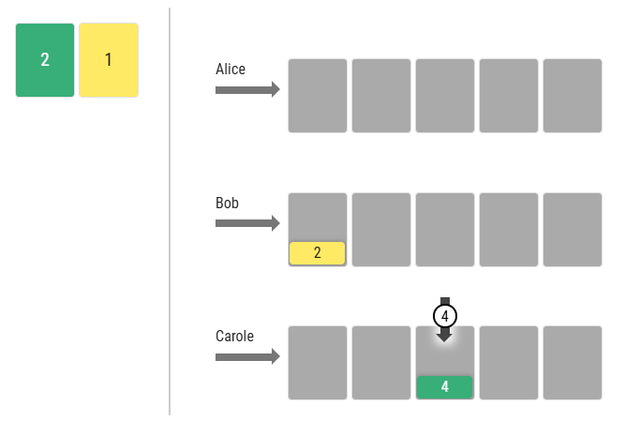
If you introduce bluffs too soon, players won't understand invalid bluffs like this:

Image

It is not worth introducing such an exception to what players naturally learn.
springiest
Posts: 37
Joined: 17 November 2022, 11:27
Location: Perth, Australia
Contact:

Re: If you clue a double bluff, must it include a promise?

Post by springiest »

why do u say invalid? imo the bluff with g4 (in ur pic) is completely valid, and moreover cathy immediately knows her 4 to be exactly green (or k4, if the team plays with black).
User avatar
Jellby
Posts: 3544
Joined: 31 December 2013, 12:22

Re: If you clue a double bluff, must it include a promise?

Post by Jellby »

Because if I were in Carole's place I would play (and probably bomb) my leftmost card after 2y is played. If the clue is green instead of 4, I'd know it'a bluff, but if it's 4, I'd think it's a finesse. It's a version of Occam's razor if you wish: if it can be true (as in not a bluff), it must be true, no need to invoke hidden motives.
springiest
Posts: 37
Joined: 17 November 2022, 11:27
Location: Perth, Australia
Contact:

Re: If you clue a double bluff, must it include a promise?

Post by springiest »

thats incorrect imo. if it can be a bluff, it is a bluff.

bob responded to alice's clue by blind-playing a card.
1. bob did not play a 3 (nor k5) - he played a 2, which does not (directly) connect to our 4. so alice's clue was a bluff not a finesse. (this idea is explained a lot better under the Cathy's Connecting Principle section.)
2. only two 1-from-playable 4s exist - g4 and k4. therefore our 4 is one of those, and the bluff is now fully resolved!
3. if we really have y4 with y3 on finesse slot, then alice needs to clue yellow to make sure that everyone knows it is a finesse and not a bluff. because 4 is possible (and in fact more likely) to be a bluff.
User avatar
Romain672
Posts: 1348
Joined: 05 April 2016, 13:53

Re: If you clue a double bluff, must it include a promise?

Post by Romain672 »

It's a priority between assuming self finesse (2 cards for yourself) versus bluff (1 card for yourself). Bga goes for self finesse and hgroup goes for bluff.

The main difference for hgroup is the 3-bluffs. Since they weirdly assume that a green clue on g3 first turn require one single bluff to be resolved (which is not the case on bga).
So when you clue 3 on r3 first turn with hgroup, that require one single bluff too.
So when b1 is on the stacks, and you clue 3 on r3 with hgroup and r1 is played, then again r1 work with 3, and the clue is resolved.

Now if r1 & b2 are on the stacks, and you clue 4 on r4 with hgroup and r2 is played, we are right in what you was discussing, and again the clue is resolved with hgroup.

One big advantage is that most of the time you can choose between color and number clue, and so the downside of hgroup is less present.
Last edited by Romain672 on 07 June 2026, 19:55, edited 2 times in total.
_mg6maciej_
Posts: 23
Joined: 07 January 2025, 22:43

Re: If you clue a double bluff, must it include a promise?

Post by _mg6maciej_ »

Romain672 wrote: 07 June 2026, 08:07 The main difference for hgroup is the 3-bluffs. Since they weirdly assume that a red clue on r3 first turn require one single bluff to be resolved (which is not the case on bga).
You seem to have outdated information on how a first turn red clue on r3 plays here. People on bga play a single card too, unless it's something more specific like finesse + bluff (1r followed by a different color) or bluff that's not revealed (1m play, requiring another play to reveal marked card is 3r and not 2m).
The difference between bga and hgroup in this example is that on bga 2r is promised to be in someone's hand.
Romain672 wrote: 07 June 2026, 08:07 (...) then again r1 'connect' to r3 (...)
Did you mean to say doesn't 'connnect' instead?
Romain672 wrote: 07 June 2026, 08:07 One big advantage is that most of the time you can choose between color and number clue, and so the downside of hgroup is less present.
What's the big advantage? With bga conv when you can choose between number and color clue (e.g. first turn on 3r), you ask for double bluff (with number) or single bluff (with color). Having these clues both work as single bluff like with hgroup conv, with an additional caveat you don't know if it's 2r or 3r does not seem to be advantageous at all.

And you guys are moving away from the main topic of this thread, which is (in the context of bga conv) does the first turn 3 clue on 3r (which is a double bluff) require 2r promise or not?
_mg6maciej_
Posts: 23
Joined: 07 January 2025, 22:43

Re: If you clue a double bluff, must it include a promise?

Post by _mg6maciej_ »

springiest wrote: 07 June 2026, 00:55 thats incorrect imo. if it can be a bluff, it is a bluff.

bob responded to alice's clue by blind-playing a card.
1. bob did not play a 3 (nor k5) - he played a 2, which does not (directly) connect to our 4. so alice's clue was a bluff not a finesse. (this idea is explained a lot better under the Cathy's Connecting Principle section.)
2. only two 1-from-playable 4s exist - g4 and k4. therefore our 4 is one of those, and the bluff is now fully resolved!
3. if we really have y4 with y3 on finesse slot, then alice needs to clue yellow to make sure that everyone knows it is a finesse and not a bluff. because 4 is possible (and in fact more likely) to be a bluff.
What's the reason you ignore the fact this is a bga forum and people mostly ask and expect answers in the context of how people play on this site? Do you think it would be appropriate for someone to join the main hgroup discussion forum and answer questions related to hgroup conv claiming they are all playing wrong, because they don't follow conventions played on unrelated site?
Post Reply

Return to “Hanabi”