another gap question

Forum rules
Please DO NOT POST BUGS on this forum. Please report (and vote) bugs on : https://boardgamearena.com/#!bugs
User avatar
dmpr0
Posts: 12
Joined: 11 April 2025, 11:32

another gap question

Post by dmpr0 »

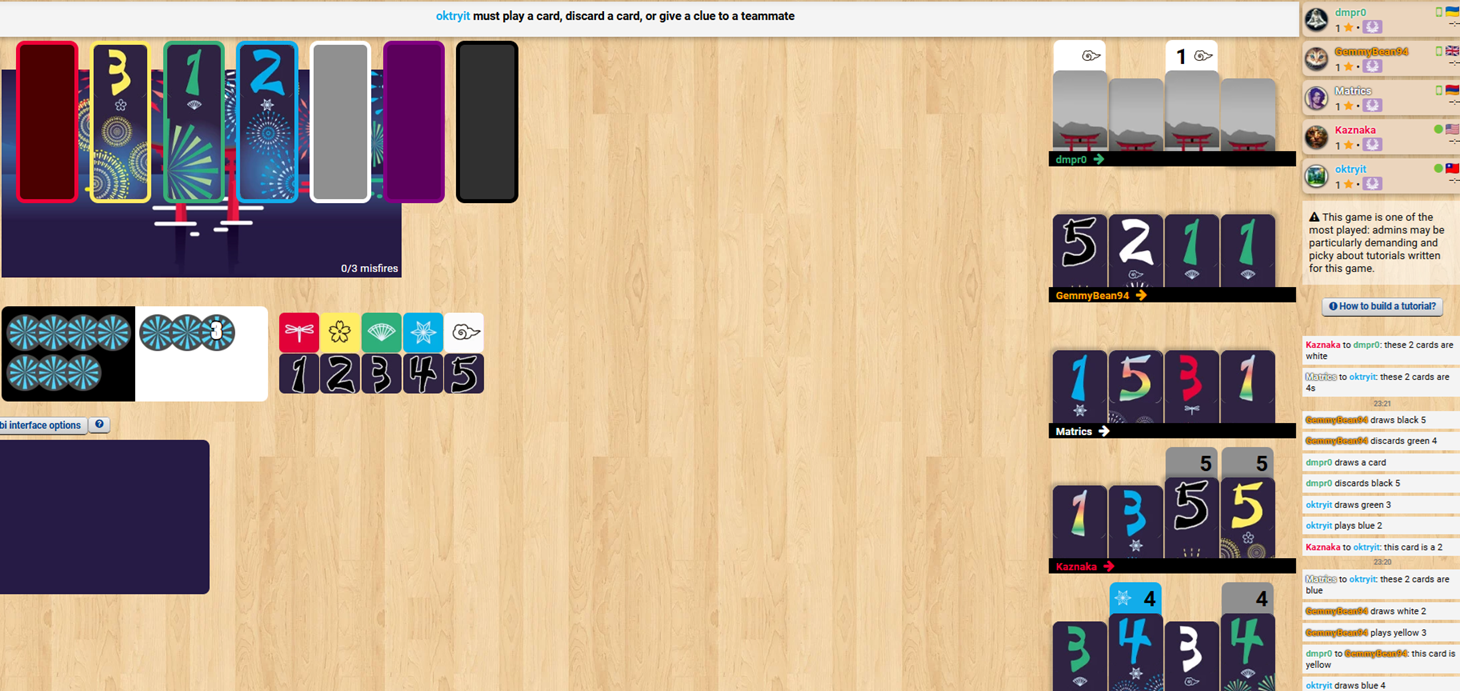
i got clued whites, knowing my 1 as playable
Image

Gemmy responded with k5 after my w1, and in my opinion that's it - the bluff is revealed, there was no gap for somebody to guarantee a layer. but I was called a noob and even kicked out from the next game lol

if this was supposed to be a layer, how do skip bluffs and double bluffs work then? IMO layer can only be assumed with a gap, and there was no gap between w1 and k5

https://boardgamearena.com/gamereview?table=884089337 move 20
User avatar
Romain672
Posts: 1353
Joined: 05 April 2016, 13:53

Re: another gap question

Post by Romain672 »

It's the same situation than last time.

Take what you know about Oktryit's pov (from Kaznaka's pov).
Can Oktryit clue k5 and make the move goes wrong?
They could clue a potential w4 on Kaznaka's hand, and then the clue still work.
So here strangly the answer is clear: Oktryit can't mess up the clue.

Which mean that w1+k5 will be played, and after your w3 will be known.

.

But now the clue is complex. Does the clue get enough things to be worth the complexity of it?
Here you do an out of position bluff to get a duplicated card and a known w3.
That's absolutely not enough.
That's one of the rare cases where you play not to resolve another player's pov, but because the clue given would be too complex for the gain.

I wanted to give you another example, but that seem way too much context dependant and rare.
_mg6maciej_
Posts: 25
Joined: 07 January 2025, 22:43

Re: another gap question

Post by _mg6maciej_ »

Yes, it's just a bluff. Just because a clue is bad, doesn't mean the meaning of it should change. And just like in a previous thread, you should avoid bluffing like that from distance because of possibility the next player assumes it's a finesse for them and does something to mess up the bluff.

A better move by Kaznaka would be to discard 5k at this point. This would achieve a few things:
1) let oktryit clue a stacked finesse with either 3 clue to dmpr (better than white, splash saving 3k) or even white/4 to 4w if Kaznaka has or draws it
2) if oktryit doesn't clue white cards finesse there are still two good things that can happen: either Gemmy delays 5k GD play (very unlikely) and stacked finesse can be clued next round or Gemmy draws a playable like 1r or 4y and someone can clue an actual layered
3) this is the most important part: by disacarding 5k and going up in clue count you encourage oktryit to clue (3 to dmpr is an obvious choice) and 3g is preserved for more turns; giving this clue (even if some group agrees that reverse bluff is not a thing and a clue like that is always layered) should suggest the opposite, that someone has the other copy of 3g and all other players should be making mental notes about this choice by Kaznaka
Kaznaka
Posts: 22
Joined: 20 October 2023, 22:32

Re: another gap question

Post by Kaznaka »

It's not a bluff because you're not the one responding to white because the 1w was already known playable. Therefore, you are the gap, therefore not a bluff.
User avatar
dmpr0
Posts: 12
Joined: 11 April 2025, 11:32

Re: another gap question

Post by dmpr0 »

I think you are misunderstanding the concept: I have to play w1 to be able to play the other white card. As soon as I play w1, k5 gets played - there is no gap in between. Nobody can play anything until I play w1. And there is no gap between w1 and k5. No gap - no layer
Kaznaka
Posts: 22
Joined: 20 October 2023, 22:32

Re: another gap question

Post by Kaznaka »

This goes back to my other thread question: are known playables considered a gap? What if your white were w2? You would still play the w1 first, no change. The only difference is Gemmy wouldn't respond. You are perceiving the clue to be targeted towards you when it's not. What if the white were m2? You would still play the w1 first; the only difference is m1 would play instead of k5. Again, the target of the clue, aka the person who first "responded" to the clue, is not you.

You could make the argument "if I don't play w1, then Gemmy wouldn't respond". The only case I can think of where you wouldn't play w1 is to give another finesse or to scream discard. Because you didn't try to finesse anyone, that is considered a non-response by you.

If there were no clue tokens, then you would play because you would have no choice. When you have no choice, can we conclude your non-response is a gap? Then, and only then, can it be considered a bluff.
User avatar
dmpr0
Posts: 12
Joined: 11 April 2025, 11:32

Re: another gap question

Post by dmpr0 »

let me try again: I MUST play w1 first - can we agree on that? and then the next player after me is blind playing something unrelated - where is the gap to promise a layer? there is nobody between my w1 and the unrelated card - so you cannot assume a layer since there is no gap. no gap = no layer. you can argue "there is no reverse bluff, it's always a layer". and I will tell you that there is a gap - the clue receiver is doing something unrelated and is giving the gap for the layer
Kaznaka
Posts: 22
Joined: 20 October 2023, 22:32

Re: another gap question

Post by Kaznaka »

I get what you're saying, but let me try at a different angle. You could've clued k5 (yes, even though I had it) but you didn't. In other words, you didn't clue k5 because you saw the path to w2 w3. Therefore, and this is the point of contention, you are the gap.

The focus of the white clue was the new white (w3). You were going to play w1 even if I didn't give white. I gave white, you did the thing you were going to do anyways, and Gemmy responded to white, seeing that you didn't try to clue k5. Why should Gemmy keep digging? Well because the white clue would be meaningless if she stopped at k5.
User avatar
Jellby
Posts: 3586
Joined: 31 December 2013, 12:22

Re: another gap question

Post by Jellby »

Not cluing a playable, no matter how obvious it is, does not create a gap. Only not saving something that needs saving could arguably mean something, but then you have to consider if that save was actually required (8 clues, further save, 1st round, locked hands...).
_mg6maciej_
Posts: 25
Joined: 07 January 2025, 22:43

Re: another gap question

Post by _mg6maciej_ »

Kaznaka wrote: 09 August 2026, 13:58 What if the white were m2? You would still play the w1 first;
If the newly marked white was 2m, you would cause 3g to bomb. I don't think you want to do that. Instead reread point 3 in my first post above to learn how to preserve 3g for longer instead of semi-forcing or encounraging BDRs.

But in a situation where you'd be able to bluff like that and that bluff would be a good clue, there is not much difference between 2m and 3w. 1w plays first and after 5k play the new white card is known 1-away (barring promise).

Here is a few examples for you to hopefully understand how a gap is created. It's when a player, who should respond to a clue at any point of it resolving to reveal a bluff (or possibily just play a continuation of finesse), did not do it. Then and only then a gap is made, which enables potential layered.

In the following examples Alice clues red to Emily on 3r. Information in () is known to the cards holder. In all examples 1g is bluffed.

1.
Bob: 1r X X X
<--- no gap here; if a player called Gabby was here and did not respond attempting to play 2r, the clue would become layered for Cathy
Cathy: 1g X X X
Donald: X X X X
Emily: X X 3(r) X

2.
Bob: X X X X
Cathy: 1r X X X
<--- no gap here; if a player called Gabby was here and did not respond attempting to play 2r, the clue would become layered for Donald
Donald: 1g X X X
Emily: X X 3(r) X

3.
Bob: X X (1)r X
<--- no gap here; if a player called Gabby was here and did not respond attempting to play 2r, the clue would become layered for Cathy
Cathy: 1g X X X
Donald: X X X X
Emily: X X 3(r) X

In these examples Alice clues red to Bob on 3r.

4.
Bob: X 3(r) X X
Cathy: 1r X X X
<--- no gap here; if a player called Gabby was here and did not respond attempting to play 2r, the clue would become layered for Donald
Donald: 1g X X X
Emily: X X X X

5.
Bob: X 3(r) (1)(r) X
<--- no gap here; if a player called Gabby was here and did not respond attempting to play 2r, the clue would become layered for Cathy
Cathy: 1g X X X
Donald: X X X X
Emily: X X X X

And a bit more fun example. Bluffing Bob's 2nd left card on the next round. Alice clues red to Cathy on 4r:

6.
Alice: X X X X
<--- no gap here; if a player called Gabby was here and did not respond attempting to play 3r, the clue would become layered for Bob
Bob: 1r 1g X X
Cathy: X 4(r) X X
Donald: X X X X
Emily: 2r X X X

As you should see from all these examples 1g is played by the first player that could have played 2r, straight after 1r is played (3r and 2r in example 6) without delays or any gaps. The structure of hands is the same in all examples. The (lack of) gap is well defined and not by something along the lines of "Well because the white clue would be meaningless if she stopped at k5". Are all these bluffs good clues? Definitely not on their own, without additional context. For instance in example 2 if Bob has nothing better to do, he will think he has the missing 2r and might clue Donald's 1g in one way or another, direct clue, finesse or even bluff. So for Alice to perform such a bluff in a controlled manner she needs Bob not to interfere. Possible situations: a) Bob has multiple 1s marked and should be playing own cards instead of cluing a card he might have, b) Bob has started or is about to start responding to another finesse or layered, c) Alice uses the last clue and Bob's only option is to discard, d) Bob is locked or otherwise knows all his cards and that 2r is not among them, but is about to play something (obviously if Bob is locked and won't unlock himself on his turn it's better to leave the bluff to him).

Hope this helps.
Post Reply

Return to “Hanabi”