...

Forum rules
Please DO NOT POST BUGS on this forum. Please report (and vote) bugs on : https://boardgamearena.com/#!bugs
User avatar
euklid314
Posts: 680
Joined: 06 April 2020, 22:56

Re: "dubious" luck

Post by euklid314 »

CaractacusPots wrote: 07 September 2020, 23:14
euklid314 wrote: 07 September 2020, 22:38 Thanks for you answer.

You estimate that red wins 70% and yellow wins 30%. Your guess was a very good one.

The true numbers are that red wins 80.8% of the games and yellow will win 19.2% of the games. So in every 5th game you will lose the game with red EVEN WITH PERFECT PLAY.

Please note that in practically all of these 19.2% of the games something crazy must(!) happen.

I think your definition of "crazy" differs from mine. I don't personally think anything "crazy" needs to happen for opponent to win the game. A simple 2-2 (1 in 36) roll is enough to really change his chances. But once he fails to get on, then I get to block the remaining open point and it's mostly game over at that point. In the event his being dealt a 2 to get on the board 5 times in 7 when his chances should be only 1 in 3 is the ridiculous or "crazy" part of the game. What that is in essence is a 3 sided die (if such a thing could exist) rolled 7 times and a 1 coming up 5 times of those 7. Many people would believe that there must be something hooky with the die if that happened.

Here's the position a little later in the game:

Image

I'm way way way ahead again in this game. Pip count is my 95 vs his 151 and I have 2 of his men knocked off in that same 5 point board.

Perhaps you'd care to calculate how many times I win from this position.

Yet system deals him a 2 on his next 2 consecutive rolls.

I only need a 2 myself to cover that remaining point or a 6-4, 55

It's just so off in some way but unless I can get to the history logs of all the games I can't prove anything.
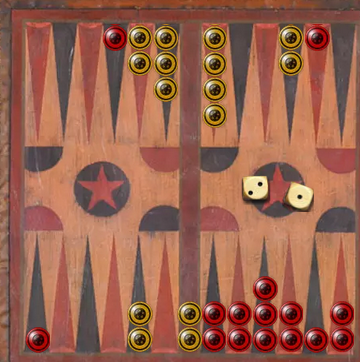
In the mean time I have entered your game in XG (Extreme Gammon) and can give you some interesting statistics and insights. Please note that an "error" is defined as losing a game equity of 0.02 and a "blunder" is defined as losing a game equity of 0.08. A game equity of +1 means a secure win, a game equity of -1 means a secure loss, so your game equity changes during the game with every lucky/unlucky roll and and also with every good/bad move decision.

1) In no position in the whole game you ever had a winning probability of more than 85%. Never!

2) In your 15 first red and 15 first yellow moves both of you played almost flawless. The only error was your 7th move when you played 6-3 as 8/5 8/2* instead of the correct 23/20 8/2*. But that was a minor error. In the first moves you are very lucky (5-5 and 6-6 in your move 3 and 4 and a fan at his move 5, such that you have a 5-point home board with 4-2 after only your fifth move). Since your opponent did not make a single error he was just unlucky. Then the luck changes and your opponent is lucky in moves 8,9,10 such that you cannot fully close him out. In moves 13 and 14 you are very lucky again such that you arrive at the situation that you show the screenshot above.

3a) Your screenshot is on your opponents move 15 and he throws 2-1. I want to stress that the game was played almost flawless by both of you and luck went back and forth. The program XG judges the luck factor equal at this moment of the game (since you are in an 83%-winning position you cannot argue that were unlucky till move 15).

3b) Please note that you have a winning percentage of 83% BEFORE your opponent rolls the "lucky" 2-1. After he hits you with 2-1 you still have a probability of 73,7% to win (not surprising since you still have a strong 5-point board). Directly after his 2-1 hit you have your first real big blunder when you play your 3-2. You lose -0.171 of equity which here means that your win probability drops from 72,3% to 63,8%. You played Bar/23 16/13 and should have played Bar/20. Now that I mention it you will surely see that you allowed your opponent a double shot in the outfield (he hits you with every 4 and 5) and anchoring up at your deep 23-point is completely worthless (you have the strong 5-board, he has the weak 2-board so you have to play bold and not timid).

4) Afterwards a hitting contest happens which goes back and forth (move 16-19). The computer values your winning chances around 50%.

5) Your move 19 is the "losing move". With your 5-1 you clear your 6-point and give up your most important asset - namely your 5-point home board. This move (6/5 6/1 instead of the correct 20/15 4/3) is a 4-fold blunder losing -0.349 equity!! Instead of getting an even game with approx 48% winning chance you now have an almost lost game with only 30% winning chance. And that in a single move decision!

6) Two moves later you have your next blunder, namely playing your 6-2 as 23/17 9/7 instead of e.g. 9/3 5/3. With your move you give your opponent again far too many hits (he hits you with every 5,6 in the outfield). 9/3 5/3 leaves not a single shot but postpones the running. Equally good as 9/3 5/3 would have been the move 23/15 (running out with a single checker all the way) since you give your opp only the direct shot of a 4). After this final blunderyour winning chances decrease to 25% and you finally lose.

Summary: You played 29 of your 33 moves almost perfectly (several where forced moves, though) but you made 4 blunders in this game which lost you an equity of -0.735. Note that you start with an equity of 0 in the beginning and -1 is a secure loss. Your opponent played better but also lost an equity of -0.434 because of his mistakes.

The computer judges him as Advanced player (Performance Rating 11,22) and you as Beginner (Performance Rating of 23,96). Note that this judgment is very harsh. You made lots of good moves and your opening moves were excellent. But the errors that you made had a huge impact on the game. Thus the bad rating.

The computer also judges the luck factor. Note that one can gain equity with lucky rolls. Without any action on your own one can change the winning probabilities of the games with lucky/unlucky rolls. By the computers judgement your opponent was "quite lucky" and you were "quite unlucky" in the game. Please note that this is the lowest ranking of luck. If you are really lucky you will be judged "lucky", "very lucky" or even "it's in the wrist". :-)

Hope this backgammon training lesson gives you some insight. Of course I could analyze such precisely only with computer help. Nevertheless I am an expert player, so my interpretation of the computer output should be quite precise.
User avatar
euklid314
Posts: 680
Joined: 06 April 2020, 22:56

Re: "dubious" luck

Post by euklid314 »

CaractacusPots wrote: 07 September 2020, 23:14
euklid314 wrote: 07 September 2020, 22:38 Thanks for you answer.

You estimate that red wins 70% and yellow wins 30%. Your guess was a very good one.

The true numbers are that red wins 80.8% of the games and yellow will win 19.2% of the games. So in every 5th game you will lose the game with red EVEN WITH PERFECT PLAY.

Please note that in practically all of these 19.2% of the games something crazy must(!) happen.

I think your definition of "crazy" differs from mine. I don't personally think anything "crazy" needs to happen for opponent to win the game. A simple 2-2 (1 in 36) roll is enough to really change his chances. But once he fails to get on, then I get to block the remaining open point and it's mostly game over at that point. In the event his being dealt a 2 to get on the board 5 times in 7 when his chances should be only 1 in 3 is the ridiculous or "crazy" part of the game. What that is in essence is a 3 sided die (if such a thing could exist) rolled 7 times and a 1 coming up 5 times of those 7. Many people would believe that there must be something hooky with the die if that happened.

Here's the position a little later in the game:

Image

I'm way way way ahead again in this game. Pip count is my 95 vs his 151 and I have 2 of his men knocked off in that same 5 point board.

Perhaps you'd care to calculate how many times I win from this position.

Yet system deals him a 2 on his next 2 consecutive rolls.

I only need a 2 myself to cover that remaining point or a 6-4, 55

It's just so off in some way but unless I can get to the history logs of all the games I can't prove anything.
My final remark to this game.
The win probability of 17% for yellow comes from the fact that there are only 3 cases that can happen in his roll:

Case 1: Your opponent rolls a 2-2 (2,8%). Then he has anchored up and has a 50:50 game (lots of contact cancels out any race value) ... that gives him 1,4% win probability in total.

Case 2: Your opponent rolls a single 2 (27,8%). Then he is a heavy favorite to anchor up. This fact you seem to have undervalued. If your opponent hits you (as he did with 2-1) then he does not need a further 2 in the next roll. He will even anchor up if he gets the 2 in the roll after that and has still good chances if it takes him 2-4 more rolls. The reason is that you have not enough ammunition. You only have the checkers on the 4-point, the 12-point and the 16-point. To close your opponent out you have to roll a 2 before his 2 AND bring a second checker nearer AND again roll the missing number exactly. While you do all this three things he only needs to roll a single 2 and you have to start all over. You need to hit the point with two points to close him out and every time he rolls a 2 you have achieved nothing.

So you were shocked because he rolled a 2 in two consecutive turns. But already after the first 2-1 you should have realized that he will now anchor up with an (estimated) probability of around 80% - resulting in an even game. ... This case 2 thus gives him a 27,8% * 80% * 50% = 11% win probability.

Case 3: Your opponent rolls no 2 (69%). In this case you are a heavy favorite to close him out - lets say 85%. This still gives him a 69% * 15% * 50% = 5%.
In total we are at 1,4+11+5=17,4%

If you do not believe that yellow will anchor up with 80% probability after his 2-1 you can simply roll it out. Take your backgammon board and put up the position after the 2-1 roll. Play out the game with real dice until red has either a 6-point home board or until yellow has anchored up. Repeat 50 times and see what happens.

Summary: You thought that he was incredibly lucky because he got two 2s successively. In reality he was lucky only to get a 2 once (he had a 30% chance). The rest (his anchoring up) was nothing crazy but was the most probable result to be expected.
User avatar
CaractacusPots
Posts: 90
Joined: 31 August 2020, 18:08

Re: "dubious" luck

Post by CaractacusPots »

euklid314 wrote: 08 September 2020, 00:22 In the first moves you are very lucky (5-5 and 6-6 in your move 3 and 4 and a fan at his move 5, such that you have a 5-point home board with 4-2 after only your fifth move).
You make your own luck by positioning your pieces in the right place at the right moment. Even after the first move I had then given myself 22 dice rolls out of 36 that would establish key primes for me and a further 4 rolls that would either enable me to knock opponent's blot off or escape a back man. That's how the game is played. You take the right risks with your blots at the right time to then maximise your chances of creating primes and building a wall.

euklid314 wrote: 08 September 2020, 00:22 Since your opponent did not make a single error he was just unlucky. Then the luck changes and your opponent is lucky in moves 8,9,10 such that you cannot fully close him out.
That's putting it very mildly !!!!!

I knock opponent off the board 3 consecutive times when i have a 5 point home board established and he can only return with a 2 each time.
He fails to get on the first attempt but then manages to get back on the next roll and then the next 2 subsequent rolls when he's knocked off. i.e. he has won a 1 in 3 event 3 times out of 4 at this point !

euklid314 wrote: 08 September 2020, 00:22 3a) Your screenshot is on your opponents move 15 and he throws 2-1. The program XG judges the luck factor equal at this moment of the game (since you are in an 83%-winning position you cannot argue that were unlucky till move 15)
Unlucky ? No that's nonsense. I was unlucky when opponent was knocked off 3 times and needed a 2 to return and did so 3 times consecutively. You seem to want to ignore this fundamental part of the game.

Having already pulled off that incredible feat I then knock 2 of his men to the bar and again he needs the same magic 2 to get back on the board. And the system dutifully rolls him 2-1 followed by 21

Summary of blot knock offs:

1 man knocked off: opp rolls 3-3 then back on with 2-3
1 man knocked off: opp rolls 2-6 back on
1 man knocked off: opp rolls 2-3 back on
1 man knocked off: opp rolls 4-5 fails
2nd man knocked off: opp rolls 2-1 gets one man back on board
opp rolls 2-1 gets 2nd man back on board

7 knock offs all requiring a throw of a 2 to get back on the board (a 1 in 3 event) and he does it 5 times out of 7 !


Forgive me but that stinks
User avatar
Giordano Bruno 1974
Posts: 225
Joined: 28 April 2020, 19:56

Re: "dubious" luck

Post by Giordano Bruno 1974 »

Analytical engines are part of "the great backgammon conspiracy". You heard it here folks.
User avatar
euklid314
Posts: 680
Joined: 06 April 2020, 22:56

Re: "dubious" luck

Post by euklid314 »

euklid314 wrote: 08 September 2020, 01:08 My final remark to this game.
You got a free analysis from the strongest computer program that is currently available (XG) together with an interpretation of these computer numbers by a player that is far more experienced than you. You are free to use that information in any way you like. Backgammon is a great game - you are not the only one to have a love-hate-relationship with this game. :-)

Have fun!
User avatar
CaractacusPots
Posts: 90
Joined: 31 August 2020, 18:08

Re: "dubious" luck

Post by CaractacusPots »

euklid314 wrote: 08 September 2020, 16:55 You got a free analysis from the strongest computer program that is currently available (XG) together with an interpretation of these computer numbers by a player that is far more experienced than you.
Unfortunately neither the analysis nor the player had any significant comment of the system here giving the underdog player 5 successful re-entries onto the board out of 7 attempts which were all 1 in 3 chances to succeed.
User avatar
euklid314
Posts: 680
Joined: 06 April 2020, 22:56

Re: "dubious" luck

Post by euklid314 »

Well no need to comment on that since you have already found out your truth.

If you roll 5-5, 6-6, and 4-2 in your moves 3,4,5 and the computer analysis calls that a lucky streak, then you answer that you have skillfully prepared for such a sequence (in moves 1+2?).
Note that the probability of you getting a 5-point board within only three moves (while your opponent plays only correct moves and does not "help you") is well below 1 in 10.000 = 0.01%.

If your opponent enters 5 out of 7 times against your 5-point-board the dice must be rigged.
Note that the probability of him achieving this feat is exactly (7 over 5)*(1/3)^5*(2/3)^7 = 0.5%.

... and now I will work very, very hard on myself not to continue this rather fruitless discussion. I think we both made our points. :-)
User avatar
CaractacusPots
Posts: 90
Joined: 31 August 2020, 18:08

Re: "dubious" luck

Post by CaractacusPots »

euklid314 wrote: 08 September 2020, 18:36 If your opponent enters 5 out of 7 times against your 5-point-board the dice must be rigged.
Note that the probability of him achieving this feat is exactly (7 over 5)*(1/3)^5*(2/3)^7 = 0.5%.

... and now I will work very, very hard on myself not to continue this rather fruitless discussion. I think we both made our points. :-)
Thanks for acknowledging the ridiculous outside chance of getting the rolls he did.

How a 5 pt home board was achieved and how quickly has absolutely no bearing on the matter of opponents odds of getting back on the board once knocked off. His odds are 1 in 3 to produce a 2.

The system giving him that 2 on 5 occasions out of 7 attempts is the issue and doesn't help anyone have more faith in the RNG here imo.

This kind of stuff simply does not happen with such frequency with real physical dice. 18+ doubles in one game etc etc. Just doesn't happen with such frequency imo.
User avatar
Giordano Bruno 1974
Posts: 225
Joined: 28 April 2020, 19:56

Re: "dubious" luck

Post by Giordano Bruno 1974 »

CaractacusPots wrote: 08 September 2020, 18:48 [This kind of stuff simply does not happen with such frequency with real physical dice. 18+ doubles in one game etc etc. Just doesn't happen with such frequency imo.
Then why don't you stick to that?

You aren't ever going to be happy with online backgammon or even games against a computer.
User avatar
CaractacusPots
Posts: 90
Joined: 31 August 2020, 18:08

Re: "dubious" luck

Post by CaractacusPots »

Giordano Bruno 1974 wrote: 08 September 2020, 19:22You aren't ever going to be happy with online backgammon or even games against a computer.
Yep most likely. At least not without having access to significant numbers of history logs to be able to undertake the required analysis.
Another poster upthread stated that computer RNG's simply are not purely random. It remains my experience that this is true everywhere I have tried.

Even on my own PC, running GNUBG I can beat GNU far more times when rolling real physical dice than when using GNU's own RNG. It is what it is.
Post Reply

Return to “Backgammon”