
In the mean time I have entered your game in XG (Extreme Gammon) and can give you some interesting statistics and insights. Please note that an "error" is defined as losing a game equity of 0.02 and a "blunder" is defined as losing a game equity of 0.08. A game equity of +1 means a secure win, a game equity of -1 means a secure loss, so your game equity changes during the game with every lucky/unlucky roll and and also with every good/bad move decision.CaractacusPots wrote: ↑07 September 2020, 23:14euklid314 wrote: ↑07 September 2020, 22:38 Thanks for you answer.
You estimate that red wins 70% and yellow wins 30%. Your guess was a very good one.
The true numbers are that red wins 80.8% of the games and yellow will win 19.2% of the games. So in every 5th game you will lose the game with red EVEN WITH PERFECT PLAY.
Please note that in practically all of these 19.2% of the games something crazy must(!) happen.
I think your definition of "crazy" differs from mine. I don't personally think anything "crazy" needs to happen for opponent to win the game. A simple 2-2 (1 in 36) roll is enough to really change his chances. But once he fails to get on, then I get to block the remaining open point and it's mostly game over at that point. In the event his being dealt a 2 to get on the board 5 times in 7 when his chances should be only 1 in 3 is the ridiculous or "crazy" part of the game. What that is in essence is a 3 sided die (if such a thing could exist) rolled 7 times and a 1 coming up 5 times of those 7. Many people would believe that there must be something hooky with the die if that happened.
Here's the position a little later in the game:
I'm way way way ahead again in this game. Pip count is my 95 vs his 151 and I have 2 of his men knocked off in that same 5 point board.
Perhaps you'd care to calculate how many times I win from this position.
Yet system deals him a 2 on his next 2 consecutive rolls.
I only need a 2 myself to cover that remaining point or a 6-4, 55
It's just so off in some way but unless I can get to the history logs of all the games I can't prove anything.
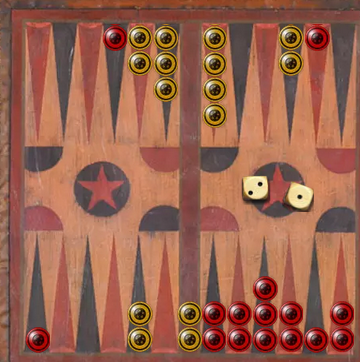
1) In no position in the whole game you ever had a winning probability of more than 85%. Never!
2) In your 15 first red and 15 first yellow moves both of you played almost flawless. The only error was your 7th move when you played 6-3 as 8/5 8/2* instead of the correct 23/20 8/2*. But that was a minor error. In the first moves you are very lucky (5-5 and 6-6 in your move 3 and 4 and a fan at his move 5, such that you have a 5-point home board with 4-2 after only your fifth move). Since your opponent did not make a single error he was just unlucky. Then the luck changes and your opponent is lucky in moves 8,9,10 such that you cannot fully close him out. In moves 13 and 14 you are very lucky again such that you arrive at the situation that you show the screenshot above.
3a) Your screenshot is on your opponents move 15 and he throws 2-1. I want to stress that the game was played almost flawless by both of you and luck went back and forth. The program XG judges the luck factor equal at this moment of the game (since you are in an 83%-winning position you cannot argue that were unlucky till move 15).
3b) Please note that you have a winning percentage of 83% BEFORE your opponent rolls the "lucky" 2-1. After he hits you with 2-1 you still have a probability of 73,7% to win (not surprising since you still have a strong 5-point board). Directly after his 2-1 hit you have your first real big blunder when you play your 3-2. You lose -0.171 of equity which here means that your win probability drops from 72,3% to 63,8%. You played Bar/23 16/13 and should have played Bar/20. Now that I mention it you will surely see that you allowed your opponent a double shot in the outfield (he hits you with every 4 and 5) and anchoring up at your deep 23-point is completely worthless (you have the strong 5-board, he has the weak 2-board so you have to play bold and not timid).
4) Afterwards a hitting contest happens which goes back and forth (move 16-19). The computer values your winning chances around 50%.
5) Your move 19 is the "losing move". With your 5-1 you clear your 6-point and give up your most important asset - namely your 5-point home board. This move (6/5 6/1 instead of the correct 20/15 4/3) is a 4-fold blunder losing -0.349 equity!! Instead of getting an even game with approx 48% winning chance you now have an almost lost game with only 30% winning chance. And that in a single move decision!
6) Two moves later you have your next blunder, namely playing your 6-2 as 23/17 9/7 instead of e.g. 9/3 5/3. With your move you give your opponent again far too many hits (he hits you with every 5,6 in the outfield). 9/3 5/3 leaves not a single shot but postpones the running. Equally good as 9/3 5/3 would have been the move 23/15 (running out with a single checker all the way) since you give your opp only the direct shot of a 4). After this final blunderyour winning chances decrease to 25% and you finally lose.
Summary: You played 29 of your 33 moves almost perfectly (several where forced moves, though) but you made 4 blunders in this game which lost you an equity of -0.735. Note that you start with an equity of 0 in the beginning and -1 is a secure loss. Your opponent played better but also lost an equity of -0.434 because of his mistakes.
The computer judges him as Advanced player (Performance Rating 11,22) and you as Beginner (Performance Rating of 23,96). Note that this judgment is very harsh. You made lots of good moves and your opening moves were excellent. But the errors that you made had a huge impact on the game. Thus the bad rating.
The computer also judges the luck factor. Note that one can gain equity with lucky rolls. Without any action on your own one can change the winning probabilities of the games with lucky/unlucky rolls. By the computers judgement your opponent was "quite lucky" and you were "quite unlucky" in the game. Please note that this is the lowest ranking of luck. If you are really lucky you will be judged "lucky", "very lucky" or even "it's in the wrist".

Hope this backgammon training lesson gives you some insight. Of course I could analyze such precisely only with computer help. Nevertheless I am an expert player, so my interpretation of the computer output should be quite precise.

